Geopolitics & Minority Rights
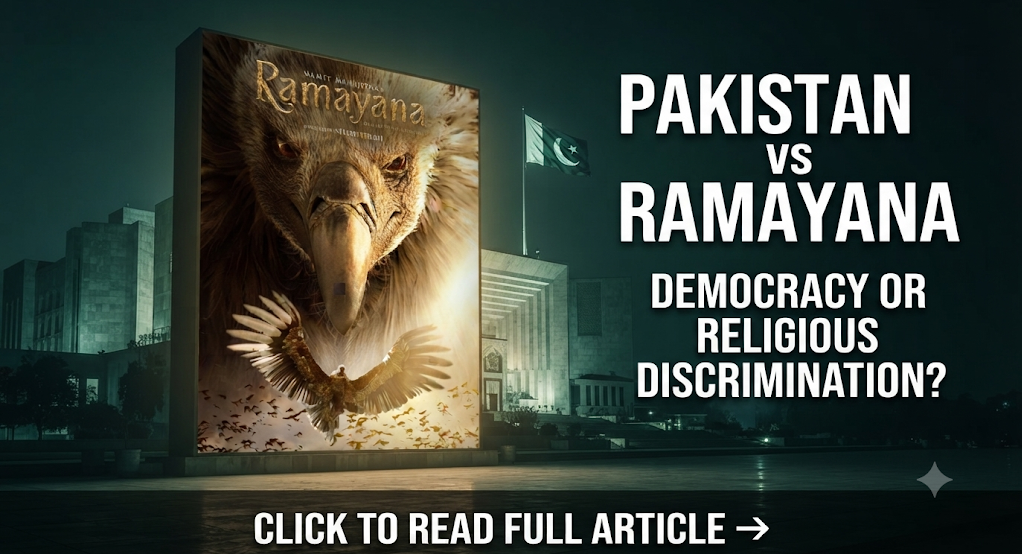
A Movie Becomes a Question of Democracy: The Ramayana Controversy in Pakistan
The Ramayana is not merely a religious story for millions of Hindus. It is a civilisational epic that represents values such as truth, duty, sacrifice, justice and righteousness. Its influence extends beyond India's borders, including communities that have preserved Hindu traditions for generations in Pakistan.
The proposed international release of the film Ramayana, starring Ranbir Kapoor, Sai Pallavi and Yash, has raised questions about whether Pakistani audiences will be able to watch it. Interestingly, members of Karachi's Hindu community have celebrated the film and expressed their desire to see it in cinemas. However, as reported by NDTV on 29 October 2026, there has been no official confirmation of its theatrical release in Pakistan.
"This development raises a larger question: Can a country genuinely call itself democratic if religious minorities cannot enjoy equal cultural freedom, security and dignity?"
The Ramayana controversy is therefore not simply about a movie. It is about the meaning of democracy, religious tolerance and the rights of minorities in Pakistan.
Is Pakistan a Truly Democracy?
Pakistan describes itself as an Islamic Republic. Article 2 of its Constitution declares Islam the state religion. Its political and constitutional identity is therefore different from that of a secular republic.
However, being an Islamic Republic does not automatically mean that non-Muslim citizens should have fewer rights. A democratic government has a responsibility to protect every citizen, regardless of religious identity.
Pakistan has held parliamentary elections and maintains democratic institutions. Yet democracy should not be measured only by voting, political parties and elected governments. It must also be measured by equality before the law, freedom of expression, religious liberty and protection against discrimination.
A country cannot claim democratic success while sections of its population live with fear because of their religious identity.
The real question is not whether Pakistan is a Muslim-majority country. It is whether its Hindu, Christian, Sikh and other minority citizens enjoy the same constitutional protection and dignity as the majority.
Why Is the Ramayana's Release in Pakistan Uncertain?
The uncertainty surrounding the Ramayana's theatrical release must be understood in its political context. Pakistan has historically restricted Indian films during periods of diplomatic and military tensions. Restrictions on Indian entertainment content are primarily connected to bilateral relations, nationalism and political decisions.
Therefore, it would be inaccurate to claim that Pakistan has officially banned the Ramayana specifically because it depicts Hinduism. No such official decision has been established in the available reporting.
Nevertheless, the issue raises legitimate concerns about cultural access. For Pakistani Hindus, the Ramayana is not simply foreign entertainment. It is part of their religious and cultural inheritance.
If Indian films are restricted for political reasons, ordinary Pakistani citizens, including Hindus, also lose access to cultural works that may be important to them. A democratic society should distinguish between political disagreements with another country and the cultural rights of its own citizens.
The Reality of Hindu and Other Minorities in Pakistan
The concerns surrounding the Ramayana cannot be separated from the wider situation of religious minorities. According to Pakistan's 2023 digital census (cited by the House of Commons Library):
- Muslims: Approximately 96.4%
- Hindus: Approximately 1.6% (with deep historical roots, particularly in Sindh)
- Christians: Approximately 1.4%
Despite contributing to the country's economic, cultural, and social life as equal citizens rather than guests, minority communities face severe challenges:
- Forced conversions and child marriages: Reports of Hindu girls being abducted, forcibly converted and married have raised serious concerns, particularly in Sindh, as highlighted by the Human Rights Commission of Pakistan.
- Attacks on religious places: Hindu temples and other minority religious sites have faced attacks and desecration, undermining constitutional rights.
- Blasphemy-related persecution: Human Rights Watch's 2026 World Report documents how blasphemy laws lead to arbitrary arrests, prosecutions, mob violence, and a lack of accountability for perpetrators.
- Discrimination against other minorities: Christians and Ahmadis face systemic challenges, with Ahmadis particularly affected by constitutional and legal restrictions on their religious identity.
Constitutional and Legal Contradictions
Interestingly, Pakistan's own Constitution contains provisions that promise religious freedom and equality:
| Constitutional Provision | Meaning |
|---|---|
| Article 2 | Islam is the state religion. |
| Article 20 | Freedom to profess, practise and propagate religion, subject to law, public order and morality. |
| Article 22 | Safeguards against compulsory religious instruction or worship of another religion in educational institutions. |
| Article 25 | Equality of citizens before the law. |
| Article 36 | Protection of minorities and their legitimate rights and interests. |
However, constitutional guarantees become meaningless when institutions fail to implement them. Pakistan's blasphemy provisions, particularly Sections 295-A, 295-B and 295-C of the Pakistan Penal Code, have attracted international criticism because of their potential misuse and disproportionate consequences.
This creates a fundamental contradiction: the Constitution promises equality, while discriminatory laws and weak enforcement undermine that very promise.
Arguments, Perspectives and Challenges
Pakistan may defend restrictions on Indian films by citing national security, diplomatic tensions, cultural sensitivities and the protection of public order. These arguments cannot be dismissed entirely, as every sovereign country has the authority to regulate cinema through transparent procedures.
However, national security should not become a permanent justification for restricting cultural expression. Political disagreements between India and Pakistan should not deprive Pakistani Hindus of access to their own religious heritage, nor can religious sensitivity justify discrimination against another faith.
Importantly, Pakistan's Hindu citizens are not responsible for political decisions. Many ordinary Pakistanis support peaceful coexistence. The problem should therefore be understood as a question of state policy, institutional accountability and extremist influence, rather than hostility between entire religious communities.
Way Forward: What Must Pakistan Do?
If Pakistan genuinely wants to strengthen its democratic credentials, it must move beyond symbolic promises and take practical steps:
- Protect minority communities: Ensure the safety of Hindus, Christians, Sikhs and other religious minorities, including their places of worship.
- Prevent forced conversions: Implement strong safeguards, independent investigations and effective prosecution to protect vulnerable women and children.
- Review discriminatory laws: Protect blasphemy-related provisions against misuse, false accusations and mob justice, while ensuring due process and equal protection.
- Strengthen institutions: Ensure police, courts and human rights commissions act independently and guarantee accountability for crimes against minorities.
- Promote cultural freedom: Prevent films, literature, religious festivals and cultural programmes from becoming victims of political hostility.
- Encourage interfaith dialogue: Educational institutions, civil society organisations and religious leaders should promote mutual respect and peaceful coexistence.
Note: Pakistan's approval of an interfaith harmony policy in March 2025 was a positive development, though its success depends on rigorous implementation and institutional commitment.(Never saw any Positive result of this policy)
Democracy Must Protect Everyone, Not Just the Majority
The Ramayana controversy offers Pakistan an opportunity to reflect on its democratic and constitutional responsibilities. The real issue is not whether Pakistan is a Muslim-majority country, but whether that identity becomes an excuse to weaken the rights of other communities.
Democracy is not the rule of the majority over the minority. It is the protection of everyone's rights, including when the majority disagrees. Pakistan cannot strengthen its international democratic image merely through elections or constitutional declarations; it must demonstrate that its minorities are equal citizens in practice.
"The ultimate test of democracy is not how comfortably the majority exercises its rights, but how securely the minority can exercise its own."
The Ramayana may be a story about the victory of righteousness over injustice, but the question it raises today remains vital: Will Pakistan allow its minority citizens to enjoy their cultural identity with dignity, equality and freedom?
Important Sources and References
These sources are useful for fact-checking and adding credibility to the published editorial.
- NDTV: Ramayana and the Hindu community in Karachi (29 October 2026).
- UK House of Commons Library: Freedom of Religion in Pakistan (2024).
- Human Rights Watch: World Report 2026, Pakistan.
- National Commission for Human Rights, Pakistan: CERD Compliance Report (2024).
- USCIRF: Pakistan and Increasing Attacks on Religious Minorities (2025).
- Pakistan Ministry of Human Rights: Constitutional Framework.
Join the Conversation