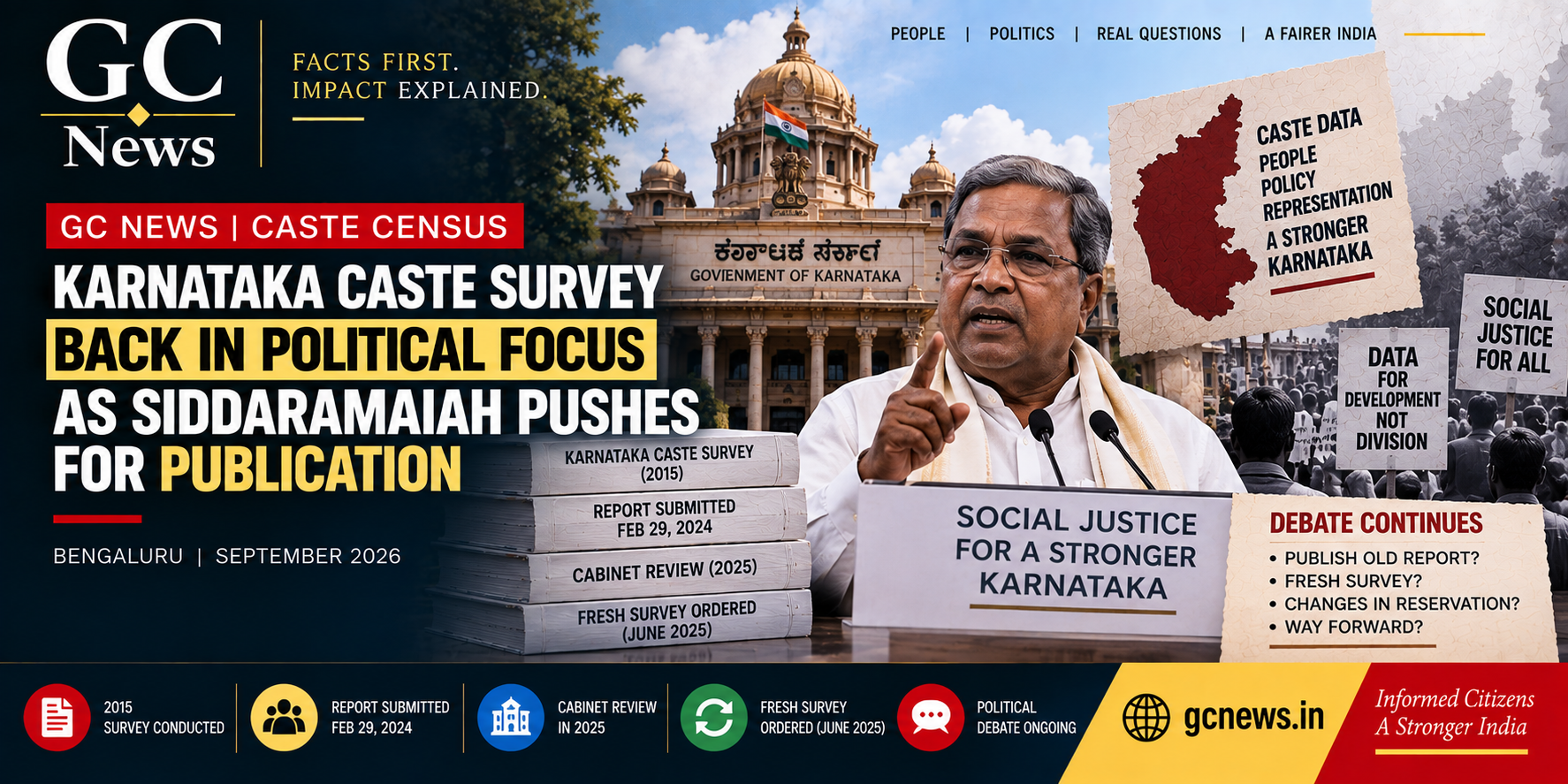
Bengaluru | September 2026
Karnataka's long-running debate over caste-based socio-economic data has returned to the political spotlight, with former Chief Minister Siddaramaiah calling for the State's caste survey findings to be published and implemented.
The issue concerns Karnataka's Socio-Economic and Education Survey, popularly referred to as the caste census, which was originally conducted during Siddaramaiah's earlier tenure.
The survey has remained politically controversial for years, particularly because of disagreements over its methodology, the population estimates of different communities and its possible implications for reservation policy.
What Happened to the Earlier Caste Census?
The survey was conducted in 2015 under the Karnataka State Commission for Backward Classes.
A final report was formally submitted to the State government by Commission Chairman K. Jayaprakash Hegde on February 29, 2024.
The report was subsequently placed before the Karnataka Cabinet in 2025.
Reported recommendations included significant changes to the State's reservation structure, including proposals concerning OBC reservation and internal classification.
However, the report faced strong political resistance, including concerns raised by sections of the Lingayat and Vokkaliga communities over the survey's methodology and population estimates.
Government Subsequently Ordered a Fresh Survey
In June 2025, the Karnataka Cabinet decided to conduct a fresh socio-economic and educational survey, citing concerns including the age of the earlier data.
This means the current controversy should not simply be described as the government deciding whether to “open” the old report.
The issue has moved beyond that stage.
The debate now concerns the publication and implementation of the earlier findings, the status of the fresh survey process and how Karnataka should ultimately use caste and socio-economic data in policymaking.
Siddaramaiah Renews Demand
Siddaramaiah has now again publicly backed publication and implementation of caste-survey data.
He has argued that reliable information on the social and economic position of different communities is necessary for policies based on social justice and representation.
His renewed intervention has brought the issue back into Karnataka's political debate.
What Could It Mean for General and Unreserved Candidates?
The survey itself does not automatically change reservation percentages.
However, caste and socio-economic data could potentially be used by political parties and the government to support future proposals for changing reservation percentages, restructuring categories or introducing further sub-classification.
Any such change would require separate government and legal action.
For candidates competing in the open category, the important issue will therefore be what policy decisions—if any—the government eventually makes on the basis of the data.
What Could It Mean for OBC and Other Reserved Communities?
The data could have greater direct significance for debates over the classification and distribution of reservation benefits among backward communities.
Different communities may use population and socio-economic data to argue that they are under-represented or that the existing distribution of reservation does not reflect their relative backwardness.
That could intensify demands for sub-categorisation, changes in quota distribution or revisions to existing reservation policy.
But population numbers alone do not automatically establish a legal entitlement to a particular percentage of reservation.
Why Is the Issue Politically Sensitive?
Karnataka has several large and politically influential communities, and any official caste-population data can affect debates over representation, reservation and government welfare programmes.
That is why the controversy is about much more than simply publishing numbers.
The larger question is:
How should caste-population and socio-economic data be used when deciding reservation policy—and should population share alone determine how reservation benefits are distributed?
For now, Karnataka's caste-survey debate remains both a major social-policy question and an important political issue.
Status: Political / Policy Debate Ongoing


Join the Conversation