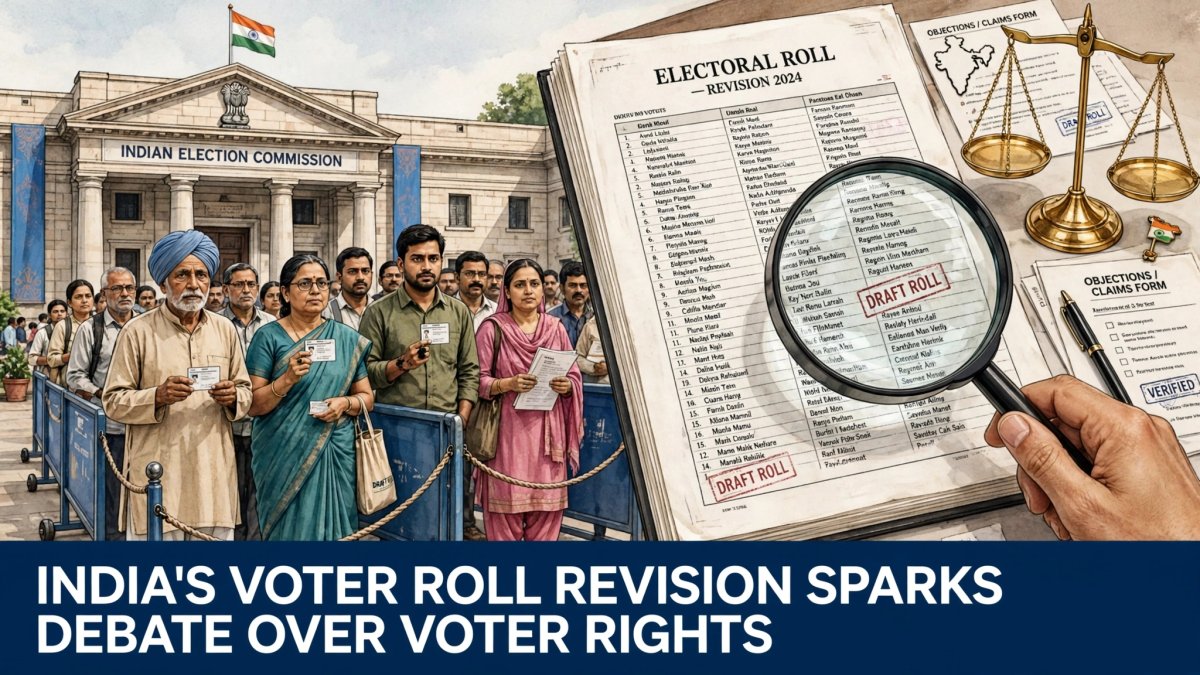
India’s Voter Roll Revision Under Scrutiny: Electoral Accuracy, Political Accountability and the Right to Vote
India’s nationwide Special Intensive Revision of electoral rolls has triggered protests, concerns over wrongful deletions and questions about the transparency of voter-verification systems. The Election Commission says the exercise is necessary to maintain accurate voter lists. Critics argue that an administrative process designed to prevent electoral irregularities must not create new barriers for eligible citizens.
India’s Special Intensive Revision (SIR) of electoral rolls has emerged as a major political and institutional controversy, placing the Election Commission of India (ECI) under growing scrutiny over how voter registrations are verified, how discrepancies are resolved and what happens when an eligible citizen’s name disappears from the electoral roll.
The revision is intended to identify outdated, duplicate and otherwise ineligible entries, including registrations associated with deceased individuals or people who have permanently moved away. These are legitimate administrative objectives. However, the scale of the exercise, reports of erroneous deletions and the difficulties some citizens have faced while attempting to restore their registrations have raised a fundamental question: can India make its electoral rolls more accurate without making the right to vote more difficult to exercise?
The controversy has moved beyond disagreements between political parties. It now concerns the practical relationship between election administration and democratic participation. For a citizen whose name has been incorrectly removed, the consequences are immediate. The person may have to locate old documents, visit government offices, attend hearings, file applications and wait for a decision—all while losing time that could otherwise be spent earning a living or supporting a family.
A Reuters investigation published on October 20, 2026 documented cases of people attempting to prove their eligibility after being classified as deceased or marked as having moved. The report illustrates how a decision recorded in an administrative database can become a serious practical obstacle for someone seeking to exercise an established voting right.
The central issue is therefore not whether voter lists should be updated. They must be. It is whether the process is sufficiently accurate, transparent, accessible and accountable to ensure that mistakes do not prevent eligible citizens from participating in elections.
1. What Is the Special Intensive Revision, and Why Does It Matter?
Electoral rolls are the administrative foundation of elections. They determine which citizens are registered to vote and where they are entitled to cast their ballots. Like other large public databases, voter lists require regular maintenance as people reach voting age, die, relocate, change personal details or appear more than once in official records.
The Special Intensive Revision is a comprehensive exercise conducted by the Election Commission to examine and update those records. Unlike routine corrections initiated by individual voters, the process involves a broader review, including house-to-house enumeration by Booth Level Officers (BLOs), collection of information, publication of draft rolls and opportunities to submit claims and objections before finalisation.
The Union government outlined the exercise and its stated safeguards in a July 25, 2026, Press Information Bureau statement. According to the statement, deletion categories include deceased electors, people who have permanently shifted residence, duplicate registrations and individuals who remain untraceable despite repeated visits. It also describes procedures for claims, objections, appeals and verification.
These safeguards are important because a voter’s absence from a particular address does not necessarily mean that the person is no longer eligible to vote. Someone may have moved temporarily, relocated for employment, changed accommodation or been away when an enumeration visit took place. A person’s name may also be recorded differently across documents because of spelling variations, transliteration, changes in personal details or data-entry mistakes.
Such cases require verification rather than assumptions.
The distinction between finding a discrepancy and establishing ineligibility is particularly important. A database can identify a record that needs investigation, but the existence of a mismatch does not, on its own, demonstrate that a citizen should be removed from the electoral roll.
For this reason, an effective revision must achieve two objectives simultaneously: identify entries that do not belong on the rolls and protect the registrations of people who remain legally entitled to vote.
2. Why Has the Revision Become a National Political Controversy?
The dispute has intensified as opposition parties, civil society groups and affected voters have questioned the number of deletions, the documentation requirements and the procedures used to verify eligibility.
In its October 13 report, Reuters examined the protests over changes to voter lists and described the competing positions surrounding the SIR. Opposition leaders have alleged that the exercise risks excluding eligible voters and have questioned whether the process could benefit the ruling Bharatiya Janata Party (BJP). The BJP and the Election Commission have denied allegations that the revision is intended to manipulate electoral outcomes.
The scale of the exercise has contributed to the intensity of the debate. Reports have referred to approximately 130 million names being removed from draft electoral rolls across states and Union Territories during the broader revision. The Election Commission has maintained that deletions largely concern people who have died, relocated, registered more than once or otherwise do not qualify to remain on the relevant roll.
These figures require careful interpretation. A deletion from a draft roll is not automatically proof of wrongful exclusion, just as an administrative explanation for a deletion does not establish that every individual decision was correct.
A meaningful assessment must distinguish between valid removals, records requiring further verification, administrative errors and cases involving eligible citizens who have been wrongly excluded.
The political implications are significant because electoral registration determines who can participate in elections. However, the existence of political controversy does not itself prove that the process has been deliberately manipulated. Equally, the Election Commission’s stated objective of improving accuracy does not eliminate the need for independent scrutiny of how the process operates in practice.
The most reliable way to resolve competing claims is to examine the evidence: the reasons recorded for removals, the verification procedures followed, the number of successful appeals, the distribution of errors and the steps taken to restore eligible voters to the rolls.
Without this information, public debate risks becoming a contest between competing political narratives rather than an evidence-based examination of electoral administration.
3. The Election Commission’s Case: Why Accurate Voter Lists Matter
The Election Commission’s position rests on an important principle: elections require reliable voter records.
An electoral roll containing deceased individuals, duplicate registrations and outdated addresses can create administrative problems and undermine confidence in the election process. Reviewing voter records can help authorities identify inconsistencies, maintain constituency-level lists and reduce errors that accumulate over time.
A comprehensive revision may also help officials address problems that are difficult to resolve through routine updates alone. From this perspective, a systematic review is not inherently controversial; the quality of its implementation is what matters.
The government’s July 25 statement describes procedures that include verification by Booth Level Officers, publication of draft rolls, a period for claims and objections, appeals to designated authorities and participation by political parties’ Booth Level Agents. The statement also refers to supervisory checks and audits of deleted entries.
These are significant safeguards on paper. Their effectiveness, however, depends on whether they are consistently applied, adequately communicated and capable of correcting mistakes before final electoral rolls are published.
An accurate voter list is not simply one with fewer duplicate entries. It must also correctly identify eligible electors. A system that removes invalid records but fails to restore eligible citizens whose registrations were wrongly deleted would remain incomplete.
The distinction becomes especially important when the process involves large numbers of records and strict administrative deadlines. A procedure can be legally established and professionally designed while still producing individual errors that require investigation and correction.
The Election Commission therefore faces two connected responsibilities: maintaining the integrity of its records and demonstrating that its verification process works fairly for the people whose voting rights depend on those records.
4. When an Administrative Error Becomes a Threat to Voter Participation
One of the most consequential concerns surrounding the SIR is the burden that a wrongful deletion can place on an eligible voter.
A person whose name disappears from the electoral roll may need to establish where they live, provide supporting documents, correct discrepancies in personal details or explain why a previous record does not match a current one. Depending on the circumstances, this process may involve repeated visits to election offices, hearings and fresh applications.
The practical cost is not the same for every citizen.
People with stable housing, reliable internet access, organised personal records and flexible working hours may find it easier to navigate an administrative process. Migrant workers, low-income households, elderly citizens, homeless people and those living in informal settlements may face substantially greater difficulties.
For a daily-wage worker, time spent resolving a registration problem can mean lost income. For a person without conventional proof of address, a mismatch between official records and their living circumstances can become a prolonged obstacle. For an elderly citizen, travelling repeatedly to government offices may be difficult even when the underlying correction is straightforward.
These problems do not mean that every deletion is unjustified. They demonstrate why verification procedures must account for the circumstances in which citizens live.
The Reuters investigation of October 20 provides a concrete example. It reported the case of Kamta Prasad, a 53-year-old Delhi tailor who was incorrectly recorded as deceased and had to visit government offices to establish that he was alive. The report said he had to forgo daily wages while attempting to correct the record.
Reuters also reported the case of Kamal Lal, a teacher who said his registration had been marked as shifted despite his continued residence in Delhi.
These cases are individual reports, not a statistical measure of all wrongful deletions. Nevertheless, they expose a practical vulnerability: errors in voter records can impose the responsibility of correction on the very citizens whom the system is supposed to serve.
The appropriate response is not to abandon verification. It is to ensure that a flagged record prompts a fair process, that affected voters receive clear information and that mistakes can be corrected without unreasonable delays or disproportionate costs.
5. The Special Drive to Re-Enrol Voters: A Necessary Test of Corrective Action
The controversy has also prompted action aimed at identifying people who may have been left out of the electoral rolls.
On October 5, The Indian Express reported that the Election Commission had directed 20 states and Union Territories where the revision had been completed to conduct special drives to enrol voters who had been left out. The report described instructions for local election officials to compare earlier and revised rolls, identify potentially affected electors and facilitate applications for inclusion.
The report is available here: Election Commission Orders Special Drive to Enrol Voters Left Out of SIR.
The initiative is important because it recognises that a revision requires more than the identification and removal of records. It must also provide a workable route for eligible citizens whose names have not been carried forward correctly.
The details of implementation matter. A special drive can produce meaningful results only when officials can identify affected voters, contact them, explain the required procedure, receive applications and process those applications within a reasonable time.
The publication of the instructions is therefore only one measure of progress. Other indicators include how many potentially affected voters are contacted, how many applications are filed, how quickly officials resolve them and how many eligible people are successfully enrolled before the relevant electoral deadline.
Accessibility is particularly important for people who do not regularly use online services. Physical application options, assistance from local officials, clear public notices and outreach in affected communities can make the difference between a formal remedy and an effective one.
The correction process should also be easy to understand. Citizens need to know whether they are being asked to correct an existing record, challenge a deletion or submit an application for inclusion. Where a previous registration has been removed, authorities should clearly explain the legally applicable route for addressing the problem.
The success of the special drive should ultimately be judged by its outcomes, not merely by the number of camps held or instructions issued.
6. Technology, Centralised Databases and the Question of Accountability
The use of technology in electoral administration has become another central issue in the SIR debate.
Digital systems can help election authorities process large volumes of information, identify duplicate records and detect inconsistencies that might otherwise be difficult to find. Yet the reliability of such systems depends on the quality of the underlying data, the criteria used to flag records and the procedures followed when a possible error is identified.
A system-generated flag should be treated as a reason to investigate, not as conclusive proof that an individual is ineligible to vote.
This distinction is especially important when personal details differ across records. Variations in spelling, residence information, family details or data-entry practices can produce inconsistencies that require human examination. If the process does not allow officials to resolve these differences effectively, a tool designed to identify possible errors can become a source of additional administrative difficulty.
On September 26, Reuters reported that the Election Commission had ordered a review of its voter-roll software after concerns were raised about voter-list changes. The Commission said a committee led by a senior election official and including an independent technology expert would examine whether the software complied with election laws and rules. It also said local officials would visit voters whose records had been flagged rather than routinely requiring them to attend government offices.
Read the report: India’s Election Commission Orders Review of Voter-Roll Changes.
The review is an important development, but its value will depend on the scope of the examination and the transparency of its findings. A credible technical assessment should examine how discrepancies are identified, whether the system supports accurate decision-making, how errors can be corrected and whether authorised local officials have the tools needed to perform their statutory responsibilities.
A separate transparency question emerged on October 26, when The Economic Times reported that the Election Commission had declined to disclose the name and version of the software used to identify voter-roll anomalies. The Commission cited exemptions relating to commercial confidence, trade secrets and intellectual property, and said no new software had been developed or procured specifically for the SIR. It also maintained that Electoral Registration Officers make inclusion and exclusion decisions based on facts and records.
Read the report: The Economic Times — “Trade Secrets”: What Powers SIR’s Voter-Roll Checks?.
There are legitimate reasons why every technical detail of a government system may not be publicly disclosed. However, protecting confidential information need not prevent meaningful oversight of a system that affects democratic participation.
Authorities can provide explanations of decision-making procedures, permit competent independent audits and publish findings about error rates, safeguards and correction mechanisms without necessarily releasing sensitive technical information.
The central accountability question is not simply whether the software should be public. It is whether the public can obtain sufficient evidence that the technology is being used lawfully, reliably and in a way that allows affected citizens to challenge mistakes.
7. The Legal and Institutional Dimension
The SIR debate also raises questions about the relationship between the Election Commission’s statutory responsibilities and the rights of individual electors.
The government’s July 25 statement refers to a May 27, 2026, Supreme Court judgment concerning the legality of the revision. According to the statement, the Court recognised the Election Commission’s authority to conduct the exercise under the relevant electoral law and its constitutional responsibility to ensure free and fair elections. Reuters’ October 13 report also noted that the Court upheld the revision while holding that the Commission could not make a final determination on citizenship.
This distinction matters. The authority to update electoral rolls does not remove the need to follow the applicable legal procedures in individual cases.
Electoral officials must apply the prescribed rules when deciding whether a person should be included or excluded. Citizens must have meaningful opportunities to respond to notices, submit relevant material and challenge decisions through the available remedies.
Similarly, concerns about the conduct of the revision must be evaluated using evidence and the applicable legal framework rather than political claims alone.
The independence and credibility of the Election Commission are essential to this process. Public confidence depends not only on the authority vested in the institution but also on whether its decisions can be explained, examined and corrected when necessary.
Institutional accountability is therefore not an alternative to administrative efficiency. It is part of what makes electoral administration credible.
8. Political Consequences: What the Evidence Can and Cannot Establish
The stakes are high because electoral registration has direct consequences for democratic participation. Large-scale changes to voter lists can influence public perceptions of electoral fairness, particularly when they occur ahead of important elections.
Opposition parties have argued that the revision risks disproportionately affecting certain communities and constituencies. The BJP and the Election Commission have rejected allegations that the process was designed to benefit one political party.
Establishing whether electoral-roll changes have produced a systematic political advantage requires more than examining the total number of deletions.
A rigorous assessment would need to establish why entries were removed, whether the affected individuals were eligible, how errors were distributed geographically and socially, how many voters successfully challenged decisions and whether eligible citizens were restored to the rolls before voting took place.
It would also require comparing the reasons for removal with the evidence available in individual cases. A reduction in registrations cannot automatically be treated as proof of electoral manipulation, but neither can the scale of the exercise be used as a substitute for examining disputed decisions.
The distinction between administrative error and deliberate interference is equally important. Errors may arise from inaccurate data, incomplete field verification, software limitations or procedural failures. Evidence of systematic manipulation would require a separate and more demanding assessment.
Maintaining this distinction protects the quality of public debate. Unsubstantiated allegations can undermine trust, while dismissing credible reports of errors without investigation can damage confidence just as seriously.
The most useful response is transparent scrutiny that allows evidence to determine the conclusions.
9. What Should Happen Next?
Restoring confidence in the revision requires a practical programme of transparency, verification and accessible remedies.
Publish clear, meaningful data
The Election Commission and state election authorities should provide regularly updated information on additions, deletions, corrections, notices, objections and appeals. Figures should distinguish between categories of deletion, draft-roll changes and final decisions so that the public can understand what the numbers represent.
Where possible, authorities should also explain how many disputed entries were reviewed and how many decisions resulted in restoration or correction. Such disclosures would allow independent observers to evaluate the process without exposing citizens’ personal information.
Make correction procedures accessible
Eligible citizens should be able to understand why their names have been removed, what documents are required and which procedure applies to their situation.
Authorities should provide clear notices, assistance for people who face difficulties accessing online services and reasonable opportunities to respond before an incorrect decision prevents participation in an election.
Where a citizen has been wrongly classified as deceased or shifted, correction procedures should reflect the evidence required to resolve that specific error rather than impose unnecessary administrative burdens.
Ensure meaningful human review
Digital tools can identify records that require attention, but consequential decisions should remain subject to appropriate human scrutiny and the procedures established by law.
Election Registration Officers and other authorised officials must have practical means to examine evidence, correct inaccurate records and document their decisions. The process should also allow citizens to challenge errors without being trapped in repeated applications or unresolved administrative loops.
Audit the technology and explain the findings
The Election Commission’s software review should produce meaningful conclusions about the system’s reliability, compliance with applicable rules and capacity to identify discrepancies accurately.
A summary of the review, including its methodology, principal findings and corrective recommendations, would help address public concerns while allowing legitimate confidential information to remain protected.
Independent technical review should be accompanied by checks of the human procedures through which flagged records are verified and final decisions are made.
Measure the effectiveness of re-enrolment drives
Special drives to identify and enrol left-out voters should be evaluated against measurable outcomes. Relevant indicators include outreach coverage, applications received, applications processed, processing times, successful corrections and the number of eligible voters restored before electoral rolls are finalised.
Such monitoring would help determine whether the announced safeguards are working in practice and where additional administrative support is required.
Separate evidence from political claims
Political parties and civil society organisations can contribute by helping citizens understand registration procedures, documenting credible complaints and directing affected voters towards official remedies.
Their role should include encouraging participation without presenting unverified allegations as established facts. Independent journalists, researchers and observers can strengthen accountability by comparing official data with documented cases and examining whether errors follow identifiable patterns.
These measures would help move the debate away from competing assertions and towards verifiable standards of accuracy, fairness and accountability.
Conclusion: A Credible Electoral Roll Must Leave No Eligible Voter Behind
India’s Special Intensive Revision has brought an essential question of democratic governance into sharp focus: how can electoral authorities maintain accurate voter lists while ensuring that eligible citizens are not excluded through administrative error?
The Election Commission has a legitimate responsibility to identify duplicate registrations, remove entries that no longer qualify and keep electoral records current. A reliable electoral roll is fundamental to the conduct of free and fair elections. However, the legitimacy of that objective depends in part on the accuracy and fairness of the methods used to achieve it.
Reports of citizens struggling to restore their registrations demonstrate why a revision cannot be judged solely by the number of records examined or removed. It must also be assessed by whether people can understand decisions affecting them, challenge mistakes and obtain timely corrections.
Political allegations require evidence, and individual cases cannot establish the overall scale or cause of wrongful exclusions. But documented cases deserve investigation, particularly when the consequences involve the ability to vote. Transparent data, effective appeals, independent technical scrutiny and accessible re-enrolment procedures are essential to establishing what has happened and what needs to change.
The ultimate test is straightforward: can the electoral system identify ineligible entries without creating unnecessary barriers for eligible voters?
A successful revision should produce records that are accurate, decisions that can be explained and remedies that work when mistakes occur. Electoral integrity is not measured by deletion numbers alone. It is measured by the reliability of the final roll and by whether every eligible citizen has a fair and practical opportunity to participate in the democratic process.
India’s electoral-roll revision should therefore be judged against both of its central responsibilities: maintaining accurate records and protecting the right of eligible citizens to vote.
Sources and Further Reading
-
Reuters — Declared Dead: Indian Voters Fight to Get Back on Electoral Rolls (October 20, 2026).
https://www.reuters.com/world/india/declared-dead-indian-voters-fight-get-back-electoral-rolls-2026-10-20/ -
Reuters — What Is Fuelling India’s Protests Over Changes to Voter Lists? (October 13, 2026).
https://www.reuters.com/world/india/what-is-fuelling-indias-protests-over-changes-voter-lists-2026-10-13/ -
The Indian Express — After 13 Crore Names Dropped from Draft Rolls, EC Orders ‘Left Out’ Voter Drive (October 5, 2026).
https://indianexpress.com/article/india/election-commission-of-india-sir-left-out-voters-special-drive-10903082/ -
Press Information Bureau, Ministry of Law and Justice — ECI’s Special Intensive Revision of Electoral Rolls Being Conducted in Phases with Multiple Safeguards to Protect Eligible Voters (July 25, 2026).
https://www.pib.gov.in/PressReleasePage.aspx?PRID=2289473&lang=1®=1 -
Reuters — India’s Election Commission Orders Review of Voter-Roll Changes (September 26, 2026).
https://www.reuters.com/world/india/indias-election-commission-orders-review-voter-roll-changes-2026-09-26/ -
The Economic Times — “Trade Secrets”: What Powers SIR’s Voter-Roll Checks? EC Declines to Reveal Software Details (October 26, 2026).
https://m.economictimes.com/news/india/trade-secrets-what-powers-sirs-voter-roll-checks-ec-declines-to-reveal-software-details/articleshow/135201271.cms

Join the Conversation