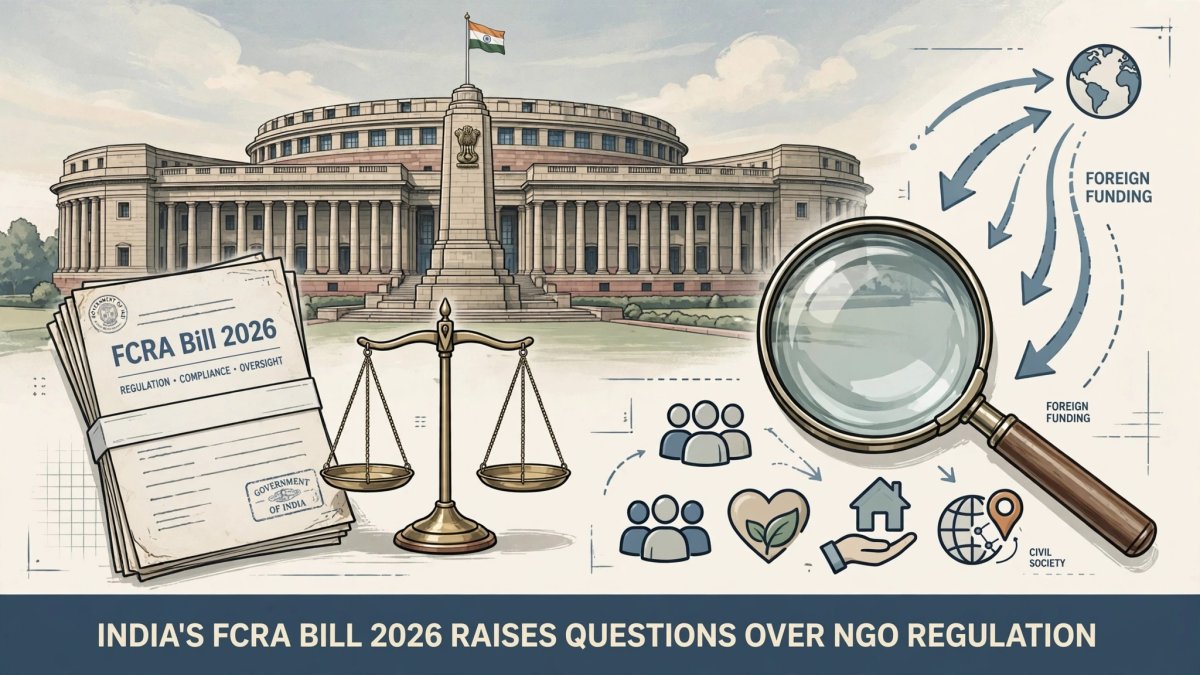
FCRA Amendment Bill 2026: Impact on NGOs, Foreign Funding and Charitable Institutions in India
New Delhi | October 26, 2026
India’s proposed FCRA Amendment Bill 2026 has triggered a debate over foreign funding regulation, government oversight and the future of assets created by non-governmental organisations (NGOs). While the government argues that stronger controls will improve transparency and accountability, critics have raised concerns about asset ownership, registration renewals, legal safeguards and the autonomy of charitable, educational and religious institutions.
India’s foreign funding regulations are facing an important legislative test as the Foreign Contribution (Regulation) Amendment Bill, 2026, moves through parliamentary scrutiny. The proposed legislation seeks to change how foreign contributions and assets are handled when an organisation’s registration under the Foreign Contribution (Regulation) Act, 2010 (FCRA) is cancelled, surrendered, denied renewal or otherwise ceases to remain valid.
Introduced in the Lok Sabha on March 25, 2026, the bill has drawn attention from opposition parties, civil society organisations, religious institutions and legal experts. The central concern is whether the proposed framework could extend government control beyond the receipt of foreign donations to buildings, facilities and other assets previously created using overseas contributions.
For NGOs working in healthcare, education, poverty alleviation, community development and social welfare, the implications could be significant. An organisation may establish a school, hospital or community facility with foreign donations and later continue operating it through domestic fundraising. Under the proposed framework, the status of assets created using foreign contributions could still become an issue if the organisation’s FCRA registration ceases to remain valid.
The Union government maintains that the proposed amendments are intended to strengthen transparency, improve accountability and establish a clear mechanism for managing funds and assets when an organisation no longer holds a valid FCRA certificate. It has also rejected allegations that the legislation is specifically directed at minority communities.
Critics, however, have questioned whether the proposed powers are proportionate, particularly when registration expires or renewal is denied. They have also raised concerns about the absence of a specific appeal mechanism in certain non-renewal situations.
The bill was referred to a 31-member Joint Parliamentary Committee (JPC) on August 12, 2026. As of October 26, the committee is examining the proposed provisions and hearing from stakeholders.
The debate is about more than regulatory compliance. It concerns the balance between national oversight of foreign funding, the protection of public interests and the ability of lawful charitable organisations to manage institutions built over many years.
1. What Is the FCRA, and Why Does It Matter?
The Foreign Contribution (Regulation) Act, 2010, governs the acceptance and utilisation of foreign contributions by eligible individuals, associations and other organisations in India. Its framework is intended to ensure that overseas funding is received and used in accordance with the law and to prevent its diversion towards activities considered detrimental to the national interest.
Organisations generally need an FCRA registration certificate or specific prior permission from the central government to receive foreign contributions. Registered organisations must comply with applicable financial reporting, record-keeping, disclosure and other regulatory requirements.
FCRA registration is ordinarily valid for five years and must be renewed to continue operating within the registration framework. The prior-permission route, by contrast, allows an organisation to receive foreign contributions for a specified purpose and from a specified source, subject to the applicable conditions.
Foreign donations support a variety of activities in India, including medical treatment, school education, disaster relief, humanitarian assistance, rural development and services for vulnerable communities. For some institutions, overseas contributions provide funding for infrastructure that would otherwise be difficult to establish through domestic donations alone.
At the same time, foreign funding involves public-interest considerations. Authorities need to ensure that contributions are properly documented, used for authorised purposes and managed in compliance with applicable law.
The policy challenge is therefore twofold: maintaining effective oversight of foreign contributions while ensuring that regulatory requirements remain transparent, proportionate and legally accountable.
The FCRA Amendment Bill 2026 addresses this challenge primarily through proposed changes to the handling of foreign contributions and assets when an organisation’s FCRA certificate ceases to remain valid.
2. What Does the FCRA Amendment Bill 2026 Propose?
The most consequential feature of the proposed legislation is the creation of a Designated Authority to supervise, manage and potentially dispose of foreign contributions and assets belonging to organisations that no longer hold a valid FCRA certificate.
Under the existing framework, the treatment of foreign contributions and assets is linked to circumstances such as cancellation or surrender of registration. The amendment bill proposes to extend the framework to cover additional situations in which a certificate ceases to be valid.
These include cases where an organisation does not apply for renewal, fails to obtain renewal before the certificate expires or has its renewal application denied.
The proposed mechanism distinguishes between provisional and permanent vesting of assets.
Initially, affected assets and foreign contributions may vest provisionally in the Designated Authority. If the organisation obtains a fresh certificate, secures renewal or has its registration restored within the applicable period, the proposed provisions provide for the return of eligible assets and unutilised foreign contributions, subject to the prescribed conditions.
If the relevant requirements are not met within the prescribed period, the vesting may become permanent.
The Designated Authority would then be empowered to use permanently vested assets for public purposes, including transferring them to government ministries, departments or agencies. Assets could also be disposed of through sale or other prescribed processes, with the proceeds handled under the proposed statutory framework.
The bill addresses places of worship as well. Where an asset that becomes permanently vested is wholly or partly a place of worship, the proposed provisions require the authority to maintain its religious character and arrange for its management in the prescribed manner.
The legislation also proposes other changes. These include defining responsibilities for key organisational functionaries, establishing obligations relating to organisations that become defunct, and reducing the maximum term of imprisonment for violations of the Act from five years to one year. It also proposes requiring prior approval from the central government before an investigation for an offence under the Act is initiated.
These provisions have different implications and should be considered individually. In particular, the proposed reduction in maximum imprisonment is a separate change from the provisions governing the vesting and disposal of organisational assets.
Importantly, these are provisions of a bill under parliamentary examination, not a description of a final enacted amendment. Their ultimate legal effect will depend on the legislative outcome and any subsequent rules.
Source: PRS Legislative Research — Foreign Contribution (Regulation) Amendment Bill, 2026.
3. The Government’s Argument: Transparency and Accountability in Foreign Funding
The government’s stated position is that foreign contributions must be subject to effective oversight and that clear procedures are necessary when an organisation loses its FCRA registration.
From a regulatory perspective, the issue is not limited to whether an organisation can continue receiving overseas donations. It also concerns what happens to unutilised contributions, assets created from those funds and the responsibilities associated with managing them.
A designated authority could establish a more clearly defined mechanism for supervising such property, addressing administrative uncertainty and determining how assets should be handled when an organisation ceases to hold a valid certificate.
Supporters of stronger oversight may argue that organisations receiving foreign contributions must take registration renewals seriously, maintain accurate financial records and ensure that funds are used in accordance with applicable rules.
The government has also rejected claims that the bill specifically targets minority communities. Following the referral of the legislation to the JPC in August, Parliamentary Affairs Minister Kiren Rijiju said there was nothing in the proposed legislation aimed at targeting minority institutions, according to DD India’s report on the referral.
The government's position presents the bill as a measure of regulatory administration rather than a restriction directed at a particular religious or social group.
Nevertheless, the effectiveness of any regulatory framework depends on how its powers are exercised. A clear statement of purpose does not, by itself, resolve questions about the consequences of non-renewal, the treatment of mixed-funded assets or the remedies available to organisations that believe an administrative decision is incorrect.
Those questions require detailed legislative examination.
Read more: DD India — FCRA Amendment Bill Referred to Joint Parliamentary Committee.
4. Why NGOs and Civil Society Organisations Are Concerned
The main criticism concerns the possible consequences of losing an FCRA certificate.
Consider a charitable organisation that receives foreign donations to establish a hospital. After construction, the hospital may operate largely through domestic donations, patient fees, local fundraising or support from Indian philanthropists.
If the organisation later decides not to renew its FCRA registration, its ability to receive further foreign donations may no longer be relevant to the day-to-day financing of the hospital. Yet the proposed asset-vesting provisions could still affect the hospital because it was created using foreign contributions.
This is the central concern raised by critics: the consequences of losing registration could extend beyond the organisation’s ability to receive additional foreign funding and affect its control over assets created in the past.
The issue becomes particularly significant for organisations that have reduced or discontinued overseas funding but continue providing services using domestic resources.
Critics argue that these institutions could face uncertainty over property, long-term investments and operational continuity, even where there is no established finding that foreign contributions were misused.
A registration certificate and the assets accumulated during years of charitable activity are not the same thing. The first establishes a regulatory status, while the second may represent buildings, equipment and infrastructure that continue to serve public purposes long after the original donations have been spent.
The bill’s proposed framework raises questions about how these interests should be balanced.
The government’s case for accountability must be considered alongside the need for predictable rules, fair decision-making procedures and remedies against potentially incorrect or disproportionate outcomes.
These concerns do not establish that every affected institution would lose its assets or that the proposed authority would necessarily act improperly. They explain why the scope of the proposed powers, the conditions for vesting and the protections available to organisations are central issues for Parliament.
5. The Asset-Vesting Debate: Hospitals, Schools and Other Public Facilities
The practical consequences become clearer when the proposed rules are applied to organisations with long-term assets.
A hospital funded partly by foreign donations
Suppose a charitable trust builds a hospital using a combination of overseas grants and domestic donations. The hospital subsequently operates through Indian fundraising and service revenue.
Under the proposed bill, an asset created partly through foreign contributions could fall within the vesting framework if the trust’s FCRA certificate ceases to remain valid.
The bill provides a process through which an organisation may apply for the return of a distinct or ascertainable portion of an asset created through domestic sources. However, that distinction may be difficult to establish when foreign and domestic donations have jointly financed a single building or facility.
The central question is how the authority would identify the eligible domestic-funded portion in practice.
A school operating entirely through domestic funding
Consider an organisation that established a school through overseas donations but now pays teachers, maintains buildings and supports students through domestic contributions.
The school’s ongoing services may no longer depend on fresh foreign funding. Even so, the proposed treatment of assets means that the organisation’s FCRA status could remain relevant to its control over the property.
This creates a potential planning concern for charitable institutions that have successfully diversified their funding sources.
A community organisation seeking to exit the FCRA framework
An organisation may also wish to stop accepting foreign contributions altogether. It could choose to rely exclusively on domestic donations because its funding requirements have changed or because it no longer wishes to maintain the administrative obligations associated with foreign funding.
However, the proposed bill raises a difficult question: can an organisation cease receiving foreign contributions while retaining assets previously created through those contributions?
PRS Legislative Research notes that, under the proposed framework, cancellation, surrender and non-renewal could all lead to assets being vested in the Designated Authority. This could effectively create a continuing incentive for organisations with such assets to maintain their FCRA registration.
The policy implications deserve careful consideration. The objective of regulating foreign contributions is not necessarily the same as ensuring that every organisation with historically foreign-funded assets remains within the registration framework indefinitely.
Lawmakers may therefore need to examine whether the proposed arrangements adequately distinguish between current foreign-funding activity and the continued operation of institutions built with past donations.
Source: PRS Legislative Research — Bill Highlights and Analysis.
6. FCRA Registration and Renewal: The Significance of the 2026 Rules
The debate over the amendment bill is taking place alongside changes to the Foreign Contribution (Regulation) Rules.
The Foreign Contribution (Regulation) Amendment Rules, 2026, were notified by the Ministry of Home Affairs on June 22, 2026. These rules are separate from the amendment bill, which remains under parliamentary examination.
The amended rules introduce changes to the information organisations must provide when applying for or renewing an FCRA certificate. They include requirements concerning an organisation’s stated purposes, states of operation, activities, utilisation of funding and certain organisational disclosures.
The rules also define “reasonable activity” for purposes of applying for or renewing an FCRA certificate. According to PRS Legislative Research, organisations are required to demonstrate utilisation of at least ₹10 lakh in foreign contributions over the previous two financial years to meet the prescribed activity threshold.
This requirement raises practical questions for organisations whose programmes are small, highly localised or dependent on irregular funding.
For example, a rural organisation may run a library, community centre or small educational programme with relatively modest annual expenditure. A low level of foreign-fund utilisation does not necessarily mean that its activities lack social value. However, the applicable renewal requirements may still be relevant to its registration.
It is important not to confuse this threshold with the asset-vesting provisions of the amendment bill. They are distinct legal measures. The rules establish regulatory requirements relating to registration and renewal, while the bill proposes changes to the handling of assets when an FCRA certificate ceases to remain valid.
Nevertheless, the measures intersect in practical terms: renewal requirements determine whether an organisation retains its registration, while the proposed bill could determine the consequences for assets if that registration ceases.
PRS has also raised questions about whether some provisions of the amended rules go beyond the powers delegated under the parent Act. These are analytical concerns identified by the legislative research organisation, not judicial findings that the rules are invalid.
For NGOs, charities and trusts, the changes underline the importance of reviewing registration dates, maintaining records of foreign contributions and expenditure, documenting activities and obtaining appropriate professional advice on compliance.
Source: PRS Legislative Research — Foreign Contribution (Regulation) Amendment Rules, 2026.
7. Legal Safeguards and the Question of Appeal Rights
One of the most important legal questions concerns what happens when the government denies an organisation’s application to renew its FCRA certificate.
The proposed amendment treats denial of renewal as a circumstance in which the certificate ceases to remain valid. The consequences could extend to the organisation’s foreign contributions and assets under the proposed vesting framework.
PRS Legislative Research has highlighted that the Act and the bill do not provide a specific appeal mechanism for cases in which the central government denies renewal. It has also raised concerns about the absence of a requirement to provide an organisation with an opportunity to be heard before such a denial.
This issue matters because renewal decisions could have consequences beyond the organisation’s ability to receive future donations. Under the proposed framework, the decision could affect control over property built using foreign contributions.
A fair regulatory system must be able to distinguish between a substantiated compliance violation, a procedural omission, an unresolved documentation issue and an administrative mistake. These situations may require different responses.
The availability of a clear hearing and review process can help prevent errors from producing consequences that are unnecessarily severe or difficult to reverse.
Critics argue that a specific, effective remedy is particularly important when a decision could result in the permanent vesting of valuable assets. Without clarity about how such decisions can be challenged, organisations may face uncertainty over both their registration status and the future of the facilities they operate.
The precise legal position will depend on the legislation ultimately enacted and the wider applicable legal framework. However, the concern identified by PRS gives Parliament a concrete issue to consider: whether the proposed powers should be accompanied by explicit procedural protections for organisations affected by non-renewal decisions.
8. What Happens to Assets Funded by Both Foreign and Domestic Donations?
Another major question concerns assets created using a combination of foreign and domestic contributions.
Many charitable institutions do not rely on a single funding source. A hospital might use an overseas grant for part of its construction, domestic donations for another part and local fundraising for equipment and subsequent expansion.
A school might similarly combine international grants with domestic philanthropy, community fundraising or contributions from Indian institutions.
The proposed bill covers assets created wholly or partly using foreign contributions. Where an asset is jointly funded, it may be difficult to separate the physical property into clearly identifiable foreign-funded and domestic-funded portions.
The bill provides for an application to the Designated Authority for the return of a distinct or ascertainable portion created using domestic sources, subject to the authority being satisfied. But this mechanism could be complicated when funding sources have contributed to a single indivisible asset.
Consider a school building funded by donations from several sources. It may be impossible to identify one classroom, corridor or structural component as having been financed exclusively by a particular contribution.
In such cases, the outcome could depend on how the relevant provisions are interpreted, what financial documentation is available and how the authority assesses the claim.
This raises practical questions about valuation, financial tracing, proportionality and dispute resolution.
Detailed guidance could help organisations understand how to document mixed funding and how the proposed authority would assess claims. Parliament may also wish to examine whether the framework gives sufficient certainty to organisations that have combined domestic and foreign resources in good faith.
The issue is not simply accounting. It concerns how a legal system treats long-term charitable assets whose funding histories may involve several donors, multiple projects and years of expenditure.
9. The Joint Parliamentary Committee: What Is Being Examined?
The Foreign Contribution (Regulation) Amendment Bill 2026 was referred to a 31-member Joint Parliamentary Committee on August 12, 2026, for detailed scrutiny. The committee consists of 21 Lok Sabha members and 10 Rajya Sabha members and is chaired by BJP MP Sanjay Jaiswal.
The committee has been tasked with examining the bill’s provisions and reporting to Parliament by the last day of the first week of the Winter Session of 2026.
Its work provides an opportunity to examine the proposed legislation clause by clause, hear from affected stakeholders and consider whether changes are needed before Parliament reaches a final decision.
According to The New Indian Express, the Home and Law ministries briefed the committee on the bill’s provisions on September 29, 2026. The discussions addressed the government’s rationale for amending the 2010 law and the proposed regulatory framework.
On October 12, Akashvani News reported that the committee heard submissions from representatives of the Institute of Chartered Accountants of India, the Catholic Bishops Conference of India, the All India Christian Council and the Centre for Advancement of Philanthropy. The committee also interacted with senior advocate and Rajya Sabha MP Kapil Sibal.
These consultations bring together several perspectives, including financial compliance, religious institutions, civil society organisations and legal analysis.
The issues that deserve particular scrutiny include:
-
How the proposed vesting provisions would apply to assets created partly through foreign and partly through domestic donations.
-
What safeguards would be available when an FCRA registration is denied renewal or allowed to expire.
-
How the authority would determine the duration of provisional vesting and the return of eligible assets.
-
How decisions involving religious places of worship would be implemented while maintaining their religious character.
-
Whether the proposed responsibilities of key functionaries are sufficiently clear and proportionate.
-
How the bill’s asset-management provisions interact with the existing registration and renewal framework.
The committee’s findings could help clarify the bill’s implications and identify possible amendments. Until the parliamentary process is completed, however, the bill’s provisions should be described as proposals rather than treated as final law.
Sources: The New Indian Express — Ministries Brief Joint Parliamentary Committee on FCRA Bill and Akashvani News — Joint Parliamentary Committee Consultations on FCRA.
10. Balancing National Interests, NGO Accountability and Institutional Autonomy
The debate over the FCRA Amendment Bill 2026 reflects a wider policy challenge: how to regulate foreign contributions effectively without creating avoidable uncertainty for organisations carrying out lawful public-benefit work.
The government has a legitimate responsibility to establish rules governing foreign funding, ensure compliance and provide for the management of assets when an organisation loses its registration. At the same time, charitable institutions need predictable procedures so that administrative decisions do not unnecessarily disrupt healthcare, education, social welfare or other public services.
A well-designed framework should make obligations clear before problems arise. Organisations should know how to maintain their registration, how compliance is assessed, what happens when renewal is denied and how they can challenge a decision they consider incorrect.
Transparency is equally important on the government side. The exercise of powers over organisational assets should follow clearly defined standards, with decisions documented and review procedures established under the applicable law.
The same principles apply to the treatment of mixed-funded property. Where foreign and domestic donations have been combined to establish a facility, the framework should provide clarity about how claims are assessed and what evidence organisations must preserve.
Accountability and institutional autonomy should not automatically be treated as opposing goals. Clear regulation can improve confidence in foreign funding while transparent decisions and fair remedies can strengthen trust in the institutions responsible for enforcing the law.
The parliamentary review therefore presents an opportunity to examine not only whether the proposed powers achieve their stated objectives, but also whether their consequences are proportionate and their procedures sufficiently clear.
Conclusion: The FCRA Amendment Bill 2026 Faces a Test of Accountability and Fairness
The Foreign Contribution (Regulation) Amendment Bill, 2026, has placed foreign funding regulation, NGO asset management and the autonomy of charitable institutions at the centre of an important legislative debate.
The government argues that the proposed changes would strengthen transparency and establish a clearer mechanism for managing foreign contributions and assets when an organisation’s FCRA registration ceases to remain valid. Critics have questioned the potential consequences for institutions that rely on a combination of foreign and domestic donations, particularly where assets were built in the past but current operations are funded locally.
Three issues stand out: the scope of the proposed asset-vesting powers, the legal protections available when registration is denied renewal, and the treatment of property created through mixed funding.
The separate FCRA Amendment Rules, 2026, add another dimension by introducing changes to registration, disclosure and renewal requirements. Together, these developments make compliance planning and a clear understanding of the proposed legal framework particularly important for NGOs, charitable trusts, educational institutions and other organisations receiving foreign contributions.
The Joint Parliamentary Committee now has an opportunity to examine the bill’s practical consequences, consider stakeholder concerns and recommend changes where necessary. Its findings will be an important part of the legislative process, although the final legal position will depend on Parliament’s subsequent decisions.
Ultimately, effective foreign funding regulation must do more than establish administrative powers. It must also define how those powers are exercised, provide clarity to the organisations affected and ensure that decisions can be challenged through appropriate legal procedures.
The success of the FCRA framework will depend on whether it can protect legitimate national interests, promote financial accountability and give lawful charitable institutions a predictable basis on which to operate.
As Parliament examines the proposed amendments, the central question is not simply how the government should regulate foreign donations. It is how India can maintain robust oversight while ensuring that the rules governing foreign-funded assets are transparent, proportionate and legally accountable.
Sources and Further Reading
-
PRS Legislative Research — Foreign Contribution (Regulation) Amendment Bill, 2026
https://prsindia.org/billtrack/the-foreign-contribution-regulation-amendment-bill-2026 -
DD India — FCRA Amendment Bill Referred to Joint Parliamentary Committee
https://ddindia.co.in/2026/08/fcra-amendment-bill-referred-to-joint-parliamentary-committee/ -
The New Indian Express — Home, Law Ministries Brief Joint Parliamentary Committee on FCRA Bill
https://www.newindianexpress.com/india/2026/Sep/29/home-law-ministries-brief-joint-parliamentary-committee-on-fcra-bill -
Akashvani News — Joint Parliamentary Committee Consultations on FCRA
https://newsonair.gov.in/jpc-deliberates-with-stakeholders-on-fcra/ -
PRS Legislative Research — Foreign Contribution (Regulation) Amendment Rules, 2026
https://prsindia.org/billtrack/foreign-contribution-regulation-amendment-rules-2026


Join the Conversation