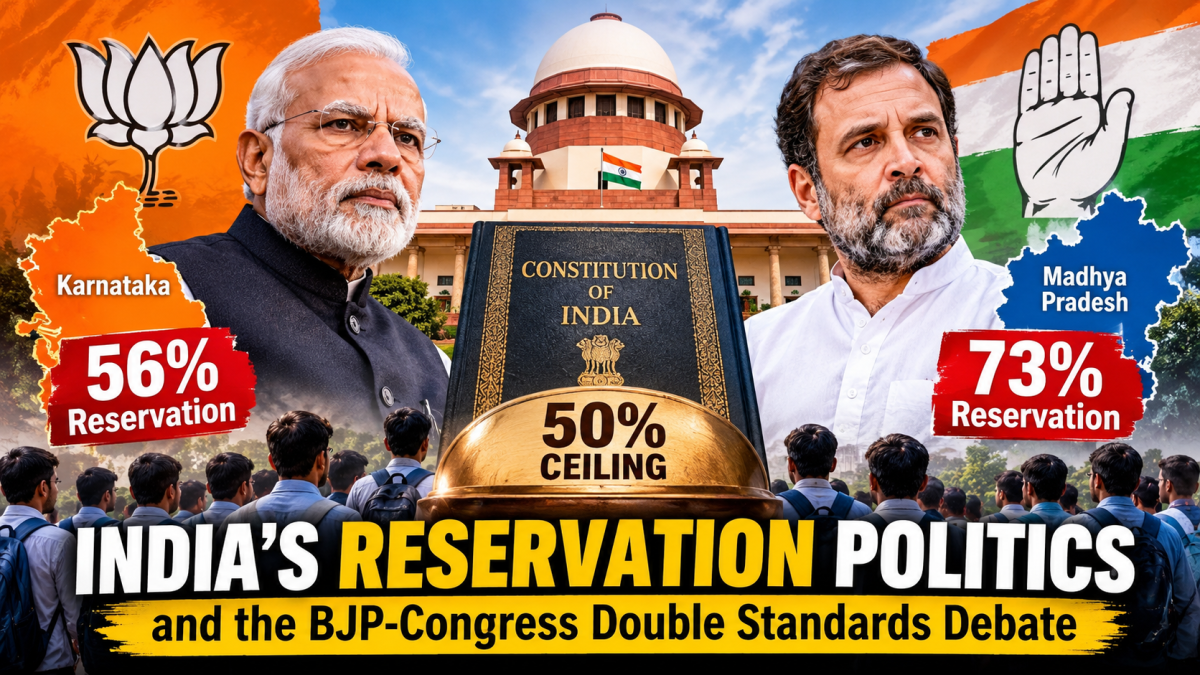
India's Reservation Politics and the BJP-Congress Double Standards Debate
India's reservation policy has once again become a subject of political and constitutional debate, raising questions about electoral promises, social justice, equality of opportunity and the consistency of major political parties. Recent developments in Karnataka and Madhya Pradesh have brought renewed attention to how the Bharatiya Janata Party (BJP) and the Indian National Congress have approached reservation policies while governing different states.
The reservation decisions taken by the BJP government in Karnataka and the Congress government in Madhya Pradesh provide important examples of how political parties have attempted to expand reservation quotas. Although these decisions emerged from different political and administrative circumstances, they raise an important question: Are reservation policies being guided primarily by constitutional principles and measurable social conditions, or are electoral considerations also influencing political decisions?
1. Karnataka's 56% Reservation Policy Under the BJP
The BJP-led government in Karnataka, under former Chief Minister Basavaraj Bommai, introduced legislation in 2022 to increase reservation for Scheduled Castes (SCs) and Scheduled Tribes (STs).
How the Reservation Was Increased?
The government increased the Scheduled Caste quota from 15% to 17% and the Scheduled Tribe quota from 3% to 7%. Alongside the existing 32% reservation for OBC communities, the total reservation reached 56%.
The government justified the decision by referring to reports and recommendations examining the social conditions and representation of SC and ST communities.
The legislation was presented as an effort to improve representation in educational institutions and government employment. However, it faced legal challenges over its compatibility with the established 50% reservation ceiling.
Karnataka High Court's October 2026 Decision
On October 12, 2026, the Karnataka High Court struck down the provisions responsible for increasing the total reservation to 56%.
The court held that the enhanced reservation violated constitutional equality guarantees under Articles 14, 15 and 16. It concluded that the state had not established sufficient extraordinary circumstances to justify exceeding the established ceiling.
The judgment has renewed discussions about the constitutional limits of state governments when expanding reservation.
Source: "The Indian Express – Karnataka High Court strikes down SC/ST quota hikes" https://indianexpress.com/article/legal-news/karnataka-hc-rules-sc-st-quota-hikes-unconstitutional-10918445/
2. Madhya Pradesh's 73% Reservation Debate Under Congress
Madhya Pradesh presents another important example of political decision-making surrounding reservation.
In 2019, the Congress government led by Kamal Nath introduced an ordinance increasing OBC reservation in the state from 14% to 27%. The amendment was subsequently passed into law.
Understanding the 73% Figure
The proposed reservation structure attracted considerable attention because the combined figures could reach 73% when the following categories were included:
• Scheduled Castes – 16%
• Scheduled Tribes – 20%
• Other Backward Classes – 27%
• Economically Weaker Sections – 10%
However, an important constitutional distinction must be recognised. EWS reservation operates under separate constitutional provisions introduced through the 103rd Constitutional Amendment. Therefore, the 73% figure should not be treated as a straightforward calculation under the traditional 50% ceiling applicable to reservations under Articles 15(4) and 16(4).
The Congress government defended the OBC quota increase as a measure intended to improve representation and address social inequalities.
Source: "The Indian Express – Madhya Pradesh Assembly passes 27% OBC reservation bill" https://indianexpress.com/article/india/madhya-pradesh-assembly-passes-bill-giving-27-reservation-for-obc-5844863/
Madhya Pradesh High Court's October 2026 Verdict
On October 9, 2026, the Madhya Pradesh High Court ruled that OBC reservation in government recruitment and higher education should remain at 14%, rejecting the state's attempt to increase it to 27%.
The court concluded that the available evidence did not establish sufficient grounds for increasing OBC reservation beyond the existing limit. It also directed recruitment agencies to fill vacancies that had remained on hold under the disputed 87:13 arrangement.
The court clarified that the dispute concerned the extent of reservation rather than the entitlement of OBC communities to reservation.
Source: "The New Indian Express – Madhya Pradesh High Court caps OBC quota at 14%" https://www.newindianexpress.com/states/madhya-pradesh/2026/Oct/09/mp-hc-caps-obc-quota-at-14-in-government-recruitment-and-high-education-orders-release-of-13-held-posts
3. BJP and Congress – Different Political Positions, Similar Approaches?
The Karnataka and Madhya Pradesh developments have exposed an interesting pattern in India's reservation politics.
The BJP introduced the 56% reservation structure in Karnataka, while Congress introduced the 27% OBC quota in Madhya Pradesh.
However, the political debate becomes more complicated when the positions of parties are examined across different states and governments.
Reservation and Electoral Considerations
Reservation is an important political issue because it affects access to education, public employment and opportunities for historically disadvantaged communities.
Political parties frequently make commitments concerning reservation during elections. Such commitments can influence public debate, community expectations and electoral calculations.
Nevertheless, it would be inaccurate to assume that every reservation decision is exclusively motivated by electoral interests. Governments also rely on constitutional provisions, social surveys, commission reports and administrative assessments.
The central concern is whether policy decisions are supported by reliable evidence and remain consistent with constitutional requirements.
The Question of Political Accountability
When political parties criticise reservation policies introduced by their opponents but defend comparable decisions when they assume power, questions about political consistency naturally emerge.
This does not automatically establish that both parties have identical policies. Their decisions must be examined individually, including their legal foundations, supporting data and intended beneficiaries.
Political accountability requires parties to explain their positions consistently, irrespective of whether they occupy government or opposition benches.
4. The Constitutional Debate Over the 50% Reservation Ceiling
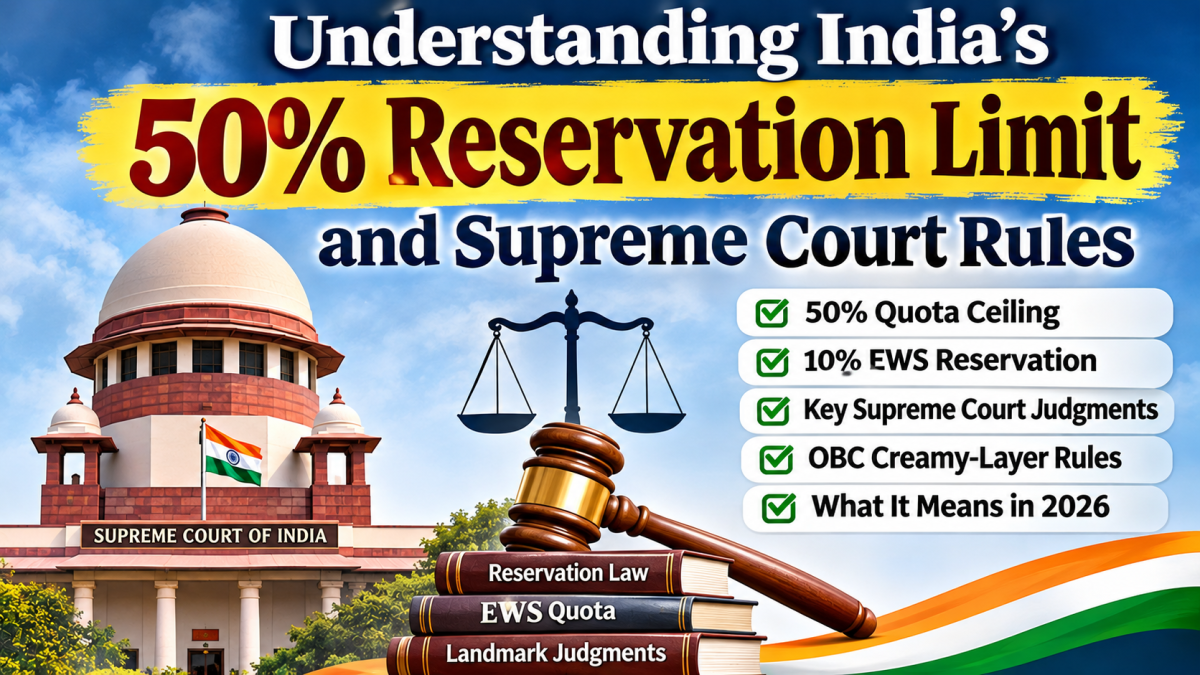
The Supreme Court's 1992 Indra Sawhney judgment established the general 50% ceiling on reservations under Articles 15(4) and 16(4), while recognising the possibility of exceptional circumstances.
The principle was intended to maintain a balance between affirmative action and the constitutional guarantee of equality.
The introduction of 10% EWS reservation through the 103rd Constitutional Amendment in 2019 added another dimension to the debate. In 2022, the Supreme Court upheld the constitutional validity of the amendment.
Consequently, discussions about reservation percentages require careful examination of the constitutional provisions governing different categories.
Equality of Opportunity and Social Justice
The Constitution recognises both equality and the need to address historical disadvantages.
Reservation policies are intended to improve representation and provide opportunities to communities that have experienced social and educational exclusion.
At the same time, questions concerning the availability of opportunities for candidates outside reserved categories remain an important part of public discussion.
A sustainable reservation framework requires transparent data, periodic assessments, effective implementation and constitutional compliance.
5. Beyond Party Politics – The Need for Consistent Reservation Policy
The developments in Karnataka and Madhya Pradesh demonstrate why reservation policies should not become instruments of political competition.
Governments should establish clear criteria for identifying disadvantage, assessing representation and determining the appropriate extent of affirmative action.
Political parties should also explain why they support or oppose particular reservation measures, rather than changing their arguments according to electoral circumstances.
The broader debate should include the effectiveness of existing quotas, unfilled reserved vacancies, access to quality education, economic disadvantages and the availability of employment opportunities.
The interests of disadvantaged communities and the constitutional principle of equal opportunity should remain central to policy discussions.
Conclusion
The reservation controversies in Karnataka and Madhya Pradesh reveal a complicated relationship between political promises, constitutional limitations and social justice.
The BJP's 56% reservation legislation in Karnataka and Congress's 27% OBC quota amendment in Madhya Pradesh illustrate how different governments have attempted to expand reservation through state-level policies. Subsequent High Court judgments have also demonstrated that such decisions must satisfy constitutional requirements.
These developments raise important questions about consistency and accountability among India's major political parties. Their respective positions deserve examination against legislative histories, constitutional principles and judicial decisions.
Ultimately, reservation policy requires more than electoral commitments. It demands constitutional responsibility, reliable evidence, transparent decision-making and a consistent commitment to equality of opportunity.
The fundamental question remains: Are India's political parties building a sustainable reservation framework based on constitutional principles, or allowing electoral competition to shape decisions concerning social justice?
Sources and Further Reading
1. "The Indian Express – Karnataka High Court strikes down SC/ST quota hikes" https://indianexpress.com/article/legal-news/karnataka-hc-rules-sc-st-quota-hikes-unconstitutional-10918445/
2. "The Indian Express – Madhya Pradesh's 27% OBC reservation legislation" https://indianexpress.com/article/india/madhya-pradesh-assembly-passes-bill-giving-27-reservation-for-obc-5844863/
3. "The New Indian Express – Madhya Pradesh High Court's October 2026 verdict" https://www.newindianexpress.com/states/madhya-pradesh/2026/Oct/09/mp-hc-caps-obc-quota-at-14-in-government-recruitment-and-high-education-orders-release-of-13-held-posts
4. "Press Information Bureau – Government of India's Reservation Policy" https://www.pib.gov.in/Pressreleaseshare.aspx?PRID=1806158
5. "Supreme Court – Indra Sawhney judgment" https://indiankanoon.org/doc/189806642/

Join the Conversation