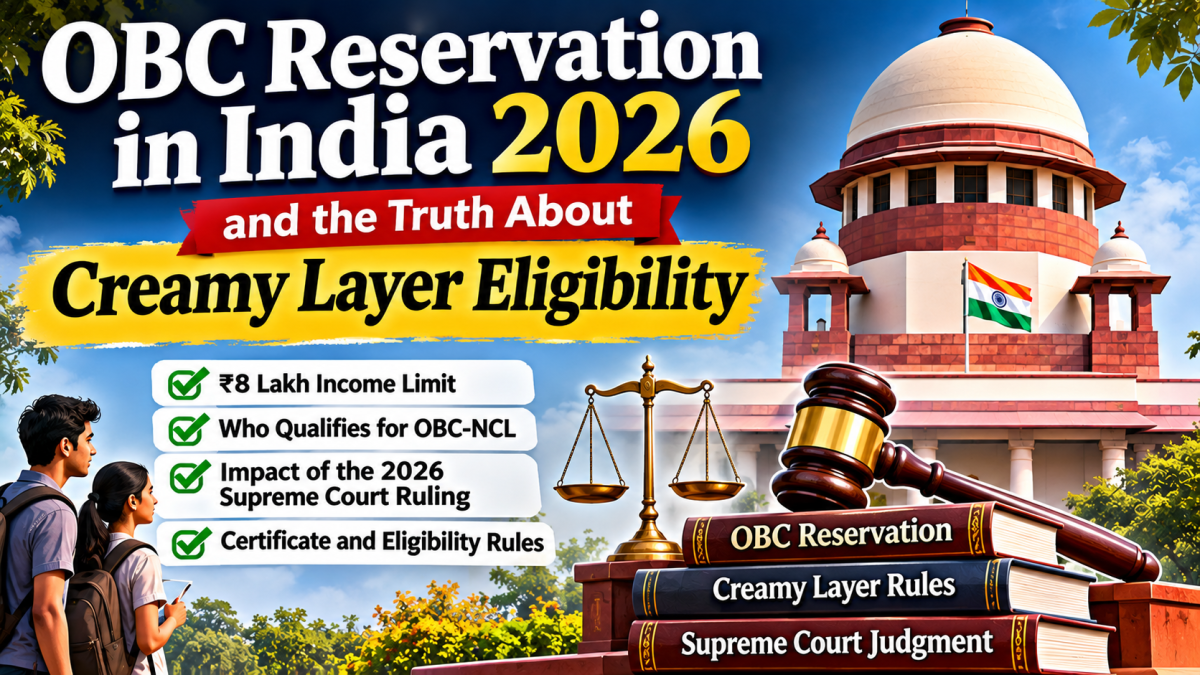
One of the most confusing parts of India's reservation system is the distinction between the OBC category and the Other Backward Classes Non-Creamy Layer (OBC-NCL) category. Many people believe that eligibility depends entirely on whether their family's annual income is below ₹8 lakh. Others assume that a parent working in a government department or private company automatically makes their children ineligible for reservation.
Neither assumption is universally correct.
The rules consider several factors, including the community to which a candidate belongs, the applicable OBC list, the status and type of employment of their parents, and the relevant income and wealth criteria.
The issue has become particularly important following a Supreme Court judgment delivered on March 11, 2026. The Court ruled that parental salary alone cannot be used as the decisive criterion for excluding certain OBC candidates from reservation benefits. In September 2026, the Court reserved its judgment on the Central government's request for clarification about how the ruling should apply to previous and ongoing recruitment processes.
Here is what candidates need to know about OBC reservation in India, creamy-layer eligibility and the latest legal developments.
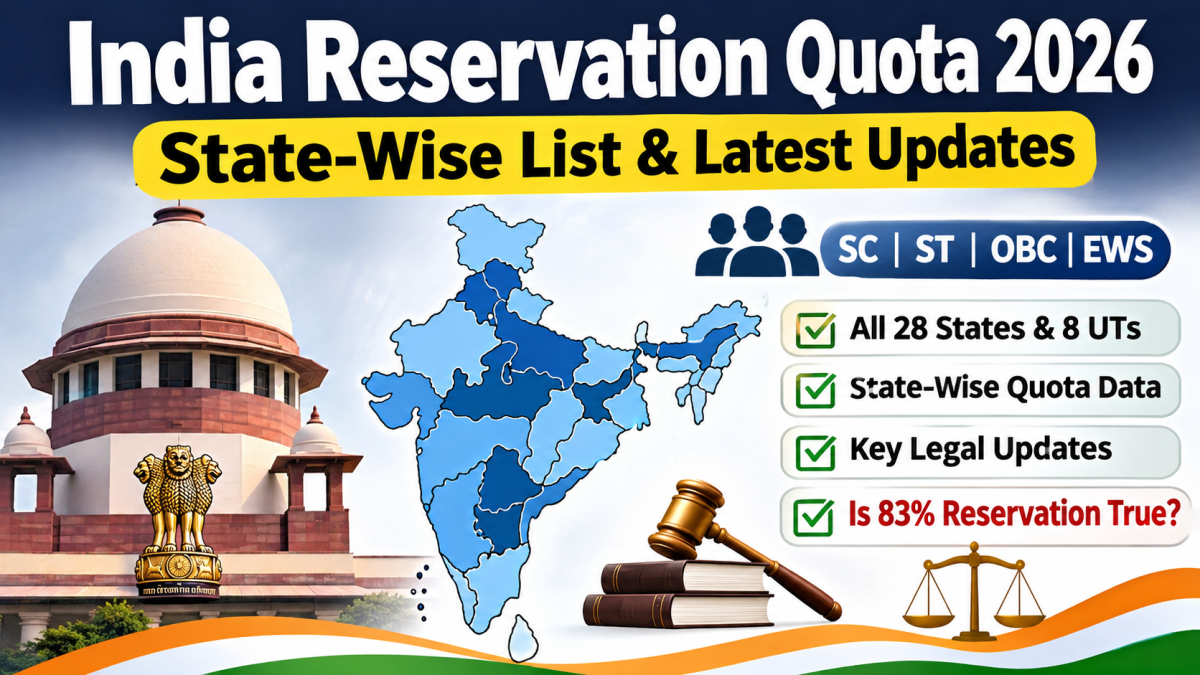
Also Read: India Reservation Quota 2026: State-Wise List
What Is OBC Reservation in India?
OBC stands for Other Backward Classes. The category covers communities recognised as socially and educationally backward under the applicable government lists.
Reservation policies aim to improve access to government employment and educational opportunities for eligible communities that have experienced social and educational disadvantages.
Under the applicable central-government framework, OBC candidates can receive reservation in eligible government recruitment and educational admissions. The central framework generally provides 27% reservation for eligible OBC candidates in applicable central government direct recruitment and central educational institutions, subject to the relevant rules and institutional exceptions.
However, not every person belonging to an OBC community can claim these benefits in every situation.
For central-government reservation, a candidate generally needs to establish that their community is included in the Central List of OBCs and that they satisfy the applicable Non-Creamy Layer conditions. State government jobs and state educational institutions may apply their own backward-class lists, categories and rules.
This distinction matters because a community recognised as OBC by one state is not automatically entitled to reservation under the Central List. Candidates should verify the list applicable to the examination, institution or recruitment they are applying for.
The National Commission for Backward Classes provides access to information about the Central List of OBCs.
What Does OBC Non-Creamy Layer Mean?
The Non-Creamy Layer concept is intended to ensure that reservation benefits reach members of backward communities who continue to face social and educational disadvantage, rather than being disproportionately accessed by relatively advanced sections within those communities.
The creamy layer consists of people within eligible OBC communities who fall under the applicable exclusion criteria. Such candidates cannot claim OBC-NCL reservation benefits under the rules governing that recruitment or admission.
In simple terms, OBC status and OBC-NCL eligibility are two separate questions.
A candidate may belong to a recognised OBC community but still be classified as creamy layer because of their parents' position in government service or another applicable exclusion criterion.
Similarly, a candidate cannot establish Non-Creamy Layer eligibility merely by presenting an income certificate showing a particular amount. The relevant rules must be applied to the family's circumstances.
This is particularly important for children of government employees, public-sector undertaking (PSU) employees, bank employees and people working in private organisations.
What Is the OBC Creamy Layer Income Limit in 2026?
The central-government income ceiling associated with the OBC creamy-layer income and wealth test is ₹8 lakh per annum.
The Union government increased the ceiling from ₹6 lakh to ₹8 lakh in 2017. The Ministry of Social Justice and Empowerment subsequently confirmed in a February 9, 2022 parliamentary response that the OBC creamy-layer income limit had last been revised in 2017 and had remained unchanged at that time.
The official government announcement on the ₹8 lakh ceiling explains the limit and its distinction from the separate EWS framework.
As of October 27, 2026, the latest sources reviewed for this article continue to report ₹8 lakh as the central OBC creamy-layer income ceiling.
However, there is an important qualification: ₹8 lakh is not a universal rule under which every family earning less than the threshold automatically qualifies for OBC-NCL benefits, or every family earning more automatically becomes creamy layer.
The central rules contain different exclusion criteria. These consider the status of parents in specified categories, as well as the applicable income and wealth test.
The distinction became especially important after the Supreme Court's March 2026 judgment concerning employees of PSUs and private organisations.
Does Salary Count Towards the ₹8 Lakh Limit?
This is one of the most misunderstood aspects of the creamy-layer rules.
Under the central government's 1993 Office Memorandum governing OBC creamy-layer exclusion, the income and wealth test distinguishes salary income, agricultural income and income from other sources. The Supreme Court's March 11, 2026 judgment examined this distinction in detail.
The Court held that salary income alone could not be used as the decisive basis for declaring candidates to be in the creamy layer in the circumstances before it. It also explained that the status and category of a parent's post matter under the prescribed framework.
For certain categories covered by the income and wealth test, salary and agricultural income are not simply combined with income from other sources to determine creamy-layer status. The relevant rules and the nature of the parent's employment must be examined.
This does not mean that salary or employment status is irrelevant in every situation. Some exclusions are based on the type or level of a parent's service, rather than on an income calculation alone.
Candidates should therefore avoid relying on informal online calculators or a simple comparison between total family earnings and ₹8 lakh.
Who Qualifies for OBC Non-Creamy Layer Reservation?
Eligibility depends on the applicable rules, but candidates applying under the central OBC framework should examine the following conditions.
1. The Community Must Be Included in the Applicable OBC List
The first requirement is membership in a recognised OBC community.
For central-government recruitment and central institutions, candidates should verify their community against the Central List of OBCs for the relevant state or Union Territory.
For state government recruitment or admission, the relevant state list and rules may apply instead.
A caste or community certificate issued by a state authority does not, by itself, establish eligibility for every central-government reservation benefit.
2. The Candidate Must Satisfy the Non-Creamy Layer Criteria
Candidates must fall outside the applicable creamy-layer exclusion categories.
The determination can depend on the position held by a parent, the nature of government service, the timing and route of recruitment or promotion in specified circumstances, and the income and wealth test.
The rules are more detailed than a simple salary calculation. Candidates whose parents hold senior government posts or comparable positions should examine the prescribed service-status criteria carefully.
3. Parental Status Must Be Assessed Correctly
For the central OBC creamy-layer framework, parental status is central to the assessment under the relevant categories. The 1993 Office Memorandum and subsequent clarifications specify that the candidate's own income or the spouse's status or income is not the test for the parental-status categories addressed by those provisions.
The Supreme Court reiterated the significance of parental status in its 2026 ruling.
This is one reason a candidate's own salary, employment or personal financial position does not automatically determine whether they qualify for OBC-NCL reservation. The applicable criteria must be examined in context.
4. The Candidate Must Meet the Certificate Requirements
Eligible candidates generally need an appropriate OBC or OBC-NCL certificate in the format accepted by the relevant recruiting body or institution.
The application may require documents establishing community membership, parental employment or income, residence and other details specified by the competent authority.
Candidates should check the exact notification, because the certificate format, issuing authority, reference date and submission deadline can differ between examinations and admissions.
Does a Government Employee's Child Automatically Become Creamy Layer?
No. A parent's government employment does not automatically make every OBC candidate ineligible.
The relevant test depends on the parent's service category and the criteria prescribed by the applicable rules.
The central framework identifies certain senior government-service categories for creamy-layer exclusion. It also contains rules concerning promotions and other service circumstances.
This means that candidates cannot establish their eligibility simply by saying that their parents work in government service, nor can they be excluded merely because a parent's salary appears high without applying the relevant criteria.
A parent employed in a lower-level government post may be treated differently from a parent who falls under a specified senior-service exclusion category. The particular facts, service history and applicable provisions determine the outcome.
The same principle became especially significant for PSU and private-sector employees in the Supreme Court's 2026 ruling.
What About Children of PSU and Private-Sector Employees?
The question of how to assess the children of PSU and private-sector employees has been a longstanding source of confusion.
Under the central framework, criteria relating to government-service status may be applied to employees of PSUs, banks, insurance organisations, universities and similar institutions where their posts are equivalent or comparable to the relevant government posts.
Determining that equivalence is important because employees with comparable responsibilities and service levels should not automatically be treated differently simply because they work in different types of organisations.
The dispute reached the Supreme Court in Union of India v. Rohith Nathan, which led to the important March 2026 judgment.
What the Supreme Court Ruled on March 11, 2026
On March 11, 2026, the Supreme Court delivered its judgment in Union of India v. Rohith Nathan and Others.
The dispute concerned OBC candidates whose parents worked in PSUs or other organisations. Their applications for reservation benefits had been rejected on the basis of creamy-layer criteria that relied on parental salary income.
The Court examined whether a clarification issued by the Department of Personnel and Training (DoPT) in 2004 could override the substantive criteria established by the government's 1993 Office Memorandum.
The Court concluded that the 2004 clarification could not override the foundational framework. It held that determining creamy-layer status purely through income brackets, without considering parental service categories and status criteria prescribed by the 1993 memorandum, was legally unsustainable.
The Court also found that treating similarly placed employees differently solely because one worked in a government department and another in a PSU or private organisation could amount to unconstitutional discrimination.
The judgment directed the government to reconsider the relevant candidates' claims under the principles laid down by the Court. It also directed the creation of supernumerary posts where required to accommodate candidates who satisfied the Non-Creamy Layer criteria and other eligibility conditions.
Read the full Supreme Court judgment in Union of India v. Rohith Nathan.
Did the Judgment Increase the OBC Income Limit?
No. The March 2026 judgment did not announce a general increase in the ₹8 lakh creamy-layer ceiling.
Its significance lies in the interpretation and application of the existing criteria, particularly where parental employment is concerned.
The ruling addressed how creamy-layer status should be decided, rather than increasing the percentage of OBC reservation or replacing the entire eligibility framework.
It is therefore incorrect to describe the March 2026 decision as a new OBC reservation quota or a universal relaxation of the income limit.
Why Is the Supreme Court Hearing Another OBC Creamy Layer Matter?
The dispute did not end with the March 2026 judgment.
On September 24, 2026, the Supreme Court reserved judgment on an application filed by the Central government seeking clarification about the implementation of the ruling.
The government raised concerns about the consequences of applying the March decision retrospectively. It argued that reopening previous recruitments and appointments could affect service allocation, seniority, admissions and other decisions already made under the criteria applicable at the time.
The Centre also sought time to carry out the required exercise concerning the equivalence of posts across different organisations.
One major issue is the treatment of candidates who participated in earlier examinations or recruitment processes but were denied OBC-NCL status because of the disputed interpretation of parental income.
According to reporting published by The Indian Express on October 25, 2026, the issue had also delayed service allocation and the start of the Foundation Course for the 958 candidates recommended through the Civil Services Examination 2025. The report said the government was seeking clarification on the effect of the ruling and its application to earlier and ongoing recruitments.
The September 24 Supreme Court order records that arguments were concluded and judgment was reserved.
As of October 27, 2026, the latest public order located for this article showed that the Court had reserved its judgment on the clarification application. That is different from a final decision granting the government's request.
Candidates affected by earlier selections should therefore check subsequent court orders and official recruitment instructions rather than assuming that the March judgment has already resolved every retrospective eligibility question.
OBC Reservation and EWS Reservation Are Not the Same
Another common source of confusion is the ₹8 lakh limit associated with both OBC creamy-layer eligibility and EWS reservation.
Although the headline figure is the same, the two systems have different legal foundations and eligibility rules.
OBC reservation is intended for eligible members of recognised socially and educationally backward communities who satisfy the applicable Non-Creamy Layer criteria.
EWS reservation arises under Articles 15(6) and 16(6) of the Constitution, introduced through the 103rd Constitutional Amendment. It applies to eligible economically weaker sections who are not covered by the relevant existing SC, ST and OBC reservation provisions.
The EWS assessment includes its own income and asset criteria. OBC creamy-layer assessment, by contrast, includes parental service-status exclusions and the prescribed income and wealth test.
A candidate cannot determine eligibility for one system merely by applying the other system's income rules.
For this reason, candidates must read the relevant examination or admission notification carefully and obtain the correct certificate.
How to Apply for an OBC-NCL Certificate
The application procedure differs between states and Union Territories, but the general process involves several steps.
Step 1 — Verify your community. Confirm that your caste or community appears in the applicable Central or State OBC list.
Step 2 — Check the creamy-layer criteria. Review the rules governing parental employment, post status and the income and wealth test. Do not rely on the income figure alone.
Step 3 — Collect the supporting documents. Depending on the issuing authority, these may include your existing caste certificate, identity and residence proof, parental employment or service records, income documents and other prescribed declarations.
Step 4 — Apply through the competent authority. Follow the procedure specified by the state revenue department, district administration or designated online service portal.
Step 5 — Verify the certificate before using it. Make sure it is issued in the format required by the recruiting body or educational institution and meets the relevant cut-off date and other conditions.
For example, the Government of Assam's certificate application guidance lists parental income documentation and other supporting records. The precise requirements elsewhere may differ.
A certificate that was accepted for one application may not automatically satisfy the conditions of another recruitment or admission process.
Common Myths About OBC Creamy Layer Eligibility
Several misconceptions continue to circulate among students and job applicants.
Myth 1 — Anyone earning more than ₹8 lakh automatically becomes creamy layer.
The reality is more complicated. The income ceiling is part of the prescribed framework, but parental service status and the rules governing different income sources also matter.
Myth 2 — Every child of a government employee is ineligible for OBC reservation.
This is incorrect. The applicable rules distinguish between service categories and other circumstances. Government employment alone is not a universal exclusion.
Myth 3 — Private-sector salary automatically disqualifies a candidate.
The March 2026 Supreme Court judgment rejected the use of salary income alone as the decisive criterion in the circumstances before it. The parent's post, its comparability and the applicable rules must be considered.
Myth 4 — The Supreme Court raised the OBC creamy-layer ceiling in 2026.
The judgment did not announce a new general income ceiling. It addressed how the existing framework should be interpreted and applied.
Myth 5 — An OBC certificate is sufficient for every central and state benefit.
The relevant list, certificate format, Non-Creamy Layer conditions and application rules must match the job or institution.
Frequently Asked Questions
What is the OBC Non-Creamy Layer income limit in 2026?
The central-government OBC creamy-layer income ceiling remains ₹8 lakh per annum in the latest sources reviewed for this article. However, the complete eligibility assessment also depends on the prescribed service-status and income/wealth criteria. State-specific policies may differ.
Is the OBC creamy-layer limit the same as the EWS limit?
Both systems use a ₹8 lakh income figure in their respective frameworks, but they have different eligibility rules. EWS eligibility includes income and asset requirements, while OBC creamy-layer assessment also considers parental status and other prescribed exclusions.
Does my own salary affect my OBC-NCL eligibility?
Under the central framework, creamy-layer status is generally assessed through the applicable parental-status criteria rather than simply by the candidate's own income. The precise treatment depends on the relevant rule and category, so candidates should verify the current requirements.
Can children of PSU employees receive OBC-NCL benefits?
Yes, where they satisfy the applicable criteria. The Supreme Court's March 11, 2026 judgment clarified that salary alone could not be the decisive basis for creamy-layer exclusion in the circumstances covered by the case.
Has the Supreme Court made the March 2026 ruling fully applicable to previous recruitments?
The Centre sought clarification on retrospective application, and the Supreme Court reserved its judgment on September 24, 2026. Candidates affected by previous selections should check the latest orders before drawing conclusions about their cases.
Where can I check whether my caste is in the Central OBC List?
Check the National Commission for Backward Classes website and select the state or Union Territory relevant to your community. The list used for central benefits is not necessarily identical to the list used by a state government.
Conclusion
OBC reservation in India involves more than a caste certificate or a single income threshold. Eligibility for Non-Creamy Layer benefits depends on the relevant community list, parental service status, the applicable income and wealth test, and the rules governing the particular recruitment or admission process.
The ₹8 lakh central-government creamy-layer ceiling remains an important part of the framework, but it should not be treated as a universal test that determines every candidate's eligibility by itself.
The Supreme Court's March 11, 2026 judgment in Union of India v. Rohith Nathan made this distinction especially important. It held that creamy-layer status cannot be determined solely by income brackets without considering the prescribed service-status criteria. The Court also rejected a discriminatory approach that treated similarly placed government and PSU or private-sector employees differently on the basis of salary alone.
The Centre subsequently sought clarification about how the judgment should apply to past and ongoing recruitments. On September 24, 2026, the Supreme Court reserved its judgment on that application.
For students and job seekers, the practical lesson is straightforward: confirm that your community is on the relevant list, understand the applicable creamy-layer rules, obtain the correct certificate and check the latest instructions issued by the recruiting body.
Ultimately, OBC-NCL eligibility is a legal determination under a defined set of criteria, not a decision that can reliably be made by looking at one income figure alone.

Join the Conversation