India’s reservation policy is not governed by a single percentage that applies identically to every state, institution and category. The familiar 50% ceiling has shaped reservation in government employment and educational admissions for decades, but constitutional amendments and later Supreme Court judgments have made the legal position more complex.
The debate is no longer limited to whether reservation should remain at 50%. It also concerns the circumstances in which a state can cross that threshold, whether economically weaker sections should receive a separate quota, how benefits should reach the most disadvantaged communities, and how courts should balance affirmative action with equality of opportunity.
Recent developments have brought these questions back into focus. The Supreme Court upheld the constitutional validity of the 10% Economically Weaker Sections (EWS) reservation in 2022, permitted states to sub-classify Scheduled Castes for reservation purposes in 2024, and delivered an important judgment on OBC creamy-layer criteria in March 2026.
Understanding these decisions is essential before drawing conclusions about reservation increases in Bihar, Uttar Pradesh or any other state.
What Is the 50% Reservation Limit in India?
The 50% reservation limit is a judicially established principle that generally restricts reservations for backward classes under the relevant constitutional provisions governing public employment and education.
Its most influential foundation is the Supreme Court’s nine-judge decision in Indra Sawhney v. Union of India, delivered on November 16, 1992. The judgment examined the constitutional basis for reservations for Other Backward Classes (OBCs) in public employment and the relationship between affirmative action and the constitutional guarantee of equality.
The Court held that reservations under Article 16(4) should ordinarily not exceed 50%. It also recognised that extraordinary circumstances could justify a departure, but warned that such exceptions must be approached with extreme caution and supported by a special case.
Read the full Indra Sawhney judgment.
The principle subsequently became a central reference point in challenges to reservation laws that raised the combined quota beyond 50%.
However, the ceiling should not be understood as a mathematical rule that automatically settles every reservation question. Its application depends on the constitutional provision involved, the categories covered, the nature of the reservation and the relevant judicial precedents.
For example, the Supreme Court has treated the reservation of EWS under a separate constitutional provision differently from reservation for SCs, STs and OBCs under the traditional framework.
Why Did the Supreme Court Establish a 50% Ceiling?
Reservation is a constitutional mechanism intended to address historical disadvantage, social exclusion and inadequate representation. At the same time, the Constitution protects equality before the law and equality of opportunity.
The Supreme Court’s reasoning in Indra Sawhney sought to reconcile these objectives. Reservation could be used to improve representation for disadvantaged communities, but the policy also had to remain within constitutional limits.
The 50% principle reflects that balance. It was not intended to deny the existence of social inequalities or prevent affirmative action. Rather, it established a general restriction on the extent of reservation under Article 16(4), subject to the narrow exception recognised by the Court.
In practice, this means that a state government cannot establish the constitutional validity of a higher quota merely by announcing that a community needs additional representation.
A reservation measure must have a defensible constitutional basis. Where a departure from the general ceiling is claimed, the supporting circumstances and evidence become important, and the measure remains open to judicial review.
This distinction explains why several state-level reservation laws have faced legal challenges even after being passed by legislatures.
Does the 50% Limit Include EWS Reservation?
This is one of the most important questions in India’s reservation debate.
The answer requires a distinction between the constitutional provisions governing traditional social reservation and those introduced specifically for economically weaker sections.
The Constitution (103rd Amendment) Act, 2019, inserted Articles 15(6) and 16(6). These provisions enable the state to provide reservation of up to 10% for eligible economically weaker sections who are outside the classes covered by the relevant existing reservation provisions.
The amendment created a separate constitutional basis for EWS reservation in educational institutions and public employment.
Consequently, the combined reservation at the central level can reach 59.5% where the applicable allocations are 15% for SCs, 7.5% for STs, 27% for OBCs and 10% for EWS.
The critical question was whether the additional 10% EWS reservation violated the constitutional principle associated with the 50% ceiling.
The Supreme Court directly addressed that question in 2022.
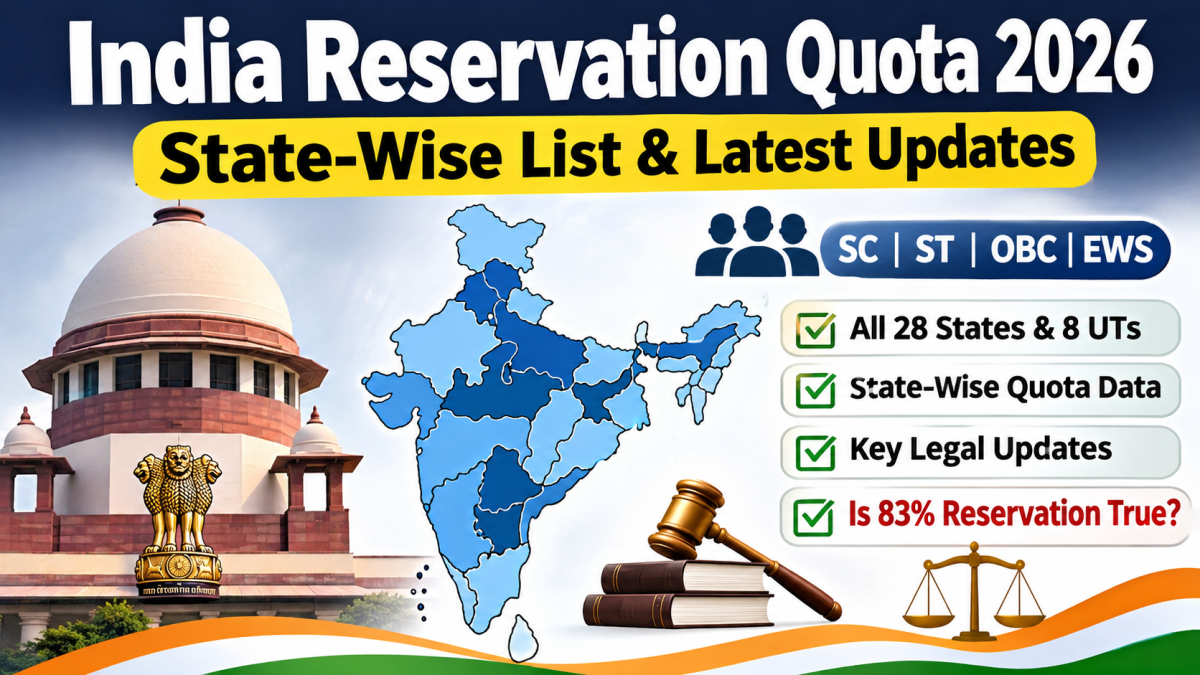
Also Read: India Reservation Quota 2026: State-Wise List
What Did the Supreme Court Decide About EWS Reservation?
On November 7, 2022, the Supreme Court delivered its judgment in Janhit Abhiyan v. Union of India, upholding the 103rd Constitutional Amendment by a 3:2 majority.
The petitioners had challenged the amendment on several grounds, including the use of economic criteria for reservation, the exclusion of SC, ST and non-creamy-layer OBC communities from EWS benefits, and the possibility that the additional 10% quota would take total reservation beyond 50%.
The majority rejected the constitutional challenge.
The judgment accepted that economic disadvantage could form the basis of a distinct reservation framework under Articles 15(6) and 16(6). It also held that the exclusion of communities already covered by the traditional social-reservation framework did not make the amendment unconstitutional.
On the 50% question, the majority concluded that the traditional ceiling could not simply be extended to invalidate the separate EWS provisions. The amendment created a distinct constitutional category, and the additional 10% reservation was not unconstitutional merely because the overall total exceeded 50%.
The decision did not abolish the traditional ceiling for SC, ST and OBC reservation. Instead, it upheld a separate constitutional arrangement for EWS.
What this means: A state cannot rely on the EWS judgment as unrestricted permission to raise every form of reservation above 50%. The case concerned a specific constitutional amendment and its distinct reservation category.
Read the Supreme Court’s judgment in Janhit Abhiyan.
The Maratha Reservation Case and the 50% Ceiling
Another landmark judgment is Jaishri Laxmanrao Patil v. Chief Minister, Maharashtra, decided on May 5, 2021.
The case concerned Maharashtra’s 2018 legislation providing separate reservation for the Maratha community. The law prescribed 16% reservation in education and public employment, which took the overall reservation beyond 50%.
The Supreme Court reaffirmed the importance of the ceiling recognised in Indra Sawhney and rejected the additional Maratha quota to the extent that it exceeded the limits recommended by the state commission.
The Court found that the state had not established the extraordinary circumstances required to justify crossing the 50% threshold in the manner proposed. It therefore set aside the additional reservation beyond the commission’s recommendations.
The judgment also considered the constitutional framework governing the identification of socially and educationally backward classes. Parliament subsequently enacted the 105th Constitutional Amendment in 2021, clarifying the power of states and Union Territories to prepare their own lists of socially and educationally backward classes for their purposes.
The Maratha case remains an important authority because it demonstrates that a state law does not become constitutionally valid simply because a legislature identifies a community as backward or adopts a higher reservation percentage.
Read the full Supreme Court judgment in Jaishri Laxmanrao Patil.
Can States Increase Reservation Beyond 50%?
There is no blanket constitutional permission allowing every state to increase reservation to 60%, 70%, 75% or any other percentage.
The general 50% principle continues to be significant in reservation matters governed by Articles 15(4), 15(5) and 16(4). A state seeking to go beyond the established ceiling must confront the applicable constitutional principles and judicial precedents.
The narrow exception recognised in Indra Sawhney concerns extraordinary situations. It is not an automatic exemption available whenever a state government announces that a community has a large population or demands additional representation.
The EWS ruling must also be considered separately. The Supreme Court upheld EWS reservation because it was created under specific constitutional provisions introduced by the 103rd Amendment. That judgment does not automatically validate unrelated increases in SC, ST or OBC quotas.
The legal status of an individual reservation law can also change through a court ruling, an appeal or an interim order. Therefore, any report about a proposed increase must identify the precise legislation and establish whether it is currently in force.
How Does the 50% Rule Apply to Local-Body Elections?
Reservation in panchayats and urban local bodies raises a distinct set of constitutional questions.
In Vikas Kishanrao Gawali v. State of Maharashtra, decided on March 4, 2021, the Supreme Court set out the conditions that states must ordinarily satisfy before providing reservation for OBCs in local-body elections.
The Court required a state to establish a dedicated commission to conduct a rigorous empirical inquiry into the nature and implications of backwardness in local bodies, determine the appropriate proportion of reservation for each local body in light of that inquiry, and ensure that the aggregate reservation for SCs, STs and OBCs does not exceed 50% of the total seats in the relevant local body.
The framework includes a narrow exception to safeguard Scheduled Tribe representation in panchayats situated in Scheduled Areas.
These requirements are often referred to as the triple test.
Importantly, the local-body framework cannot automatically be applied to government employment or university admissions. Different constitutional provisions and legal tests govern different forms of reservation.
Read the Supreme Court judgment in Vikas Kishanrao Gawali.
Important Supreme Court Reservation Judgments Explained
The following decisions help explain how India’s reservation framework has developed.
1. Indra Sawhney v. Union of India, 1992
This nine-judge decision established the leading 50% ceiling principle for reservation under Article 16(4), while recognising the possibility of carefully justified departures in extraordinary circumstances.
The Court also addressed OBC reservation, the exclusion of the creamy layer, and the relationship between affirmative action and equality of opportunity.
Its reasoning remains foundational to later challenges involving higher reservation percentages.
2. Jaishri Laxmanrao Patil v. Chief Minister, Maharashtra, 2021
The Supreme Court rejected the excess Maratha reservation provided under Maharashtra’s 2018 law because the state had not established the exceptional circumstances needed to justify the departure from the general ceiling.
The decision reaffirmed the importance of the 50% rule in social reservation and demonstrated that state reservation laws remain subject to constitutional scrutiny.
3. Janhit Abhiyan v. Union of India, 2022
The Court upheld the 103rd Constitutional Amendment by a 3:2 majority, validating the separate EWS reservation framework.
The ruling is particularly important because it explains why the additional 10% EWS allocation can take the combined central reservation above 50% without automatically invalidating the amendment.
4. State of Punjab v. Davinder Singh, 2024
On August 1, 2024, a seven-judge Constitution Bench ruled by a 6:1 majority that states may sub-classify Scheduled Castes for reservation purposes.
The case considered whether the Scheduled Castes should be treated as a single, indivisible group for allocating reservation benefits. The majority held that states could identify differences in the degree of disadvantage and inadequate representation within the wider Scheduled Caste category.
However, sub-classification must rest on a rational basis supported by relevant empirical material. The state must establish why the proposed distinction is necessary, and its decision remains open to judicial review.
The ruling did not give states unrestricted power to create separate quotas for every caste. It recognised a conditional power to address differences in disadvantage and representation within the Scheduled Castes.
The judgment is important because it shifts attention from the overall reservation percentage to the distribution of benefits within reserved categories.
Read the Supreme Court’s official summary of Davinder Singh.
5. Dr. Tanvi Behl v. Shrey Goel, 2025
On January 29, 2025, the Supreme Court considered residence-based reservation in postgraduate medical admissions.
The case concerned seats at Government Medical College and Hospital, Chandigarh. The Court held that residence-based reservation in postgraduate medical courses was impermissible, while recognising that a reasonable institutional preference for candidates who had completed their MBBS at the same institution could be valid.
The decision distinguished between undergraduate medical education, where a reasonable degree of residence-based preference may be permitted in appropriate circumstances, and postgraduate medical education, where the Court stressed the importance of merit.
This was not a direct ruling on the general 50% ceiling. It was a separate decision about equality of opportunity and permissible preferences in specialist medical education.
Read the Tanvi Behl judgment.
6. Union of India v. Rohith Nathan, 2026
A significant reservation-related judgment came on March 11, 2026, when the Supreme Court decided Union of India v. Rohith Nathan.
The dispute concerned the central government’s criteria for deciding whether children of parents employed in public-sector undertakings and private organisations fell within the OBC creamy layer.
Under the existing framework, creamy-layer status cannot be determined through an unrestricted calculation of family income alone. The nature and status of the parents’ employment, along with the relevant criteria prescribed by the government, are important.
The Court held that parental salary alone could not be mechanically used as the sole criterion for excluding a candidate from OBC reservation benefits in the circumstances before it. It also held that the government’s 2004 clarificatory letter could not override the substantive framework established by the 1993 Office Memorandum.
The judgment matters because it concerns who can qualify for OBC non-creamy-layer reservation, rather than the overall percentage allocated to the OBC category.
However, the implementation of the ruling remains an evolving issue. On September 24, 2026, the Supreme Court reserved judgment on the Centre’s request for clarification concerning its application to past and ongoing recruitments. The Centre raised concerns about the effect of retrospective implementation on completed selections, service allocations and related matters.
As of October 27, 2026, the latest published order located for this article showed the clarification matter as reserved for judgment. The March ruling should not be described as having been overturned.
Read the Supreme Court’s original Rohith Nathan judgment and the September 24, 2026 order.
7. Chaya v. State of Maharashtra, 2026
In another decision on March 23, 2026, the Supreme Court examined whether candidates from reserved categories who received relaxation in the qualifying Teachers Eligibility Test could compete for unreserved vacancies on the basis of their merit in the main selection examination.
The Court ruled that relaxation in the qualifying examination does not automatically prevent a candidate from moving into the open category. Where that relaxation only establishes eligibility, does not alter merit in the final selection, and the recruitment rules do not prohibit such movement, consideration in the open category may be permissible.
The ruling reinforces an important principle: an unreserved vacancy is not necessarily restricted to candidates from communities outside the reservation system.
However, the result depends on the applicable recruitment rules. The Court did not establish an unconditional right to migrate to the open category after every form of relaxation.
Read the Supreme Court’s Chaya judgment.
What Is the Difference Between Vertical and Horizontal Reservation?
Understanding this distinction helps avoid errors when comparing reservation percentages.
Vertical reservation refers to the principal category-based allocations, such as those for Scheduled Castes, Scheduled Tribes, OBCs and EWS under the relevant legal framework.
Horizontal reservation refers to provisions that operate across vertical categories, such as certain reservations for persons with disabilities and ex-servicemen, depending on the applicable rules.
The Supreme Court explained this distinction in Indra Sawhney. Horizontal reservations can intersect with vertical categories instead of necessarily being added to the overall reservation total in the same manner.
For instance, an eligible candidate with a disability may also belong to an SC, ST, OBC or open category. The applicable rules determine how that candidate is adjusted in the selection or admission process.
This is why adding every reservation percentage found in a recruitment notification may produce an inaccurate total. A proper calculation must identify the category, the legal basis and the method through which each reservation operates.
Does an Unreserved Seat Mean It Is Only for General-Category Candidates?
No. The terms “unreserved” and “general category” are often used interchangeably in public debate, but they do not always mean the same thing.
An unreserved or open seat is generally available to eligible candidates on merit, subject to the applicable recruitment rules. A candidate belonging to a reserved category who meets the relevant conditions and performs well enough may be selected against an open vacancy.
This principle is consistent with the reasoning in Indra Sawhney and has been applied in later decisions concerning selection and movement between categories.
The precise treatment of candidates who have used a relaxation in eligibility, however, depends on the applicable rules and the nature of that relaxation. The 2026 Chaya ruling illustrates why the distinction matters.
What These Judgments Mean for Higher Reservation Demands in 2026
The combined effect of these judgments is that reservation law in India must be examined through several separate questions.
First, what constitutional provision authorises the reservation? The EWS framework is different from the traditional provisions for SC, ST and OBC reservation.
Second, is the proposed percentage consistent with the applicable ceiling and judicial precedent? The general 50% principle remains important even though the law recognises distinct arrangements and narrowly defined exceptions.
Third, how will the benefits be distributed? The Davinder Singh decision demonstrates that the internal distribution of reservation benefits can itself raise constitutional questions.
Fourth, are eligibility criteria being applied consistently? The Rohith Nathan and Chaya decisions demonstrate the importance of examining the rules for creamy-layer exclusion, qualifying relaxations and open-category selection.
Finally, what is the current legal status of the measure? A bill, government announcement, enacted law, notification, interim order and final judicial decision are different things.
These distinctions are particularly important when reports claim that a state is increasing reservation to 65%, 75%, 83% or another figure. The number alone does not establish whether a proposal has been implemented, whether it applies to jobs or education, or whether it has survived judicial scrutiny.
Frequently Asked Questions
Is the 50% reservation limit still valid in India?
The 50% ceiling remains the general rule governing traditional social reservation under the relevant constitutional provisions. The Supreme Court recognised the possibility of narrowly justified exceptions, but they are not automatic. The EWS framework is separately governed by Articles 15(6) and 16(6).
Did the Supreme Court allow 60% reservation because of EWS?
The Supreme Court upheld the constitutional validity of the 10% EWS quota in Janhit Abhiyan in 2022. This allows total reservation under the applicable central framework to reach 59.5%. It does not establish a general permission for states to increase every category of reservation beyond 50%.
Can a state government introduce 75% or 83% reservation?
A state cannot make such an arrangement constitutionally valid merely by announcing it or passing a law. Its legality depends on the applicable constitutional provisions, judicial precedents, supporting evidence and any court orders affecting implementation. Each specific law must be examined separately.
What did the Supreme Court decide about OBC creamy-layer rules in 2026?
In Union of India v. Rohith Nathan, the Supreme Court held that parental salary alone could not be the sole basis for determining creamy-layer exclusion in the circumstances addressed by the judgment. In September 2026, the Court reserved judgment on the Centre’s request for clarification concerning implementation and its effect on past and ongoing selections.
Can an SC candidate be selected against an unreserved seat?
Yes, an eligible SC candidate can generally be selected against an unreserved vacancy on merit, subject to the applicable selection rules. Whether a candidate who has used a particular eligibility relaxation can migrate to the open category depends on the relevant rules and the nature of the relaxation.
Conclusion
India’s reservation framework continues to evolve through legislation, constitutional amendments and judicial decisions. The 50% ceiling remains a key principle in traditional social reservation, while the Supreme Court’s EWS judgment confirms that a separate constitutionally authorised reservation category can operate beyond that threshold.
The Maratha reservation case reaffirmed the need for states to justify departures from the general ceiling. The Davinder Singh decision permitted evidence-based sub-classification within Scheduled Castes. Meanwhile, the 2026 Rohith Nathan ruling has brought renewed attention to how OBC creamy-layer eligibility is determined and applied.
For policymakers, candidates and readers following reservation debates, the central lesson is to look beyond the headline percentage. The constitutional provision, the category covered, the legal evidence, the applicable rules and the latest court orders all matter.
The 50% rule remains an important constitutional benchmark, but understanding its exceptions and separate reservation frameworks is essential to accurately explain how reservation operates in India.
Join the Conversation