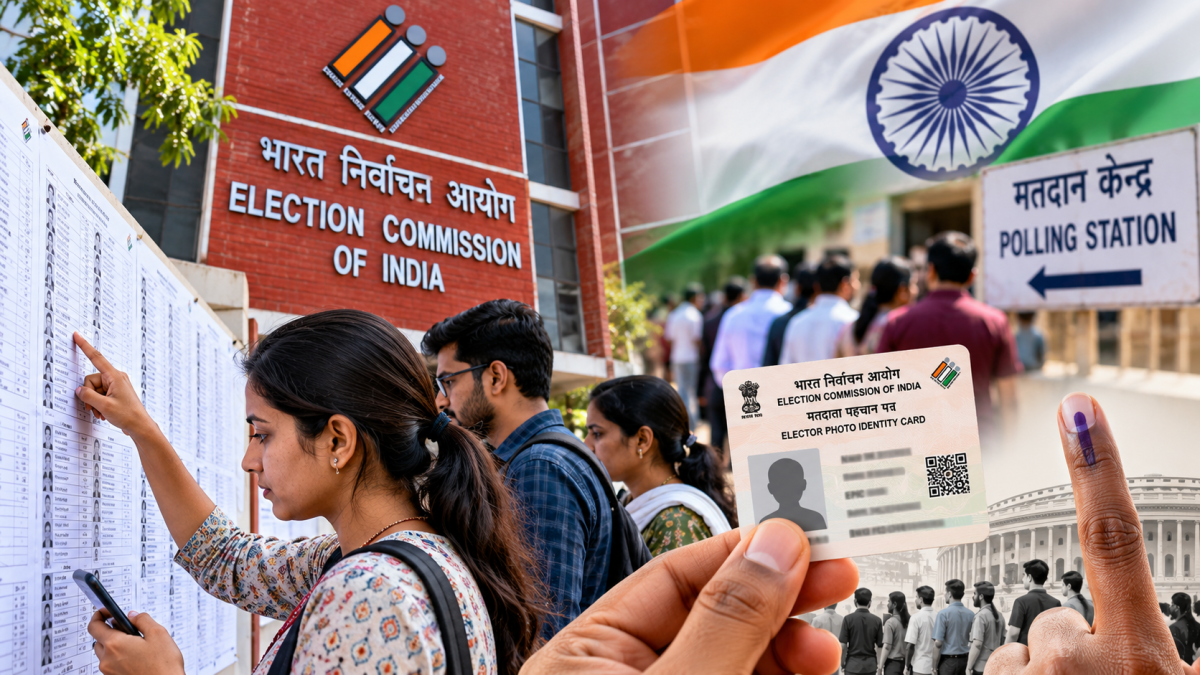
Voter List Revision in India 2026: Latest News, Election Commission Updates and What Voters Should Know
Voter List Revision in India 2026: The Election Commission of India (ECI) has announced a Special Summary Revision (SSR) of electoral rolls in 17 states and Union Territories, giving eligible citizens an opportunity to check their voter details, register as new voters and correct errors in the electoral roll.
The announcement, made on October 15, 2026, comes after the Election Commission's Special Intensive Revision (SIR) exercise became a major subject of political debate. The latest revision is particularly important for young voters, people who have recently moved, and eligible citizens whose names may be missing from the voter list.
According to the Election Commission's announcement, January 1, 2027, will be the qualifying date for voter eligibility under this revision. The exercise is intended to improve the accuracy of electoral rolls while ensuring that eligible citizens are included. The final schedule and applicable procedures should be checked through official election authorities.
For voters, the most important step is simple: check your name and personal details in the electoral roll rather than assuming that an old voter ID card automatically guarantees that your name appears on the current list.
Latest Voter List Revision News in India
The Election Commission announced a Special Summary Revision of electoral rolls across 17 states and Union Territories on October 15, 2026. The announcement was reported by public broadcaster Akashvani News on October 15 and 16.
The revision covers the following states and Union Territories:
-
Assam
-
Bihar
-
Chhattisgarh
-
Goa
-
Gujarat
-
Kerala
-
Madhya Pradesh
-
Manipur
-
Punjab
-
Rajasthan
-
Tamil Nadu
-
Uttar Pradesh
-
Uttarakhand
-
West Bengal
-
Andaman and Nicobar Islands
-
Lakshadweep
-
Puducherry
The Election Commission has stated that January 1, 2027, is the qualifying date for eligibility in this exercise. It has also directed officials to facilitate the enrolment of eligible citizens who may have been left out of the electoral rolls.
The latest announcement is significant because five of the states covered—Assam, Kerala, Tamil Nadu, West Bengal and Puducherry—are among the regions scheduled for Assembly elections in 2027. Accurate voter lists are an important part of election preparation.
Voters should not assume that every state will follow identical dates for each stage. They should check the schedule published by their respective Chief Electoral Officer (CEO) and local election authorities.
What Is the Special Summary Revision (SSR)?
A Special Summary Revision is a process used to update electoral rolls. It allows eligible citizens to apply for inclusion, correct errors and raise objections in accordance with the applicable election rules.
During the revision process, election officials work to identify eligible voters who are missing from the list and remove or correct entries where legally justified, such as records relating to deceased persons or voters who have permanently shifted.
The process also provides an opportunity to correct information such as a person's name, age, address or other electoral details.
The Election Commission's published guidance explains that draft electoral rolls are made available for public scrutiny and that claims and objections are processed before the final rolls are published.
The purpose is to maintain accurate electoral rolls while ensuring that eligible citizens have a proper opportunity to register and correct their details.
What Is the Difference Between SSR and SIR?
The terms Special Summary Revision (SSR) and Special Intensive Revision (SIR) have appeared frequently in recent news reports. Although both concern electoral rolls, they refer to different revision processes.
Special Summary Revision (SSR): This process updates existing electoral rolls through the prescribed revision procedure. Eligible citizens can seek inclusion, corrections and other permitted changes.
Special Intensive Revision (SIR): This is a more intensive exercise involving additional verification of electoral records. Its procedures can differ from those used during an ordinary or summary revision.
The distinction matters because the documentation, verification requirements and deadlines can depend on the particular exercise and the instructions issued for the relevant state.
The October 2026 announcement concerns the Special Summary Revision in 17 states and Union Territories. It should not be confused with the separate SIR exercise that has been the subject of political and legal debate.
Why Has Voter List Revision Become a National Political Issue?
The revision of electoral rolls has become a major political issue because the voter list determines who is registered to participate in an election.
Supporters of intensive verification argue that electoral rolls should be updated to identify duplicate entries, deceased voters and people who have permanently moved away. Accurate lists are important for maintaining public confidence in elections.
Opposition parties and other critics have raised concerns about the possible exclusion of eligible voters, the documentation required during the SIR exercise and the transparency of the process.
These concerns have become part of a wider debate about election administration and the protection of voting rights.
It is important to distinguish between an allegation and an established finding. Claims about wrongful deletions or political interference should be assessed against the relevant electoral records, official responses and judicial decisions.
The Election Commission's stated responsibility is to maintain electoral rolls that include eligible citizens and exclude ineligible entries in accordance with the law.
For ordinary voters, the practical response is to check their registration, follow official instructions and submit the appropriate application if a correction or inclusion is required.
How to Check Your Name in the Voter List Online
Voters can check their electoral registration through the Election Commission's official voter services website.
Follow these steps:
-
Visit the official Voters' Service Portal.
-
Look for the option to search the electoral roll or check voter details.
-
Search using the information requested on the portal, such as your personal details or Electoral Photo Identity Card (EPIC) number.
-
Select the relevant state and constituency if required.
-
Check that your name, address and other available details are correct.
-
If your name is missing or your information is incorrect, follow the instructions for submitting the appropriate application.
You can also contact your local Booth Level Officer (BLO) or Electoral Registration Officer (ERO) for assistance.
Important: A voter ID card and an entry on the current electoral roll are not the same thing. Before an election, check the current electoral roll to confirm your registration.
What Should You Do If Your Name Is Missing From the Voter List?
If your name does not appear in the electoral roll, do not assume immediately that you have permanently lost your registration.
First, check whether you have searched using the correct spelling, constituency and other details. If you have recently moved, your entry may be associated with your previous address.
If your name is genuinely missing, contact your local election office or BLO and ask which application and procedure apply to your circumstances.
Depending on the situation, an eligible citizen may need to submit an application for inclusion rather than a correction to an existing entry. The appropriate route can depend on the revision exercise and the status of the person's registration.
Keep a copy of the application reference or acknowledgement and follow up through the official portal or local election office.
Do not submit multiple applications without checking the status of an existing application, and do not provide personal documents to unofficial websites or unknown individuals claiming to offer voter-list services.
Which Form Is Required to Update Voter Details?
The Election Commission uses different forms for different electoral services. The correct form depends on what the voter needs to do.
Form 6: Application for Inclusion
Form 6 is generally used by eligible citizens applying for inclusion in the electoral roll, including eligible first-time voters.
If your name is missing, check with the election authorities whether Form 6 is the correct procedure for your circumstances.
Form 7: Objection or Deletion
Form 7 is used for specified objections to inclusion or requests for deletion of an entry, in accordance with the applicable rules.
It should not be used casually to challenge another person's registration without a valid basis.
Form 8: Correction or Other Permitted Changes
Form 8 is used for specified changes to an existing electoral entry, including corrections and other permitted services covered by the form.
Because the procedure can differ during an intensive revision exercise, voters should confirm the applicable instructions before submitting an application.
Forms and services can be accessed through the official Voters' Service Portal. The portal and local election authorities should be treated as the primary sources for current requirements.
Who Can Register as a Voter in India?
Indian citizens who meet the legal eligibility requirements can apply for registration in the electoral roll for the relevant constituency.
In general, a person must be an Indian citizen, satisfy the prescribed age requirement and meet the ordinary residence and other conditions applicable under election law.
The January 1, 2027, qualifying date announced for the latest revision is important for determining eligibility under this exercise.
Young people approaching the qualifying age should check the official registration instructions rather than waiting until an election is announced.
Citizens who have moved to a different address should also check whether their electoral registration needs to be transferred or updated through the prescribed process.
Registration is subject to verification and the applicable legal requirements. Submitting an application does not, by itself, guarantee that an entry has been approved.
What Should Voters in Uttar Pradesh and Uttarakhand Know?
Uttar Pradesh and Uttarakhand are both included in the 17 states and Union Territories covered by the latest Special Summary Revision announcement.
Residents should check their electoral registration through the official voter services portal and monitor announcements from their respective Chief Electoral Officers.
People who have recently changed residence, young citizens becoming eligible to vote and voters who previously had difficulty locating their names should pay particular attention to the published schedule.
If a name is missing, the voter should seek clarification from the local BLO or ERO and submit the appropriate application within the applicable period.
Voters should rely on official notices for the dates of draft-roll publication, claims and objections, and final-roll publication. They should not assume that the same deadlines apply in every state or at every stage of the revision.
How Does Voter List Revision Affect Upcoming Elections?
Accurate electoral rolls are an essential part of election preparation. They help election officials determine which eligible citizens are registered in each constituency.
The latest revision is particularly relevant to states preparing for Assembly elections in 2027. An updated roll can help identify new eligible voters, correct inaccurate records and address entries that require lawful removal or modification.
For citizens, the most immediate concern is ensuring that their registration is accurate and that any missing or incorrect information is addressed through the prescribed process.
For political parties and election observers, the process also raises questions about transparency, public access to electoral data and the handling of claims and objections.
The quality of the process depends not only on identifying errors but also on ensuring that eligible citizens have a meaningful opportunity to correct them.
Frequently Asked Questions About Voter List Revision 2026
1. Has the Election Commission announced a new voter list revision in 2026?
Yes. On October 15, 2026, the Election Commission announced a Special Summary Revision of electoral rolls in 17 states and Union Territories, with January 1, 2027, as the qualifying date.
2. Which states are included in the latest revision?
The announced list includes Uttar Pradesh, Uttarakhand, Bihar, Assam, West Bengal, Tamil Nadu, Kerala, Punjab, Rajasthan, Gujarat, Madhya Pradesh, Chhattisgarh, Goa and Manipur, along with Andaman and Nicobar Islands, Lakshadweep and Puducherry.
3. How can I check my name in the voter list?
Visit voters.eci.gov.in, use the voter-search service and check your registration details. You can also contact your local BLO or ERO.
4. What should I do if my name is missing?
Check your search details first. If your name is genuinely missing, contact the local election office and follow the prescribed procedure for inclusion. Form 6 is generally used for applications for inclusion, but you should confirm the rules that apply to your circumstances.
5. Is SSR the same as SIR?
No. SSR is a summary revision process for updating electoral rolls. SIR is a separate, more intensive verification exercise. The applicable procedures and requirements can differ.
6. Does having a voter ID card guarantee that my name is on the current voter list?
No. You should check the current electoral roll to confirm that your registration appears correctly.
7. Where can I find official voter-list updates?
Use the Election Commission's Voters' Service Portal and the official website of your state's Chief Electoral Officer for the relevant notices, forms and revision schedule.
Conclusion
The 2026 voter-list revision is an important development for eligible voters across India. The Election Commission's announcement covers 17 states and Union Territories and sets January 1, 2027, as the qualifying date for the Special Summary Revision.
For citizens, the most useful step is to verify their electoral registration, correct any errors and follow the official instructions if their names are missing. Young and first-time voters should also check their eligibility and complete the prescribed registration process in time.
The wider political debate over electoral-roll revisions will continue to involve questions of accuracy, transparency and the inclusion of eligible voters. Whatever their political views, citizens should use official information to verify their registration and understand the process.
This article reflects publicly reported information available as of October 18, 2026. Voters should check the latest notices from the Election Commission and their state election authorities for current dates and procedures.


Join the Conversation