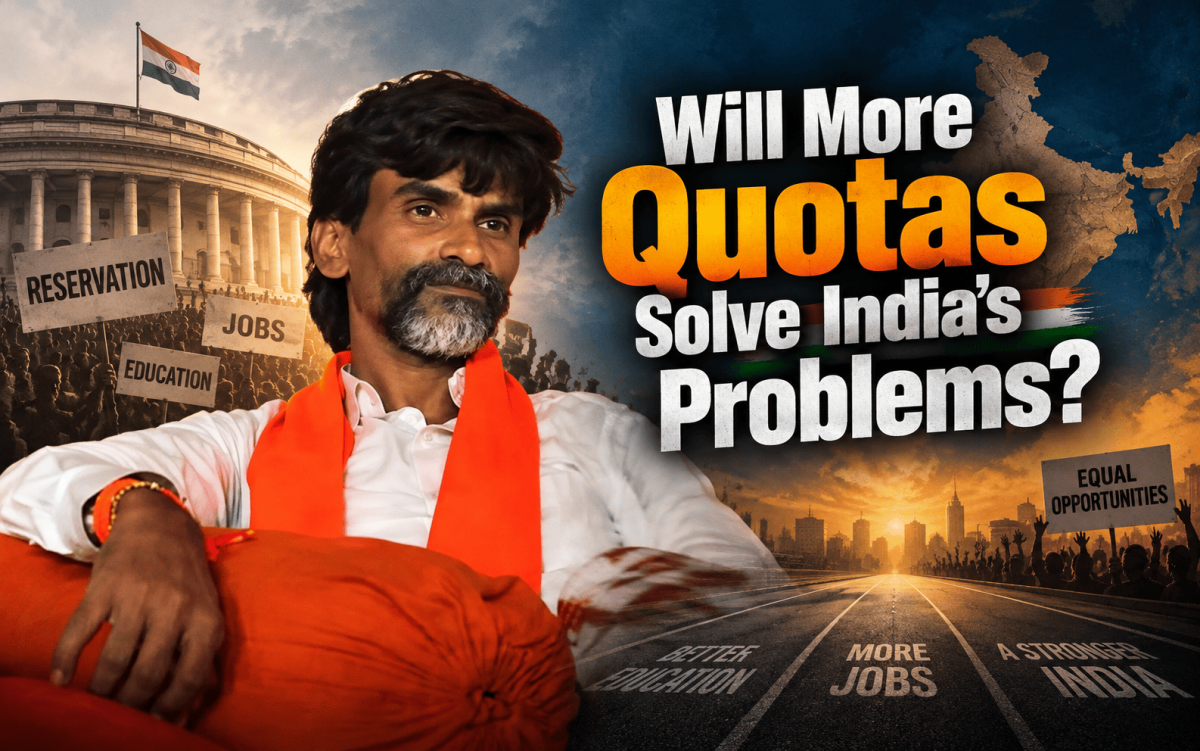
Maratha Reservation Debate: Can Quotas Solve India’s Unemployment Crisis?
Maharashtra’s Maratha reservation controversy raises a larer question for India: how can the country ensure social justice while creating enough quality education opportunities and jobs for its growing population?
Maharashtra’s long-running Maratha reservation debate is about more than a quota. It reflects the economic pressures facing farming families, the aspirations of young people, competition for government jobs and the continuing challenge of ensuring equal opportunities across society.
The controversy has also brought the interests of two communities into sharper focus. Maratha activists are demanding greater access to reservation benefits, including recognition of eligible Marathas as Kunbis. Meanwhile, OBC organisations have expressed concerns that expanding eligibility through Kunbi certificates could increase competition within the existing reservation framework.
At the centre of this debate is a difficult question: how can the government address genuine social and educational disadvantages without making access to a limited number of college seats and government jobs an increasingly competitive struggle?
There is another question that deserves equal attention. Can reservation alone address unemployment, poor educational outcomes and the economic difficulties faced by millions of Indian families?
The answer requires a closer look at Maharashtra’s reservation history, the legal framework and the wider challenges facing India’s education and employment systems.
What Is Behind the Maratha Reservation Controversy?
To understand the current debate, it is important to distinguish between two separate issues: the demand for a dedicated Maratha reservation and the demand to recognise eligible members of the Maratha community as Kunbis.
1. The separate Maratha reservation
In February 2024, the Maharashtra government enacted the Maharashtra State Reservation for Socially and Educationally Backward Classes Act, 2024.
The law provides 10% reservation for the Socially and Educationally Backward Classes in educational institutions and direct recruitment to state government posts. It establishes a separate reservation category rather than simply adding eligible Marathas to the existing OBC category.
However, the law has faced constitutional challenges. As reported by The Indian Express in July 2026, the Bombay High Court was examining its validity, including questions surrounding the constitutional reservation ceiling and the evidence used to establish backwardness.
The legal position is important because a state government’s decision to introduce a reservation does not, by itself, settle whether the measure will withstand judicial scrutiny.
2. The demand for Kunbi certificates
The second issue concerns historical records that may establish Kunbi status for eligible individuals.
Kunbi is recognised within Maharashtra’s OBC framework. If a person establishes eligibility under the applicable rules and receives a valid certificate, that recognition can provide access to benefits available to the relevant category.
The Maharashtra government has cited the identification of approximately 58 lakh Kunbi records in connection with this process. However, the number of records should not automatically be interpreted as the number of people who have already received certificates or become eligible for OBC benefits.
That distinction matters.
Historical records must be examined, eligibility must be established and certificates must be issued according to the applicable legal and administrative procedures. The process should be transparent enough to protect eligible applicants while maintaining confidence in the reservation system.
For OBC communities, the concern is that a significant expansion of the eligible population could affect competition for opportunities within an existing framework. For Maratha families, the demand is connected to historical documentation and access to benefits they believe they are entitled to receive.
Both concerns need to be examined through evidence, law and transparent administration rather than assumptions about entire communities.
How Maharashtra Reached This Point
The Maratha reservation controversy has developed over more than a decade. Understanding its history helps explain why the issue continues to generate strong public reactions.
2014: The first major reservation law
Maharashtra introduced a separate reservation measure for the Maratha community in 2014. The law was challenged in court, and its implementation faced legal obstacles.
The dispute established a pattern that has continued since then: political demands for reservation have repeatedly collided with constitutional requirements.
2016–2017: A major public movement
The Maratha Kranti Morcha organised a series of large demonstrations across Maharashtra. The movement became one of the most significant reservation-related mobilisations in the state.
The demands centred on access to education, government employment and recognition of the community's social and economic difficulties.
The scale of the protests demonstrated how deeply employment insecurity and educational aspirations had become connected to the reservation debate.
2018: Maharashtra introduces a 16% quota
The Maharashtra government subsequently enacted legislation granting 16% reservation to the Maratha community, relying on findings from the State Backward Class Commission headed by M. G. Gaikwad.
The commission examined social, educational and economic conditions within the community. Its findings were cited as evidence of difficulties affecting sections of Maratha society, including agricultural dependence, limited landholdings and educational disadvantage.
These concerns deserve serious consideration. Families dependent on small farms can face unstable incomes, rising costs and limited access to alternative employment. Young people from such households may struggle to afford higher education or prepare for competitive examinations.
However, evidence of economic hardship and the legal criteria for reservation are not identical questions. A policy must address both.
2021: The Supreme Court strikes down the 2018 law
In Jaishri Laxmanrao Patil v. State of Maharashtra, the Supreme Court struck down the 2018 Maratha reservation law in May 2021.
The Constitution Bench held that the circumstances established in the case did not justify exceeding the established 50% reservation ceiling. It also found that the evidence did not satisfy the applicable constitutional standard for treating the Maratha community as inadequately represented in public employment.
The judgment reinforced an important principle: reservation policies must be supported by evidence and comply with constitutional requirements.
At the same time, the ruling did not mean that economic hardship among Maratha families was imaginary or unimportant. It meant that the particular legal basis used for the 2018 quota did not meet the required constitutional standards.
2024: A new 10% reservation law
Maharashtra enacted a new law in February 2024, providing 10% reservation for the Maratha community under the SEBC category.
The state relied on a fresh assessment of the community's social, educational and economic circumstances. Opponents have challenged the law, and the constitutional issues have continued before the Bombay High Court.
As of the reporting available in July 2026, the litigation remained an important part of the dispute.
The continuing legal proceedings demonstrate why the debate cannot be reduced to a simple argument between supporters and opponents of reservation. It involves questions of evidence, representation, equality and the limits of state power.
The Bigger Question: What Problem Are We Trying to Solve?
Imagine a young person from a farming family who wants to pursue higher education and secure a stable job.
The family may be struggling with an uncertain agricultural income, limited savings and the rising cost of education. The student may face difficulties paying college fees, accessing quality coaching or preparing for competitive examinations.
What does that young person need?
A fair opportunity to compete for educational and employment opportunities is certainly important. Where constitutionally justified, reservation can be one instrument for improving access.
But the student's needs do not end there.
They may also need:
-
A good school with qualified teachers.
-
Affordable and accessible higher education.
-
Scholarships and financial assistance.
-
Practical skills and professional training.
-
Access to technology and digital learning.
-
Internships and employment opportunities.
-
A growing economy that creates productive jobs.
Reservation can influence access to existing opportunities. It cannot, on its own, create additional colleges, improve teaching standards or generate thousands of new jobs.
That is why the national debate should consider both access to opportunities and the number and quality of opportunities available.
India Has Expanded Higher Education, but Access Is Only Part of the Story
India has made considerable progress in expanding higher education.
According to the Ministry of Education's All India Survey on Higher Education (AISHE) 2021–22, total enrolment reached approximately 4.33 crore students, compared with 3.42 crore in 2014–15. The figures demonstrate a substantial increase in participation over that period.
The government has also published the AISHE final reports for 2022–23 and 2023–24, providing more recent material for examining changes in the higher education system.
Sources: Ministry of Education — AISHE 2021–22 and AISHE final reports.
However, rising enrolment does not automatically translate into better learning outcomes or employment.
A student may complete a degree without developing the communication, analytical, technical or practical skills required by employers. Another may possess the necessary skills but struggle to find work because suitable jobs are not available nearby.
These problems require different solutions.
Schools need stronger foundational learning. Colleges need relevant curricula, capable faculty and better connections with industry. Students need career guidance, practical experience and access to emerging technologies.
The goal should not be simply to increase the number of students receiving degrees. It should be to ensure that education equips them to build productive and independent lives.
Reservation and Merit: Why India Needs a More Informed Debate
Discussions about reservation frequently become arguments about merit. Yet merit cannot be examined independently of the circumstances in which people study, prepare and compete.
A student who attends a well-equipped private school and receives years of coaching may have advantages over someone who studies in an under-resourced school while helping their family earn a living.
Recognising these differences does not mean abandoning standards. It means acknowledging that educational opportunity is shaped by access to resources, social conditions and the quality of schooling.
Reservation is one constitutional instrument intended to address specified forms of disadvantage. It should be assessed according to its legal purpose, the evidence supporting it and the outcomes it produces.
At the same time, India should strengthen the educational system available to all children.
A child should not have to wait until adulthood to discover that inadequate schooling has limited their options. Improving public education, providing financial assistance and making quality coaching more accessible can help address disadvantages much earlier.
The objective should be to widen opportunity while maintaining fair, transparent and constitutionally sound selection processes.
The Agricultural Distress Behind the Maratha Debate
The reservation controversy also reflects the economic pressures experienced by parts of Maharashtra's rural population.
For a family dependent on agriculture, income can be affected by rainfall, crop prices, input costs, debt, irrigation facilities and access to markets. Small or fragmented landholdings can make it difficult to generate a reliable income.
When farming becomes financially uncertain, a government job can appear to offer something increasingly valuable: a regular salary, greater stability and the possibility of supporting the entire household.
That helps explain why government employment remains such an important aspiration for many young people.
However, agricultural distress cannot be resolved through reservation alone.
A broader rural development strategy would need to consider:
-
Better irrigation and water management.
-
Improved access to agricultural technology.
-
Reliable storage, transport and market infrastructure.
-
Food processing and value-added agricultural businesses.
-
Affordable credit and appropriate financial support.
-
Rural industries and small-business development.
-
Vocational training and employment beyond farming.
Reservation may help eligible individuals access particular educational and employment opportunities. Rural development can address a wider set of economic pressures affecting families and communities.
These approaches should complement one another rather than being treated as competing alternatives.
India's Employment Challenge Extends Beyond Government Jobs
One of the central issues in the reservation debate is the limited number of government positions relative to the number of people seeking secure employment.
Government jobs offer important benefits, including regular salaries, defined service conditions and opportunities for public service. Competition for these positions is therefore understandable.
But government recruitment alone cannot meet the employment aspirations of India's entire workforce.
The country also needs productive employment across manufacturing, healthcare, education, construction, logistics, tourism, information technology, electronics, renewable energy, food processing and other sectors.
Small businesses and emerging enterprises also have an important role to play.
Creating these opportunities requires investment, reliable infrastructure, access to finance, effective education and training, and a business environment in which enterprises can grow and hire workers.
A young person should be able to build a secure future through several legitimate career paths, rather than feeling that a single competitive examination offers the only respectable route to success.
This does not diminish the importance of government employment. It recognises that a diverse economy can provide opportunities to a much larger number of people.
Five Areas Where India Can Make Progress
The Maratha reservation debate offers an opportunity to examine a wider set of policy priorities.
1. Make reservation policy evidence-based
Reservation decisions should rely on credible and current evidence of social and educational backwardness, representation and the relevant constitutional requirements.
Governments should explain their findings clearly and ensure that policies can withstand legal scrutiny.
Transparent administration is essential for public confidence.
2. Improve the quality of government schools
Access to education means little if students do not receive a strong educational foundation.
Schools need qualified teachers, adequate classrooms, libraries, laboratories, digital resources and effective learning support.
Students from rural and disadvantaged backgrounds should have a genuine opportunity to prepare for higher education and competitive examinations.
3. Connect education with employable skills
Colleges and training institutions should help students develop practical capabilities alongside academic knowledge.
Internships, apprenticeships, technical education, communication skills and digital literacy can help students prepare for employment.
Training programmes should also be evaluated by whether they lead to meaningful employment, not merely by how many people complete them.
4. Encourage job creation across the economy
India needs more productive employment in both the public and private sectors.
Manufacturing, infrastructure, healthcare, renewable energy, tourism, technology and food processing can all contribute to employment growth when supported by suitable investment and skills development.
The government should also consider the needs of small businesses, which can provide employment closer to where people live.
5. Provide targeted support to families facing disadvantage
Scholarships, affordable hostels, healthcare, nutrition, educational assistance and access to credit can help families overcome specific barriers.
Support should be designed according to its purpose, with clear eligibility criteria and safeguards against exclusion or misuse.
Social disadvantage, educational deprivation and economic hardship can overlap, but they are not always identical. Policies should recognise those differences.
Four Questions Maharashtra's Debate Raises for India
First: If reservation opportunities expand, what is being done to improve the quality and availability of education and employment?
A reservation policy can change access to available seats. Expanding the number of high-quality institutions and productive jobs addresses a different part of the problem.
Second: Are reservation decisions supported by reliable, updated evidence?
Governments need to distinguish between political demands, economic hardship, historical documentation and the legal criteria required to establish eligibility.
Third: How can students from disadvantaged backgrounds receive better preparation before they compete for limited opportunities?
Improving school education, scholarships, digital access and affordable coaching can help address inequalities before students enter higher education or the job market.
Fourth: Why should young people have to view one another primarily as competitors for a limited number of government jobs?
The question is not whether competition can be eliminated. It is whether India can expand the range of opportunities available to young people, allowing them to pursue different careers and contribute to economic growth.
These questions do not settle the legal or political dispute over Maratha reservation. They help place it within the broader challenge of building a more inclusive economy.
Social Justice and Economic Development Must Work Together
There is no necessary contradiction between supporting social justice and investing in economic development.
A society can recognise historical disadvantages while also improving public education, strengthening healthcare, expanding employment and supporting rural incomes.
The challenge is to ensure that these policies work together.
Reservation cannot replace good schools. Economic growth cannot automatically eliminate social discrimination. Skill development cannot compensate for every structural barrier. And new jobs alone will not guarantee that every community has fair access to them.
Each intervention addresses a different problem.
For this reason, public policy should be judged not only by the number of seats allocated under a particular category but also by whether disadvantaged people gain meaningful access to education, employment and a better standard of living.
The Maratha controversy also demonstrates the importance of reliable data and transparent communication. When communities believe that opportunities are scarce or that the system treats them unfairly, mistrust can deepen. Clear eligibility rules, credible assessments and consistent implementation can help reduce uncertainty.
The Real Measure of Progress
For many young Indians, the future still appears closely tied to competitive examinations, government recruitment and the hope of securing a stable income.
That aspiration is understandable. But it also raises a larger question about the opportunities the country is creating.
A young person should be able to become a teacher, engineer, entrepreneur, researcher, healthcare professional, skilled worker or civil servant without believing that only one career path offers a dignified life.
Achieving that requires better schools, stronger universities, affordable education, useful skills, growing industries and more productive employment.
It also requires policies that recognise genuine disadvantage and comply with constitutional principles.
The debate over Maratha reservation should therefore be approached with an understanding of both its immediate demands and its wider implications. Eligible individuals must be assessed according to the law. Communities' concerns deserve careful examination. And governments must continue working on the economic and educational problems that reservation alone cannot solve.
Conclusion: Expanding Opportunity Must Remain a National Priority
The Maratha reservation controversy is a reminder that India's development challenges are closely connected. Social justice, educational access, agricultural distress and employment cannot be addressed effectively in isolation.
Reservation can remain an important instrument for correcting recognised disadvantage, provided that the relevant constitutional and legal requirements are met. At the same time, India needs sustained investment in education, skills, rural development and job creation.
The country should not have to choose between fairness and growth. It needs policies that advance both.
Ultimately, progress should be measured by whether people from different backgrounds can access quality education, develop their abilities and earn a dignified living.
The goal is not to dismiss reservation or suggest that it has no continuing role. It is to ensure that reservation operates alongside a wider effort to expand opportunity.
Because a more inclusive India will need both a fair system of access and an economy capable of creating more opportunities for everyone.
Sources and further reading
-
The Indian Express — Bombay High Court examines Maharashtra's 2024 Maratha reservation law
-
Supreme Court of India — Jaishri Laxmanrao Patil v. State of Maharashtra (2021), judgment text
-
Ministry of Education, Government of India — All India Survey on Higher Education, final reports
-
Ministry of Education, Government of India — AISHE 2021–22 enrolment figures
Editorial note: The status of protests, certificate issuance and court proceedings can change. Verify the latest official position before publishing time-sensitive claims.

Join the Conversation