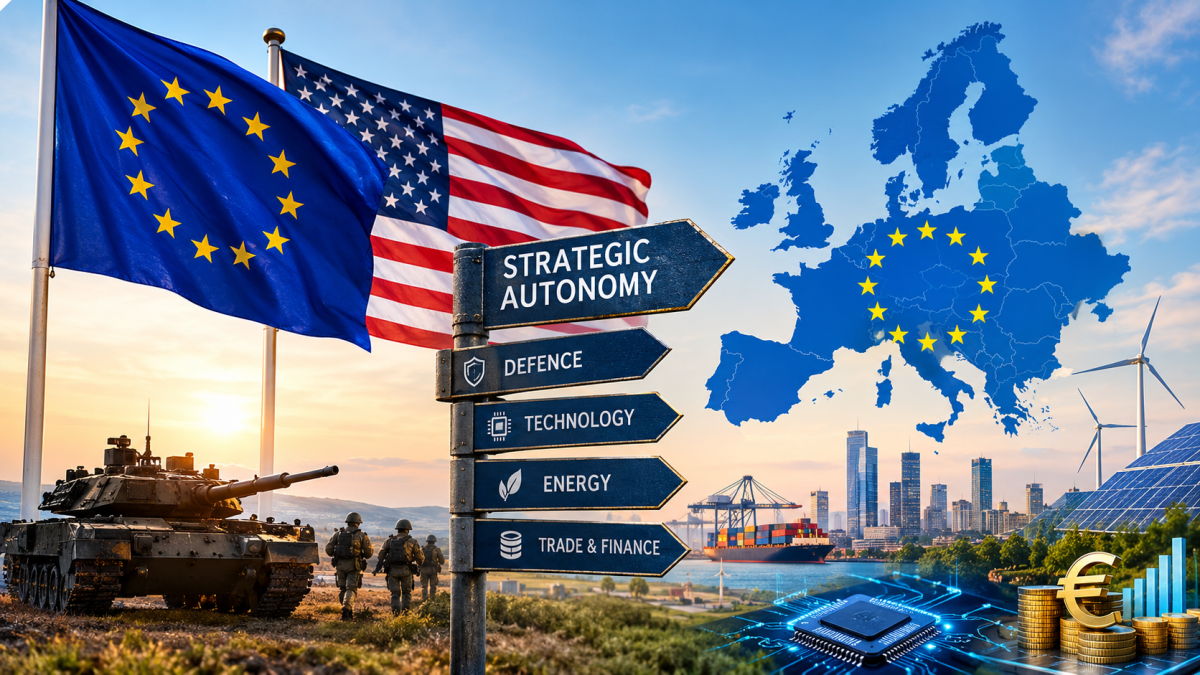
Europe’s Strategic Autonomy: Can It Reduce Dependence on the US?
Europe is reassessing its relationship with the United States as geopolitical tensions, technological competition and uncertainty over future security commitments reshape international relations. For decades, American military power, technology companies and financial influence have played a central role in Europe's security and economic development. However, growing concerns about excessive dependence have strengthened calls for European strategic autonomy.
Strategic autonomy means the ability to protect essential interests, make independent decisions and respond to international challenges without relying excessively on external powers. For the European Union (EU), the objective is not to abandon cooperation with Washington but to ensure that Europe has credible alternatives when its interests are at stake.
The central question is whether Europe can achieve greater independence while preserving the economic and security benefits of its transatlantic partnership.
1. Why Is Europe Seeking Strategic Autonomy?
Changing Geopolitical Priorities
The United States remains a major security partner for European countries through the North Atlantic Treaty Organization (NATO). Nevertheless, shifting American political priorities have encouraged European governments to reconsider whether their current arrangements provide sufficient long-term security.
Russia's war against Ukraine has also demonstrated the importance of military preparedness, defence production and reliable access to critical resources. Meanwhile, competition between the United States and China has increased pressure on Europe to protect its economic and technological interests.
Key factors driving Europe's strategic autonomy agenda include:
• Security uncertainty: Europe wants stronger defence capabilities and greater capacity to respond to crises.
• Economic vulnerability: Dependence on concentrated supply chains can expose European industries to disruption.
• Technological competition: Reliance on foreign digital infrastructure raises concerns about cybersecurity and competitiveness.
• Energy security: Diversified energy supplies can reduce exposure to external shocks.
• Diplomatic independence: European countries want greater influence over decisions affecting their regional and global interests.
Strategic autonomy is therefore becoming a broader economic and political objective, rather than simply a defence policy.
2. Military Security and Capabilities: Can Europe Protect Itself?
Strengthening European Military Capabilities
Defence is among the most challenging areas in which Europe could reduce its dependence on the United States. Although European countries possess advanced militaries and significant economic resources, their capabilities remain divided across national systems and procurement programmes.
The United States provides important capabilities, including intelligence, strategic transport, aerial refuelling and elements of NATO's nuclear deterrence. Replacing these capabilities would require substantial investment and closer coordination between European governments.
Europe's defence priorities include:
• Expanding ammunition and military equipment production.
• Improving air and missile defence systems.
• Strengthening intelligence-sharing and military coordination.
• Increasing joint procurement and reducing unnecessary duplication.
• Investing in drones, cybersecurity and advanced defence technologies.
Persistent Obstacles to European Strategic Autonomy
Higher defence spending alone will not guarantee military independence. European governments must coordinate procurement, address capability gaps and agree on common strategic priorities.
Political disagreements and differences in national security requirements may slow progress. Consequently, Europe is more likely to strengthen its ability to act independently over time than to replace the American security contribution completely in the near future.
3. Technological Sovereignty: Advancing Europe’s Digital and Innovation Capabilities. Europe is strengthening its technological sovereignty by investing in artificial intelligence, semiconductor manufacturing, cloud computing, and advanced digital infrastructure. Through research, innovation, and the development of domestic technological capabilities, the European Union aims to enhance its global competitiveness, reduce reliance on external technology providers, and establish a resilient digital economy that supports long-term strategic independence.
Building European Digital Capacity
American companies occupy influential positions in cloud computing, enterprise software, artificial intelligence and digital services. European businesses and public institutions rely on many of these technologies, making rapid substitution difficult.
This dependence offers access to advanced products but can create risks involving data governance, cybersecurity, market concentration and technological competitiveness.
Europe can strengthen its position by:
• Supporting semiconductor research and manufacturing.
• Developing competitive European cloud and artificial intelligence capabilities.
• Investing in cybersecurity and secure digital infrastructure.
• Helping European technology startups expand internationally.
• Strengthening research partnerships between universities and businesses.
However, developing European alternatives requires substantial investment, skilled workers and competitive products. Regulation alone cannot create globally successful technology companies.
The objective should be to provide reliable alternatives, not automatically exclude American technology. Europe would gain greater autonomy if businesses and governments could choose between competitive providers without becoming locked into a single ecosystem.
4. Energy Security: Diversification Over Dependence
Building a More Resilient Energy System
Europe's experience following Russia's invasion of Ukraine highlighted the economic risks associated with concentrated energy supplies. Diversification has since become an important part of its wider security agenda.
However, replacing one dominant supplier with another would not necessarily eliminate vulnerability. Long-term energy security requires a combination of diversified imports, domestic production, infrastructure and efficiency.
Important priorities include:
• Expanding renewable energy production.
• Modernising electricity grids and cross-border connections.
• Investing in energy storage and efficiency.
• Diversifying imports of essential energy resources.
• Supporting research into emerging energy technologies.
Europe must also balance energy security with affordability and environmental objectives. Excessively high energy costs can weaken industrial competitiveness, making investment and infrastructure development essential.
Strategic autonomy in energy should therefore mean having reliable options and greater resilience, rather than complete independence from international markets.
5. Trade and Finance: Protecting Europe's Economic Interests
Reducing Critical Supply-Chain Risks
The European Union and the United States maintain extensive trade and investment relationships. These connections support employment, innovation and economic growth, but they can also expose businesses to political disagreements and international disruptions.
Completely separating the two economies would be costly and impractical. A more realistic approach is to identify critical vulnerabilities and diversify the supply of essential goods.
Europe can strengthen economic resilience by:
• Diversifying sources of critical raw materials.
• Supporting domestic production where security considerations justify it.
• Developing trade relationships with reliable international partners.
• Improving recycling and material recovery.
• Maintaining strategic reserves of selected essential goods.
This targeted approach would reduce exposure to external pressure without sacrificing the benefits of global trade.
Strengthening the Euro's International Role
The euro gives Europe an important financial advantage, but the US dollar remains central to global trade and finance. A stronger international role for the euro could increase Europe's financial flexibility and reduce some vulnerabilities.
Achieving this would require deeper capital markets, attractive investment opportunities, confidence in European institutions and stronger financial integration.
Europe can expand its financial influence, but replacing the dollar's global position is not a realistic short-term objective.
6. Political Unity: Europe's Biggest Test
Different Interests, Shared Challenges
European countries do not always agree on defence spending, relations with Washington, trade policy or responses to international crises. Differences in geography, political priorities and historical experience can complicate collective decisions.
Nevertheless, strategic autonomy does not require every member state to hold identical views. It requires sufficient agreement to coordinate action where common interests exist.
European cooperation could deliver several benefits:
• Reducing duplication in defence procurement.
• Creating larger markets for European technology companies.
• Improving responses to economic and security emergencies.
• Strengthening Europe's negotiating position internationally.
• Making better use of collective financial and industrial resources.
Greater coordination would allow Europe to turn its combined economic strength into greater strategic influence.
7. What Should Europe Aim to Achieve by 2030?
A Practical Roadmap
By 2030, Europe could make substantial progress towards strategic autonomy if governments maintain investment and improve cooperation. However, the results will differ across defence, technology, energy and finance.
The most important priorities should be:
• Defence readiness: Expand production capacity and address critical military capability gaps.
• Technological competitiveness: Invest in research, digital infrastructure and advanced computing.
• Energy resilience: Diversify supplies and strengthen domestic clean-energy production.
• Economic security: Reduce dependence on concentrated sources of essential goods.
• Financial strength: Improve capital markets and support the international role of the euro.
• Political coordination: Establish clear priorities and improve cooperation between member states.
Progress should be measured by Europe's ability to withstand disruptions, maintain essential services and make independent decisions—not simply by how many American products it replaces.
Conclusion
Europe's strategic autonomy is an increasingly important objective in a world shaped by geopolitical competition and economic uncertainty. The European Union has the financial resources, industrial capacity and scientific expertise to reduce critical dependencies on the United States. However, achieving meaningful progress will require sustained investment, political coordination and realistic expectations.
Defence and technology will remain particularly challenging because American capabilities and companies are deeply integrated into Europe's security and economy. Energy diversification, stronger supply chains and deeper financial markets can also improve resilience.
Europe's goal should not be separation from the United States, but a stronger partnership built on greater European capability. By developing credible alternatives and addressing its most serious vulnerabilities, Europe can cooperate with Washington while retaining more freedom to act independently when necessary.
Sources
1. "European Council — European Defence and Security" (https://www.consilium.europa.eu/)
2. "European Commission — Strategic Priorities and Policies" (https://commission.europa.eu/)
3. "NATO — Collective Defence and Transatlantic Security" (https://www.nato.int/)
4. "Chatham House — International Affairs and European Security Analysis" (https://www.chathamhouse.org/)
Join the Conversation