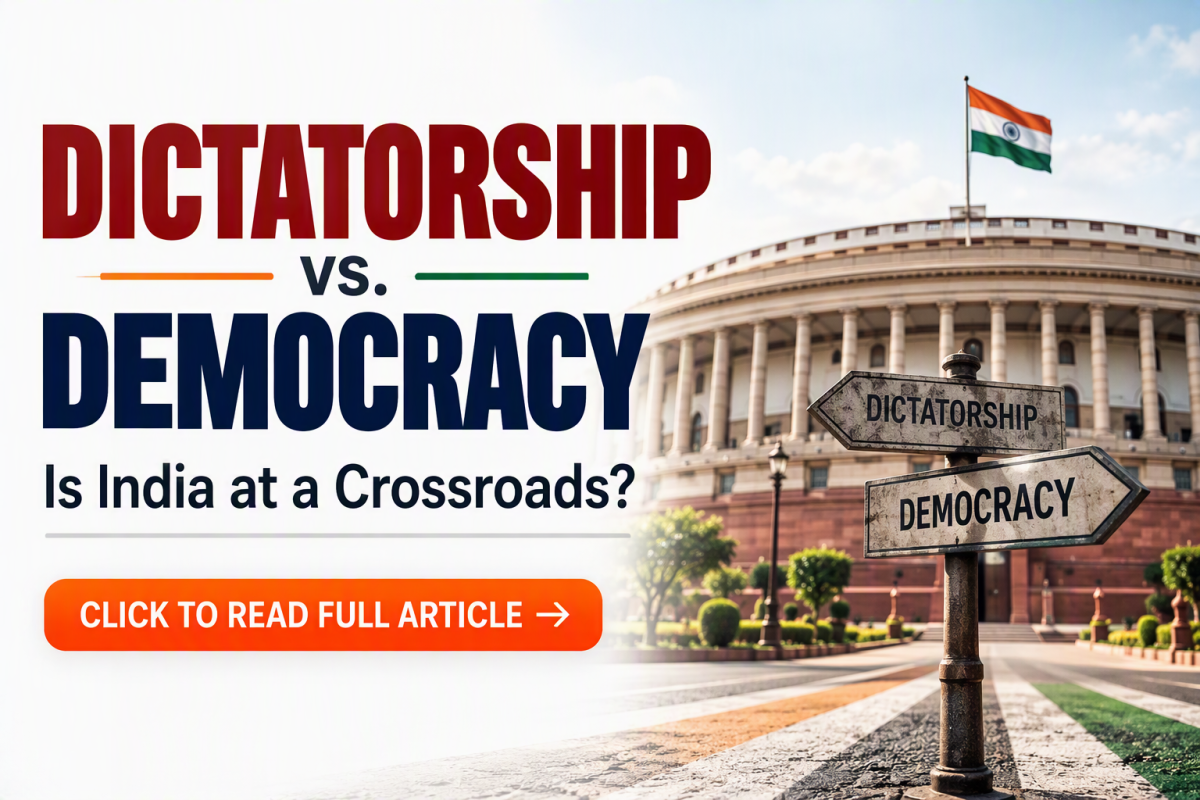
The debate over dictatorship vs. democracy matters worldwide, especially in India. The world's largest democracy faces difficult questions about political power, civil liberties, economic development, and institutional independence.
Can India achieve strong leadership without sacrificing democratic freedoms? Let's try to find out the solution.
1. Dictatorship vs. Democracy: Understanding the Difference
A democracy allows citizens to choose their representatives through elections. Independent institutions, free expression, and legal protections help limit government power.
A dictatorship concentrates authority in a leader or ruling group. Opposition parties, independent media, and public criticism may face severe restrictions.
2. India: A Democracy Facing Difficult Questions
India remains a constitutional parliamentary democracy, with regular elections, competing political parties, and a written Constitution. Calling India a dictatorship as a statement of established fact would misrepresent its political system.
However, asking whether India shows authoritarian tendencies is a legitimate subject for political analysis. Concerns about press freedom, dissent, institutional independence, and the treatment of opposition voices deserve careful examination.
Both perspectives deserve examination against evidence rather than slogans. Elections matter, but democracy also requires civil liberties, fair competition, independent institutions, and genuine opportunities to challenge government decisions.
"India's democratic strength ultimately depends on more than counting votes. It also depends on whether citizens, journalists, courts, and opposition parties can question those who govern."
3. What History Teaches Us About Strong Leadership
Consider China, where the Communist Party maintains one-party rule. Its extraordinary economic transformation lifted hundreds of millions of people out of extreme poverty over several decades.
Yet China's growth cannot be attributed to authoritarianism alone. Market reforms, investment, global trade, education, and industrial development played crucial roles. Political restrictions also limit independent opposition and public criticism.
Singapore offers a more complicated comparison. It has achieved high incomes, effective public administration, and strong public services. However, its political environment differs from that of liberal multiparty democracies.
India and the United States illustrate another trade-off. Competitive elections and constitutional institutions create channels for peaceful political change. Yet polarization, bureaucratic delays, and policy reversals can complicate governance.
Economic success does not prove that dictatorship is superior. Nor does holding elections automatically guarantee prosperity, justice, or competent leadership.
Winston Churchill observed that:
"democracy was the worst form of government, except for the alternatives tried. His remark captured democracy's imperfections without dismissing its value."
The central lesson is straightforward: governments need both the capacity to act and the ability to correct mistakes.
4. Democracy vs. Dictatorship: A Direct Comparison
| Parameter | Democracy | Dictatorship |
|---|---|---|
| Political power | Distributed through elections and institutions | Concentrated in a ruler or ruling group |
| Citizen freedom | Generally protected by constitutional rights | Often restricted, depending on the regime |
| Decision-making | Can be slower because of consultation | Can be faster because fewer actors decide |
| Accountability | Elections, courts, media, and legislatures provide checks | Accountability to citizens is often limited |
| Economic growth | Depends on policy, institutions, and investment | Can support rapid growth, but outcomes vary |
| Political stability | Peaceful transitions are possible | Leadership changes can be unpredictable |
| Human rights | Rights have legal protections, though violations occur | Abuses may be harder to challenge independently |
| Policy continuity | Elections can change priorities | Centralized leadership may sustain long-term plans |
The comparison reveals an important distinction. Speed is not the same as effectiveness, and stability is not the same as justice.
A dictator may approve a project quickly, but weak oversight can allow corruption or costly errors. A democracy may debate longer, but public scrutiny can expose problems before they become irreversible.
Neither system guarantees good government. Institutions, leadership quality, public participation, and the rule of law shape actual outcomes.
5. The Economic Question: Does Dictatorship Deliver More?
Concentrated power also creates risks. Leaders may suppress bad news, reward loyalists, or pursue projects without meaningful public scrutiny. When independent criticism disappears, policy mistakes can become harder to correct.
Democracies face different obstacles. Coalition negotiations, court challenges, elections, and administrative delays can slow implementation. Yet transparent institutions and predictable laws can support investor confidence and reduce arbitrary decision-making.
Economic performance depends on several factors, including education, infrastructure, institutional quality, trade, and fiscal management. The political system matters, but it is not the only variable.
For India, the practical goal should be faster implementation alongside stronger transparency. Development should not require citizens to surrender their rights or silence legitimate criticism.
Also Read: Will AI Replace Government Jobs in India? Future of UPSC, Banking, SSC
Democracy is generally the better system for protecting political freedom, enabling peaceful leadership changes, and holding governments accountable. However, its success depends on strong institutions, responsible leadership, and informed citizens.
What matters more for India's future: a leader who can act quickly, or a system that allows citizens to challenge that leader?
Well... Share your perspective in the comments.
Also Read: Question Vaults to AI: Will Technology Really Stop India's Exam Paper Leaks?
Right 👍
Next Topic should be?
Well explained
वेलडन 👌👍