South China Sea Dispute: Regional Security and Global Trade
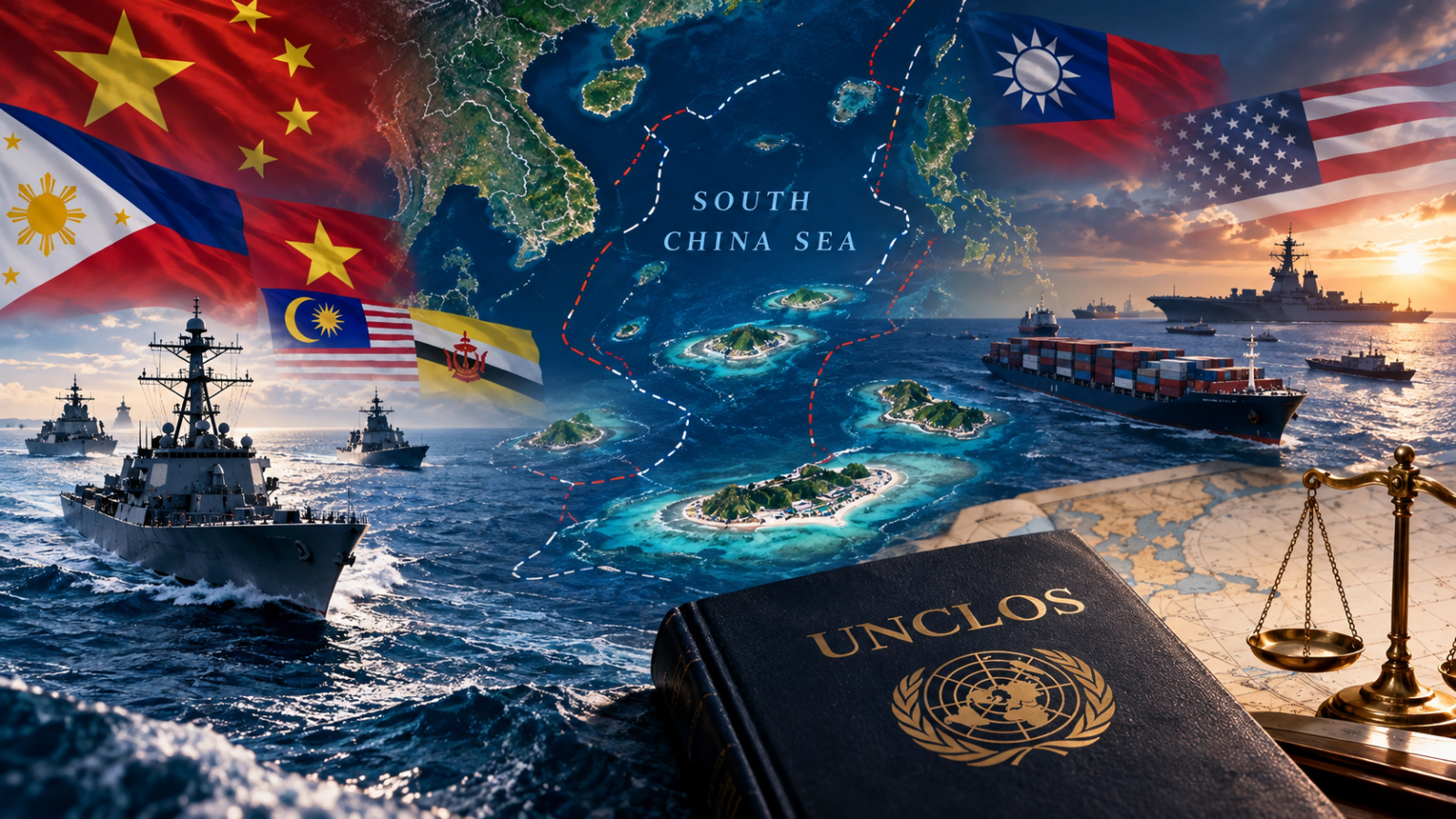
The South China Sea has emerged as one of the most consequential geopolitical flashpoints in the Indo-Pacific, where territorial disputes, maritime security concerns and competition for strategic influence intersect with the interests of the global economy. China, the Philippines, Vietnam, Malaysia, Brunei and Taiwan maintain competing claims or maritime interests in the region, making the dispute a persistent source of diplomatic tension.
The significance of these contested waters extends far beyond Southeast Asia. The South China Sea connects major Asian manufacturing centres with international markets and supports essential shipping routes, fisheries and offshore energy activities. Any serious disruption to maritime traffic could affect international supply chains, transportation costs and energy security, with consequences reaching well beyond the countries directly involved.
At the centre of the dispute lies a complex question of sovereignty and international law: how can countries defend their maritime interests without undermining regional stability or threatening the freedom of navigation on which international commerce depends?
Although diplomatic negotiations and international legal proceedings have helped clarify aspects of the dispute, fundamental disagreements remain unresolved. The future of the South China Sea will depend on how effectively governments manage competing claims, prevent maritime incidents from escalating and balance national interests with their shared responsibility to maintain peace.
1. Why Is the South China Sea Strategically Important?
The South China Sea occupies a central position in the Indo-Pacific's maritime network. It connects important commercial centres in East and Southeast Asia with routes leading towards the Indian Ocean and international markets. Ships carrying manufactured products, industrial materials, food commodities and energy supplies regularly navigate these waters.
For countries whose economies depend on international trade, the security of these sea routes is essential. Even without an outright military confrontation, prolonged instability can increase uncertainty for shipping operators, complicate business planning and raise the cost of transporting goods.
However, the region's importance cannot be measured through commercial shipping alone. Its marine resources, geographical position and military significance make it a vital area for both coastal states and major powers.
Global trade and supply chains: The South China Sea facilitates the movement of goods between major Asian economies and international markets. A serious interruption could delay deliveries, increase transport expenses and disrupt manufacturing networks that depend on reliable maritime connections.
Fisheries and coastal livelihoods: Fishing is an important source of food, employment and income for communities across Southeast Asia. Restrictions on access to traditional fishing grounds or damage to marine ecosystems can have direct economic and social consequences.
Offshore energy resources: The region contains established oil and gas activities as well as areas with potential additional reserves. Competition over exploration rights and access to resources adds an economic dimension to the territorial disagreements.
Military and strategic positioning: Islands, reefs and surrounding maritime areas can influence surveillance, naval operations and access to important sea routes. Their strategic value has encouraged governments to strengthen maritime capabilities and increase their attention to developments in the region.
Geopolitical influence: The dispute forms part of wider strategic competition involving China, the United States and other Indo-Pacific countries. It also reflects the efforts of Southeast Asian governments to preserve their sovereignty and maintain room for independent foreign-policy decisions.
The combination of these interests makes the South China Sea more than a regional boundary dispute. It is an important test of whether economic interdependence and international legal principles can coexist with growing strategic competition.
2. Which Countries Are Involved in the South China Sea Dispute?
The dispute encompasses competing sovereignty claims, overlapping maritime entitlements and disagreements about access to natural resources. Although the parties do not hold identical positions, their interests frequently intersect in the same geographical areas.
China: Sovereignty Claims and Maritime Interests
China asserts extensive claims and rights in the South China Sea, including claims associated with the nine-dash line. These overlap with maritime areas claimed by several Southeast Asian countries.
Beijing maintains that its position reflects historical rights, territorial sovereignty and legitimate maritime interests. It has rejected the 2016 arbitration award brought by the Philippines, arguing that the proceedings were invalid and that the ruling cannot determine China's sovereignty or maritime rights.
Other claimant governments contest important aspects of China's position, particularly where they believe its claims conflict with the maritime entitlements established under the United Nations Convention on the Law of the Sea (UNCLOS).
China's naval and coast guard capabilities also influence the regional security environment. Activities around disputed features, encounters with foreign vessels and disagreements over access to fishing grounds have contributed to tensions with neighbouring countries.
For Beijing, the dispute is closely connected to sovereignty and national security. For other claimant states, it raises questions about their ability to exercise maritime rights in areas they consider legally theirs.
The Philippines: Maritime Rights and International Arbitration
The Philippines has become one of the most prominent parties in the dispute because of its competing maritime claims with China.
Manila maintains that its maritime rights must be respected under international law. It has repeatedly raised concerns about encounters involving Chinese and Philippine vessels, particularly in areas where the two countries assert overlapping interests.
The Philippines initiated arbitration proceedings against China under UNCLOS in January 2013. The resulting award, delivered on July 12, 2016, addressed significant questions concerning historic rights, maritime entitlements and activities in disputed waters.
The Philippines considers the ruling an important legal basis for its position. China rejects the award, and the disagreement remains a major obstacle to a broader settlement.
The Philippines' defence relationship with the United States adds another dimension to the dispute. Maritime incidents can carry wider security implications because of the two countries' longstanding mutual defence treaty.
Vietnam: Territorial Sovereignty and Resource Protection
Vietnam maintains sovereignty claims over the Paracel and Spratly Islands and asserts maritime rights in parts of the South China Sea.
Hanoi has repeatedly opposed activities it considers inconsistent with its sovereignty and maritime interests. For Vietnam, the dispute is directly connected to coastal security, fishing livelihoods, offshore energy exploration and the protection of its economic interests.
Vietnam combines diplomatic engagement with efforts to strengthen its maritime capabilities and maintain relationships with regional and international partners.
Its position illustrates a broader challenge facing smaller and middle-sized countries in the Indo-Pacific: defending national interests while managing relations with a considerably more powerful neighbour.
Malaysia and Brunei: Maritime Entitlements and Economic Interests
Malaysia and Brunei have maritime interests and claims in parts of the southern South China Sea. Both have interests in offshore resources and the exercise of rights within maritime zones claimed under international law.
Malaysia has raised concerns about overlapping claims and activities affecting its maritime interests. Brunei's position is also connected to its maritime entitlements and offshore economic interests.
Although their approaches and priorities differ from those of China, the Philippines and Vietnam, their positions demonstrate that the dispute involves multiple legal and economic questions rather than a simple confrontation between two countries.
Taiwan: An Additional Layer of Complexity
Taiwan also maintains claims involving disputed islands and maritime areas in the South China Sea. Its position is complicated by its political status and the broader disagreement between Beijing and Taipei.
Taiwan's involvement further complicates efforts to develop a comprehensive settlement acceptable to all relevant parties.
Together, the competing claims demonstrate why resolving the dispute requires careful consideration of sovereignty, maritime entitlements, resource access and the legal rights of the countries concerned.
3. What Role Does International Law Play?
International law provides a framework for regulating activities at sea, establishing maritime entitlements and resolving certain disputes between countries.
The central legal instrument is the United Nations Convention on the Law of the Sea, widely known as UNCLOS. The Convention establishes rules concerning territorial seas, exclusive economic zones, continental shelves, navigation rights and the use of ocean resources.
Under UNCLOS, a coastal state may generally claim an exclusive economic zone extending up to 200 nautical miles from its legally recognised baselines, subject to the Convention's provisions and any overlapping entitlements. Within this zone, the coastal state has specific sovereign rights over natural resources and certain economic activities.
An exclusive economic zone is not equivalent to territorial sovereignty over the entire area. Other states retain specified rights and freedoms, including navigation and overflight, in accordance with the Convention.
This distinction is essential to understanding the South China Sea dispute. A claim to an island does not automatically establish unrestricted control over all the surrounding waters. The maritime entitlements generated by a feature depend on its legal status under international law.
The 2016 South China Sea Arbitration
The Philippines initiated arbitration proceedings against China on January 22, 2013, under the dispute-settlement provisions of UNCLOS. China did not participate in the proceedings and maintained that the tribunal lacked jurisdiction over the dispute.
On July 12, 2016, the tribunal issued its award, addressing several questions concerning maritime rights, historic claims, the status of particular maritime features and the legality of certain activities.
Among its principal findings, the tribunal concluded that China had no legal basis under UNCLOS to claim historic rights to resources within the relevant areas beyond the rights provided for by the Convention.
The tribunal also examined whether particular maritime features could generate their own maritime zones and considered allegations concerning interference with the Philippines' exercise of its maritime rights and damage to the marine environment.
Crucially, the tribunal did not determine sovereignty over the disputed islands or establish a maritime boundary between China and the Philippines. These limits are important because the award did not resolve every dimension of the conflict.
China rejected the award and continues to dispute its validity. The tribunal, however, issued its decision under the UNCLOS dispute-settlement framework and stated that its award was final and binding on the parties.
The disagreement over the ruling continues to influence diplomatic relations and regional discussions about maritime law.
Why the Arbitration Award Matters
The award established important legal findings concerning historic rights, maritime entitlements and activities in the South China Sea. It also demonstrated that international legal procedures can address specific disputes even when the parties disagree over the broader political context.
Nevertheless, a legal ruling cannot independently resolve every territorial dispute or guarantee compliance at sea.
Its practical significance depends on how governments respond, whether maritime incidents can be managed peacefully and whether diplomatic engagement produces arrangements that reduce confrontation.
The South China Sea therefore illustrates both the value and the limitations of international law: legal rules can clarify rights and obligations, but sustained political cooperation remains essential to maintaining stability.
4. How Does the Dispute Affect Regional Security?
Maritime security has become one of the most sensitive dimensions of the South China Sea dispute. Naval vessels, coast guard ships, fishing fleets and other maritime operators regularly operate in areas where governments disagree about jurisdiction and access.
An encounter that one country regards as a legitimate law-enforcement operation may be interpreted by another as an infringement of its maritime rights. This disagreement can turn routine activities into politically significant incidents.
Several security risks deserve particular attention.
The danger of accidental escalation: Close encounters, dangerous manoeuvres, collisions or confrontations involving water cannons can result in injuries and rapidly increase diplomatic tensions. Even a limited incident can become more serious when governments respond with threats or additional deployments.
Military modernisation: Countries concerned about their maritime security may invest in naval vessels, surveillance systems and other capabilities. These measures can strengthen their ability to monitor maritime activity, but they can also intensify competition when neighbouring governments view them with suspicion.
Alliance commitments: Defence agreements influence how countries calculate the risks associated with a confrontation. The relationship between the Philippines and the United States is particularly important because a serious incident could raise questions about treaty obligations and regional deterrence.
Reduced diplomatic trust: Repeated confrontations can damage confidence between governments and make negotiations more difficult. They may also undermine cooperation on issues such as marine conservation, fisheries and regional economic development.
Broader strategic competition: Military activity by major powers can affect the decisions of smaller states and intensify concerns about freedom of navigation and the regional balance of power.
These risks do not make a wider conflict inevitable. Governments have strong economic and strategic reasons to avoid a major confrontation. Reliable communication, restraint and effective crisis-management mechanisms can help prevent maritime incidents from escalating.
5. What Role Does ASEAN Play in Managing the Dispute?
The Association of Southeast Asian Nations (ASEAN) provides a regional platform through which Southeast Asian countries can discuss shared security concerns and pursue diplomatic cooperation with China.
ASEAN's role is particularly important because its members have different relationships with Beijing and do not share identical interests in the South China Sea. Some countries are directly involved in competing claims, while others are primarily concerned with regional stability, trade and freedom of navigation.
Reaching a common position can therefore be difficult. Nevertheless, ASEAN offers an institutional channel for dialogue that individual countries may struggle to establish independently.
Negotiations on a Code of Conduct
One of the principal diplomatic efforts is the proposed South China Sea Code of Conduct between ASEAN and China. The objective is to develop agreed rules and arrangements for managing activities in the disputed waters and reducing the risk of confrontation.
Negotiations have continued over several years. In August 2026, China and ASEAN member states held another meeting of their joint working group in Manila to advance consultations on the Code of Conduct, according to China's Ministry of Foreign Affairs.
The continued negotiations demonstrate that diplomatic engagement remains active even though a comprehensive settlement has proved difficult.
The effectiveness of any eventual agreement will depend on its scope, clarity, implementation arrangements and the willingness of participating governments to honour their commitments.
Other Areas for Regional Cooperation
Maritime communication: Better communication between coast guards and maritime authorities can help clarify the circumstances of an encounter and reduce the likelihood of miscalculation.
Environmental protection: Countries share an interest in protecting marine biodiversity, reducing pollution and preventing the depletion of fish stocks.
Fisheries management: Practical arrangements can help protect fishing livelihoods and encourage sustainable use of marine resources.
Search and rescue: Cooperation during maritime emergencies can save lives and create opportunities for constructive engagement despite political disagreements.
ASEAN cannot independently settle every territorial claim, and its consensus-based approach can limit the speed of collective action. Even so, regular dialogue and practical cooperation remain valuable tools for preventing disputes from escalating.
6. Why Are the United States and Other Major Powers Involved?
The South China Sea has become an important arena of strategic competition between China and the United States.
Washington emphasises freedom of navigation, respect for international law and the security of its regional partners. It conducts maritime operations and maintains defence partnerships across the Indo-Pacific, including its longstanding mutual defence treaty with the Philippines.
China objects to certain US military activities near areas it claims, arguing that they threaten its security interests and can increase regional tensions. Beijing views its maritime claims as closely connected to sovereignty and national security.
This disagreement reflects a broader strategic problem. The United States seeks to maintain access to international maritime routes and strengthen its regional partnerships, while China seeks to protect its claims and expand its influence in waters it considers strategically important.
Other countries, including Japan, Australia and India, also have interests in a stable and open Indo-Pacific. For these countries, secure shipping routes, predictable maritime rules and the prevention of a major regional conflict are important economic and security considerations.
International involvement has several dimensions.
Defence cooperation: Security partnerships can strengthen regional countries' maritime capabilities and provide reassurance during periods of uncertainty.
Freedom of navigation: Countries that depend on international shipping have a shared interest in the lawful use of international sea routes.
Diplomatic engagement: External partners can encourage dialogue, support confidence-building measures and promote peaceful dispute resolution.
Strategic competition: Rivalry between major powers can make negotiations more difficult, particularly when maritime disputes become linked to military access, alliance commitments and wider geopolitical influence.
The challenge is to ensure that security partnerships and military activities do not undermine the diplomatic efforts needed to manage competing claims. Maintaining regional stability requires both credible security arrangements and sustained engagement between countries with opposing positions.
7. How Could the South China Sea Dispute Affect Global Trade?
The South China Sea is an important corridor for international maritime commerce. Its location connects major manufacturing and trading economies with regional ports and shipping routes leading towards international markets.
For this reason, a serious disruption could affect businesses far beyond the immediate area of the dispute.
However, the economic consequences would depend on the severity, location and duration of the disruption. A diplomatic disagreement or isolated maritime incident does not automatically produce a major interruption to international trade. A prolonged confrontation that threatens commercial shipping would present a considerably greater risk.
Shipping Delays and Higher Transport Costs
If shipping operators considered certain waters unsafe, they could change routes or schedules. Longer journeys would increase fuel consumption, extend delivery times and potentially require additional logistical arrangements.
Maritime insurance premiums and operating expenses could also rise if insurers and shipping companies assessed the affected region as carrying greater risk.
These additional costs can eventually be reflected in the prices paid by businesses and consumers.
Supply-Chain Disruption
Modern manufacturing depends on interconnected supply chains. Electronic components, industrial machinery, consumer products and raw materials often pass through several countries before reaching their final destinations.
A serious disruption to shipping could delay these movements, complicate production schedules and increase costs for companies that depend on timely deliveries.
Businesses with limited alternative suppliers or transport routes could be particularly vulnerable.
Energy Security
The South China Sea is relevant to the transportation of oil, liquefied natural gas and other energy supplies. A major interruption could create uncertainty for importing countries and place pressure on shipping arrangements and energy markets.
The effects would depend on the routes affected, the availability of alternative supplies and the ability of shipping operators to adjust their operations.
Investment and Regional Economic Confidence
Persistent instability can influence business decisions even before trade routes are directly disrupted.
Companies may reconsider investment plans, adjust procurement strategies or seek alternative production and distribution arrangements if they believe maritime risks are increasing.
Coastal communities could also face economic pressure if fishing access, port operations or industries connected to maritime commerce were affected.
For India, Japan, South Korea and Southeast Asian economies, a predictable maritime environment is important for trade and economic planning.
Protecting the South China Sea's stability is therefore not merely a regional security concern. It is also part of safeguarding the international trading system and limiting the economic consequences of geopolitical tensions.
8. Why Is a Peaceful Settlement So Difficult?
Despite diplomatic initiatives and international legal frameworks, the South China Sea dispute remains unresolved. The difficulty lies in the way territorial sovereignty, economic interests, domestic politics and major-power competition overlap.
Conflicting Territorial and Maritime Claims
The parties disagree over sovereignty, the legal status of maritime features and the rights that those features may generate under international law.
A settlement would need to address these disagreements while taking account of the legal positions and interests of the relevant countries.
Competition for Strategic Influence
The dispute is connected to the wider balance of power in the Indo-Pacific. Governments view the region not only in terms of natural resources and maritime boundaries, but also through the lens of national security, military access and regional influence.
This broader strategic context makes compromise more difficult.
A Persistent Lack of Trust
Repeated maritime confrontations and conflicting official statements can strengthen suspicion between governments. When parties doubt one another's intentions, even practical agreements covering fisheries, environmental protection or resource development can become difficult to implement.
Different Interpretations of International Law
The 2016 arbitration award remains a central point of disagreement. The Philippines relies on its findings to support its legal position, while China rejects the ruling.
The award clarified certain questions under UNCLOS but did not determine sovereignty over disputed islands or establish a complete maritime boundary between the two countries.
These unresolved issues leave important areas for diplomatic negotiation.
Domestic Political Pressures
Territorial disputes frequently carry strong national significance. Governments may face public pressure to demonstrate that they are defending sovereignty and protecting national interests.
This can limit their willingness to make compromises, even when an agreement could provide practical economic or security benefits.
A lasting settlement will therefore require more than legal clarification or military deterrence. It will depend on sustained negotiations, mutual restraint and arrangements that reduce the costs of continued confrontation.
9. What Can Be Done to Reduce Tensions?
A comprehensive settlement may take considerable time, but governments can take practical steps to improve maritime security and create better conditions for negotiations.
Maintain regular diplomatic dialogue. Communication should continue even during periods of heightened tension. Established diplomatic channels can clarify positions, address grievances and reduce the risk of misunderstandings.
Strengthen maritime crisis-management mechanisms. Coast guards, naval authorities and diplomatic officials should have reliable procedures for communicating during dangerous encounters. Rapid communication can help prevent incidents from becoming wider confrontations.
Use international legal frameworks. UNCLOS and appropriate peaceful dispute-settlement mechanisms can provide a basis for addressing maritime rights and obligations. Countries should distinguish between unresolved sovereignty claims and questions that can be examined under the Convention.
Pursue practical regional agreements. Cooperation on fisheries, scientific research, marine conservation and maritime safety can produce shared benefits without requiring countries to settle every territorial disagreement first.
Exercise restraint during maritime encounters. Governments should discourage dangerous manoeuvres, prioritise the safety of personnel and avoid responses that unnecessarily intensify confrontation.
Advance the ASEAN-China Code of Conduct negotiations. A clear and workable agreement could establish practical expectations for managing activities in disputed waters. Its value would depend on meaningful commitments and effective implementation.
Protect the marine environment. Sustainable fisheries management, pollution control and conservation initiatives can support coastal livelihoods and reduce pressure on shared marine resources.
These measures will not eliminate every disagreement. They can, however, lower the risk of accidental escalation, strengthen regional cooperation and help create a more stable environment for political negotiations.
Conclusion: Why Peace in the South China Sea Matters to the World
The South China Sea dispute remains a major challenge for regional security, international law and global economic stability. Competing territorial claims, maritime resource interests and strategic rivalry continue to complicate relations between China and several Southeast Asian countries.
International law, particularly UNCLOS, provides a framework for understanding maritime rights and resolving certain disputes. The 2016 arbitration award established important findings, while ASEAN continues to offer a platform for dialogue and negotiations. Yet legal decisions and diplomatic declarations alone cannot guarantee stability without practical cooperation and restraint.
The economic consequences of escalation could reach far beyond the region. Disruptions to commercial shipping could affect transport costs, energy supplies, manufacturing networks and the movement of goods through international markets. Preserving the security and predictability of maritime routes is therefore important not only for claimant countries but also for the wider global economy.
The challenge is to prevent competing national interests from turning a manageable maritime dispute into a broader security crisis. That requires governments to maintain communication, respect applicable international law, strengthen regional mechanisms and pursue peaceful ways of addressing disagreements.
Ultimately, the future of the South China Sea will depend on whether its stakeholders can balance sovereignty and security concerns with their shared interest in peace, economic cooperation and open maritime routes. Sustained diplomacy remains essential to reducing tensions and protecting stability across the Indo-Pacific.
Sources and Further Reading
-
Permanent Court of Arbitration — The South China Sea Arbitration: Official information about the Philippines-China arbitration proceedings and the award issued on July 12, 2016.
https://pca-cpa.org/en/cases/7/ -
United Nations — UNCLOS, Part V: Exclusive Economic Zone: Legal provisions concerning coastal states' rights and other states' freedoms within exclusive economic zones.
https://www.un.org/depts/los/convention_agreements/texts/unclos/part5.htm -
International Tribunal for the Law of the Sea — UNCLOS: Background on the international convention governing maritime rights and obligations.
https://www.itlos.org/en/main/the-tribunal/unclos/ -
ASEAN — ASEAN-China Senior Officials' Meeting, May 21, 2026: Official information on discussions regarding the Declaration on the Conduct of Parties and negotiations towards a South China Sea Code of Conduct.
https://asean.org/the-26th-asean-china-senior-officials-meeting-on-the-implementation-of-the-declaration-on-the-conduct-of-parties-in-the-south-china-sea-convenes-in-kuala-lumpur/ -
Ministry of Foreign Affairs of China — ASEAN-China Joint Working Group Meeting, August 2026: China's official account of the meeting held in Manila to advance consultations on the proposed Code of Conduct.
https://www.fmprc.gov.cn/mfa_eng/wjb/zzjg_663340/bianhaisi_eng_665278/bianhaixiangguanxinwen_665280/202608/t20260822_12008584.html


Join the Conversation