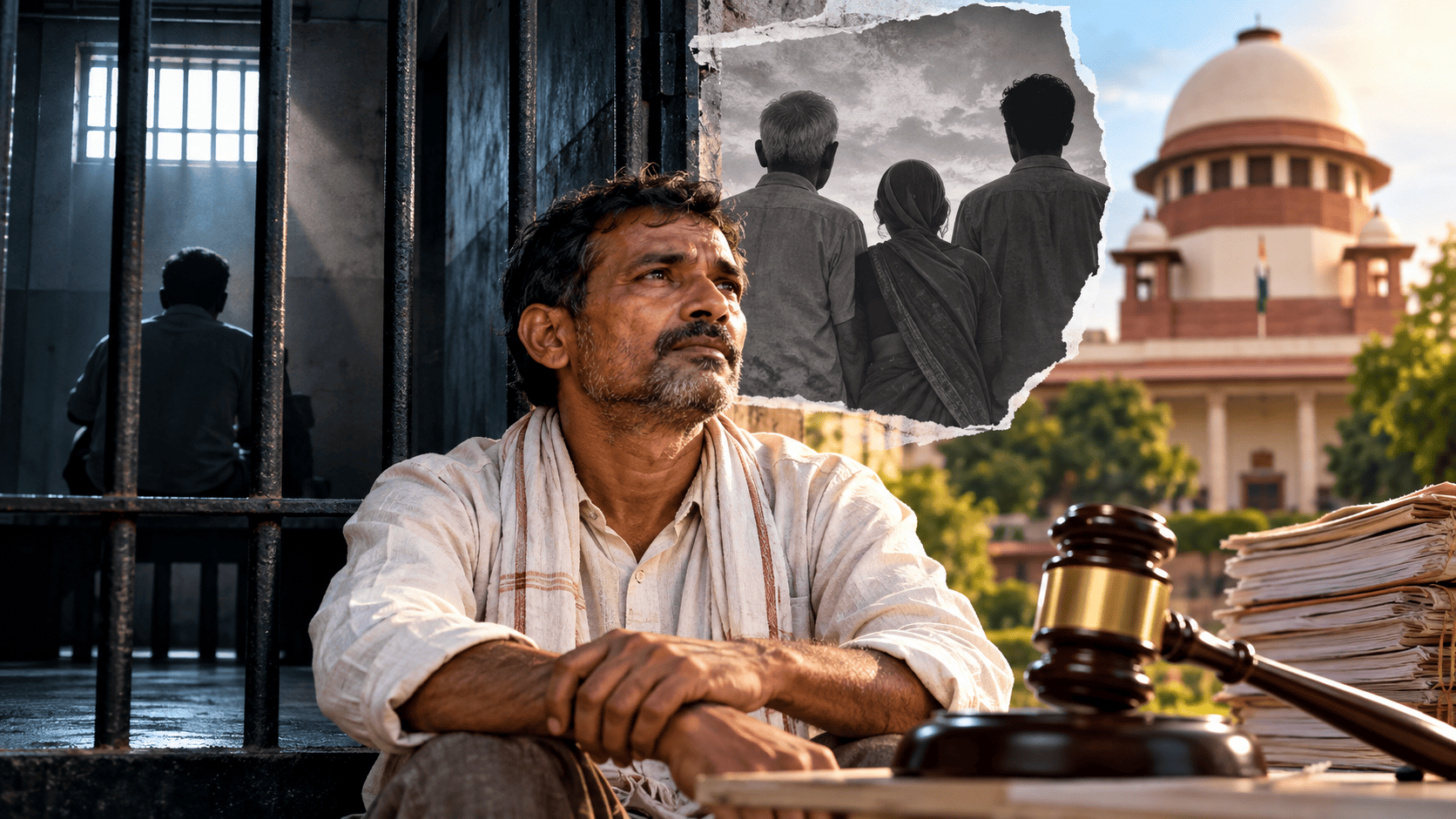
Vishnu Tiwari’s Story: When Acquittal Comes After 20 Years, Can Justice Truly Be Done?
Some stories stay with us long after we finish reading them. Not because they have a happy ending, but because they leave us wondering whether justice has really been served. The story of Vishnu Tiwari from Lalitpur, Uttar Pradesh, is one such case.
Vishnu Tiwari spent nearly two decades in prison after being accused in a criminal case registered under the SC/ST Act and other legal provisions. For years, his life remained tied to court proceedings, legal arguments and the hope that one day he would be able to return home.
Eventually, after almost 20 years behind bars, he was acquitted by the court.
Legally, it was a moment that brought an end to a long and difficult battle. But for Vishnu, freedom came at a cost that no court order could undo.
A Life That Moved On Without Him
While Vishnu was in prison, the world outside continued to change. His parents and brother passed away during his years of incarceration. According to accounts of his case, he could not be with them in their final moments or attend their last rites.
Think about what that means.
A person enters prison hoping to prove his innocence and return to his family. Years pass, and when he finally gets the opportunity to come home, some of the people he most wanted to see are no longer alive.
There is no second chance to sit beside his parents, no opportunity to speak to his brother again, and no way to recover the moments they could have shared.
These are losses that cannot be measured in money or explained through legal terminology. They are deeply personal, and they remain even after a person is declared not guilty.
For Vishnu, freedom meant returning to a world in which the people he had left behind were no longer there.
The Financial Cost of a Long Legal Battle
The consequences were not limited to the loss of family members and years of personal freedom. His family reportedly struggled to meet the expenses of the legal battle, and land was sold to cover legal costs.
For a family with limited financial resources, a prolonged court case can become a burden that affects every aspect of life. Savings disappear, property may have to be sold, and the future becomes increasingly uncertain.
For wealthier individuals, a lengthy legal battle may be financially manageable. For a poor family, the same process can threaten its entire livelihood.
This highlights a difficult reality: although everyone is entitled to equal protection under the law, not everyone has equal resources to defend themselves for years.
When a case continues for such a long period, the consequences can extend far beyond the person standing trial. Entire families may suffer financially, emotionally and socially.
Is Acquittal the End of the Story?
When a court acquits someone, the legal outcome is clear: the person has been found not guilty in that case. But what happens after that decision is delivered?
For someone who has spent almost 20 years in prison, returning to ordinary life is not as simple as walking through the prison gates.
Time has passed. Relationships have changed. Family members may be gone. Career opportunities have disappeared, and the person may have to start again without the support system they once had.
The world has moved forward, but the individual has lost years that can never be recovered.
This is why an acquittal should not always be viewed as the end of a person's struggle. In cases involving prolonged incarceration, it may mark the beginning of a different and equally difficult challenge: rebuilding a life after years of loss.
The court can deliver its judgment, but it cannot turn back the clock.
Who Takes Responsibility for Lost Years?
Vishnu Tiwari's case raises several important questions that deserve serious public discussion.
What support should be available to a person who spends many years in prison and is eventually acquitted? Should there be a clear mechanism for compensation in cases involving prolonged wrongful incarceration? Who should help such individuals return to society and rebuild their lives?
These questions are not about dismissing the importance of the law or suggesting that every acquittal automatically proves that an arrest or prosecution was wrongful. An acquittal is a legal outcome, and the circumstances of each case must be examined carefully.
However, when a person has spent a substantial part of their life behind bars and is ultimately acquitted, it is reasonable to ask whether the legal system offers enough support to help them recover from the consequences.
Freedom is essential, but it may not be enough.
A person may need financial assistance, access to rehabilitation, help finding employment and support in rebuilding family and social connections. Where the facts establish wrongful detention or other legally recognised grounds for compensation, there should also be an effective way to pursue appropriate remedies.
Justice should not end with the opening of a prison gate.
The Importance of Access to Justice
Another important lesson from this case concerns access to justice.
A legal system may promise equal treatment to everyone, but the ability to navigate that system can vary greatly depending on a person's financial circumstances. Legal representation, repeated court appearances and prolonged proceedings can place enormous pressure on people who are already struggling to make ends meet.
For a family living on a limited income, years of litigation can mean selling land, taking on debt or sacrificing basic needs. Even when the final judgment brings relief, the financial damage may remain.
This is why timely trials, access to effective legal aid and careful judicial scrutiny are so important. Delays are not merely administrative problems. They affect real people, their families and their futures.
Every additional year spent waiting for a decision can mean another year away from work, family responsibilities and the ordinary experiences that make up a human life.
The longer a case takes, the greater the potential consequences for everyone involved.
Justice Must Also Consider Human Dignity
A justice system has an essential responsibility to protect society, investigate allegations fairly and hold people accountable when guilt is established through due process. At the same time, it must protect individual rights and ensure that legal proceedings do not leave people facing consequences that receive no meaningful attention afterward.
Vishnu Tiwari's story brings this responsibility into focus.
It reminds us that behind every case number is a human being. Behind every court hearing is a person waiting for an answer. And behind every long delay may be a family dealing with uncertainty, financial pressure and emotional pain.
The law must be judged not only by the decisions it delivers but also by whether its processes protect human dignity and provide meaningful remedies when serious harm has occurred.
Twenty Years That Can Never Be Returned
Twenty years is a significant part of a human life. It is enough time to build a career, raise a family, care for ageing parents and experience countless moments that can never be repeated.
For Vishnu Tiwari, those years were spent in prison. His eventual acquittal may have brought legal relief, but it could not restore his lost time, bring back his family members or automatically reverse the financial hardships his family reportedly experienced.
That is what makes this story so difficult to forget.
The question is not simply whether Vishnu Tiwari eventually walked free. It is whether the system can do enough to help a person rebuild a life after such a prolonged period of incarceration.
No amount of money can bring back a lost parent. No compensation can return two decades of life. But meaningful support, accountability where warranted and reforms that prevent unnecessary delays can make a difference.
Perhaps the most important lesson is this: justice should not be measured only by the moment a verdict is delivered. It should also be measured by how fairly people are treated throughout the legal process and what happens when they finally return to society.
Vishnu Tiwari's story leaves us with a difficult question: When freedom arrives after nearly 20 years, but the life a person once knew is gone, can we honestly say that justice is complete?


Join the Conversation