THE BETRAYAL OF THE CORE VOTER – TWICE
How the BJP Lost the Confidence of Sections of Its Traditional General Category Support Base (2014–2026)
Introduction: Why Are General Category Voters Feeling Betrayed by the BJP?
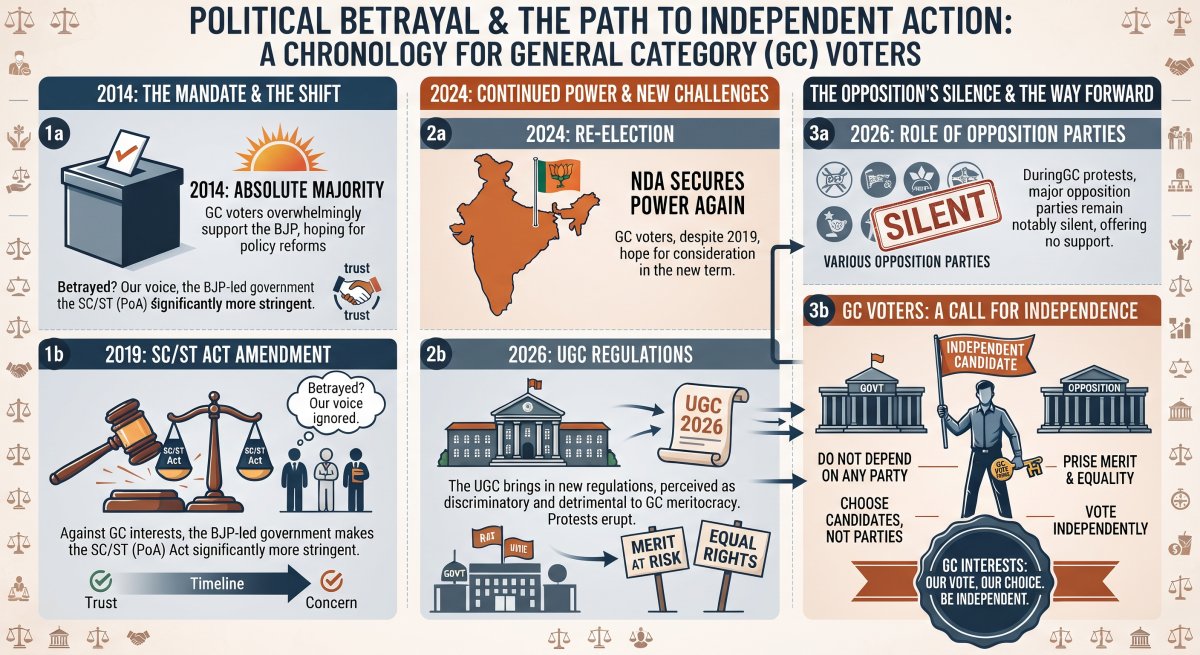
In 2014, millions of Indians voted for the Bharatiya Janata Party (BJP), hoping for a new political direction. Among them were General Category voters who expected development, good governance, economic justice, merit-based opportunities and equal treatment.
They believed that a government promising change would listen to their concerns and protect their interests.
In 2019, the BJP returned to power with an even stronger mandate. Expectations among its supporters increased. Many believed that the government would address longstanding concerns relating to reservation, education, employment and equal opportunities.
However, two major policy controversies subsequently created serious dissatisfaction among sections of the General Category population.
The first was the government's response to the Supreme Court's March 2018 judgment concerning the SC/ST (Prevention of Atrocities) Act.
The second was the introduction of the University Grants Commission (UGC) Equity Regulations in January 2026.
Both controversies raised questions about procedural safeguards, institutional fairness and the political representation of General Category citizens.
The introduction of EWS reservation in 2019 was an important policy development. Nevertheless, sections of General Category voters continued to feel that their broader concerns were not receiving sufficient attention.
This raises an important political question:
Has the BJP betrayed the confidence of its traditional General Category supporters twice?
This article examines the two controversies, their political implications and why General Category voters should consider developing independent political leadership rather than depending exclusively on established political parties.
1. The First Betrayal: BJP, the SC/ST Act and the 2018 Amendment
The Scheduled Castes and Scheduled Tribes (Prevention of Atrocities) Act was introduced to protect SC/ST communities against caste-based atrocities, discrimination, humiliation and violence.
Protecting historically disadvantaged communities is an important constitutional responsibility.
However, concerns about procedural safeguards and the possibility of misuse became a major national issue following the Supreme Court's judgment of March 20, 2018, in Subhash Kashinath Mahajan v. State of Maharashtra.
What did the Supreme Court decide in 2018?
The Supreme Court introduced safeguards intended to prevent arbitrary arrests and misuse of the SC/ST Act.
These included preliminary inquiry requirements in certain circumstances and approval procedures for arrests of public servants.
The judgment generated considerable debate.
Sections of the General Category population welcomed the emphasis on due process. They argued that while genuine victims must receive justice, innocent individuals should also be protected against arbitrary action and malicious allegations.
Why did the BJP government face criticism?
In August 2018, Parliament passed the SC/ST (Prevention of Atrocities) Amendment Act, restoring provisions concerning immediate registration of cases and arrest procedures and expressly addressing anticipatory bail restrictions.
The government defended its decision as necessary to ensure that the protection available to SC/ST communities was not weakened.
However, the decision disappointed sections of General Category citizens who had expected the government to retain stronger procedural safeguards.
Their concern was straightforward: Why should an innocent person be denied adequate protection against arbitrary or malicious complaints?
In 2019, the Supreme Court upheld the constitutional validity of the amendment in Union of India v. State of Maharashtra.
The political dissatisfaction among some General Category supporters nevertheless continued.
The unanswered question
Could the government have protected genuine victims of caste-based atrocities while also strengthening safeguards against malicious complaints?
The demand was not to weaken protection for SC/ST communities. It was to ensure that the criminal justice system protects genuine victims while respecting the rights of accused individuals.
For sections of General Category voters, the government's 2018 decision became the first major breach of political confidence.
2. The Second Betrayal: UGC Equity Regulations 2026 and General Category Students
Nearly eight years after the SC/ST Act controversy, another policy decision brought General Category concerns into the national debate.
On January 13, 2026, the University Grants Commission notified the Promotion of Equity in Higher Education Institutions Regulations, 2026.
The stated objective was to prevent discrimination and create safer, more inclusive educational institutions.
The regulations introduced institutional mechanisms such as:
-
Equal Opportunity Centres.
-
Equity Committees.
-
Equity Squads.
-
Equity Ambassadors.
-
Equity Helplines.
-
Institutional complaint and monitoring mechanisms.
Preventing discrimination in universities is an important objective. Every student deserves a safe and fair educational environment.
However, the definition of caste-based discrimination under Regulation 3(c) became controversial because it specifically referred to discrimination against SC, ST and OBC members.
Critics questioned whether General Category students would receive equivalent protection against caste-based discrimination and whether the complaint mechanisms contained sufficient safeguards.
Why did General Category students oppose the regulations?
The concerns raised by critics included:
-
Whether General Category students experiencing caste-based discrimination would receive equivalent protection.
-
Whether institutional complaint committees would function impartially.
-
Whether sufficient safeguards existed against malicious complaints.
-
Whether accused students would receive a fair opportunity to defend themselves.
-
Whether investigation and appeal procedures were clearly defined.
There is an important distinction between opposing discrimination and questioning the fairness of a particular regulatory framework.
General Category students are entitled to raise concerns about institutional fairness without automatically being portrayed as opponents of social justice.
Every genuine complaint deserves investigation. Every accused individual deserves due process.
Supreme Court intervention: January 29, 2026
On January 29, 2026, the Supreme Court stayed the implementation of the UGC Equity Regulations, 2026, and directed that the 2012 regulations would continue until further orders.
The Court raised concerns about ambiguity and possible misuse.
The Union government subsequently informed the Court that it was reconsidering the regulations.
The controversy became an important national debate about equality, institutional accountability and procedural fairness in higher education.
For sections of General Category voters, this development revived concerns that had emerged during the 2018 SC/ST Act controversy.
The second major question was whether the government was adequately considering the legitimate concerns of General Category students while designing policies intended to promote social justice.
3. BJP and General Category Voters: What Changed Between 2014 and 2026?
The BJP's political journey between 2014 and 2026 provides an opportunity to examine the changing relationship between the party and sections of its traditional support base.
2014: The promise of political change
The BJP won 282 Lok Sabha seats in 2014.
The election created expectations of development, good governance, economic opportunity and a new political direction.
Many General Category voters believed their concerns would receive greater recognition.
2019: The stronger mandate
The BJP increased its tally to 303 seats in 2019.
The government introduced the 103rd Constitutional Amendment, enabling up to 10% reservation for Economically Weaker Sections outside the existing reservation categories.
This was a significant step towards recognising economic disadvantage.
However, concerns about education, employment, reservation and institutional fairness continued.
2024: The electoral warning
The BJP won 240 seats in the 2024 general election and formed the government as the largest party in the NDA coalition.
The result demonstrated that political dominance cannot be taken for granted.
It would be incorrect to attribute the result exclusively to General Category dissatisfaction. Nevertheless, it reinforced the importance of understanding voter expectations and political accountability.
2026: A growing debate about political representation
The UGC Equity Regulations controversy renewed questions about the BJP's relationship with General Category voters.
The larger lesson is that political loyalty cannot be assumed to continue indefinitely.
A political party must earn the confidence of its supporters through consistent policies, meaningful representation and accountability.
4. What Do General Category Voters Actually Want?
General Category citizens are not asking for the rights of other communities to be taken away.
Their concerns include:
-
Equal protection under the law.
-
Fair and impartial complaint procedures.
-
Safeguards against malicious allegations.
-
Greater educational assistance for economically weaker students.
-
Fair opportunities in competitive examinations.
-
Recognition of economic hardship across communities.
-
Transparency in reservation policies.
-
Equal opportunity in education and employment.
-
Political representation of their legitimate concerns.
Social justice should not become a competition between communities.
The objective should be a system that recognises historical disadvantages while ensuring fairness, dignity and due process for every citizen.
5. EWS Reservation: An Important Step, but Is It Enough?
The 103rd Constitutional Amendment, introduced in 2019, enabled up to 10% reservation for Economically Weaker Sections.
This was an important recognition that economic hardship also exists among citizens outside existing reservation categories.
However, reservation alone cannot resolve every economic and educational disadvantage.
General Category students from low-income households may struggle with expensive coaching, tuition fees, accommodation and access to quality education.
The government should therefore consider additional scholarships, affordable coaching facilities, financial assistance and better access to professional education.
Economic disadvantage deserves meaningful policy attention beyond electoral promises.
6. The Solution: Independent Political Representation for General Category Voters
If sections of General Category voters feel betrayed by the BJP, should they simply wait for another election and another promise?
My argument is that they should reconsider their entire political strategy.
The experience of 2014–2026 demonstrates an important lesson: No political party should be trusted with unconditional support.
Any political party can change its position according to electoral calculations. Therefore, General Category voters must develop an independent political identity and the ability to influence electoral outcomes.
6.1 Stop giving unconditional political support
General Category voters must stop assuming that their votes automatically belong to a particular political party.
Political support must be earned through policies, representation and accountability.
A party's previous achievements should not give it permanent immunity from criticism.
6.2 Promote independent General Category candidates
General Category citizens should encourage capable and credible independent candidates who genuinely understand their concerns.
Such candidates should raise issues involving:
-
Fairness in education and employment.
-
Economic support for disadvantaged families.
-
Equal protection under the law.
-
Procedural safeguards in criminal proceedings.
-
Transparency in reservation policies.
-
Constitutional rights and equal opportunity.
Independent candidates can provide an alternative political voice when established parties fail to represent these concerns.
The objective should be to develop credible leadership at local, state and national levels.
6.3 Support political parties that genuinely speak for General Category concerns
General Category voters should evaluate every political party based on its present policies and actions rather than its historical identity.
If a political party openly raises legitimate General Category concerns, proposes practical solutions and demonstrates commitment through its actions, voters should consider supporting it.
This support should not be restricted to any single political party.
A party that represents the concerns of General Category citizens deserves consideration, regardless of its political background.
The principle should be simple:
Support those who represent your concerns. Question those who ignore them. Explore alternatives when established parties fail to listen.
6.4 Build an organised General Category political platform
Scattered individual grievances cannot create meaningful political influence.
General Category citizens need stronger democratic organisation.
Student groups, professional organisations, social organisations and concerned citizens should work towards a common platform.
Such a platform could:
-
Identify common policy demands.
-
Encourage credible independent candidates.
-
Organise peaceful democratic campaigns.
-
Publish election-time assessments of political parties.
-
Engage with elected representatives.
-
Monitor election promises.
-
Raise educational and employment concerns through constitutional and democratic channels.
An organised political constituency has a stronger ability to influence public policy than a collection of disconnected voters.
6.5 Make electoral support conditional on accountability
Before supporting any candidate, General Category voters should ask:
-
What is the candidate's position on equal educational opportunities?
-
What safeguards does the candidate support against misuse of legal provisions?
-
What policies will help economically weaker families?
-
Does the candidate support impartial complaint mechanisms?
-
Will the candidate raise General Category concerns in Parliament or the state legislature?
Candidates who demonstrate genuine commitment should receive consideration and support.
Those who ignore these concerns should not assume automatic loyalty.
6.6 No political party owns the General Category vote
The most important political lesson from the past twelve years is that political loyalty must never become political dependency.
Replacing unconditional support for one party with unconditional support for another would solve nothing.
General Category voters must develop their own political leadership, encourage independent candidates and support parties that genuinely represent their concerns.
This is not about hostility towards any community. It is about democratic representation and the right to choose political alternatives.
The General Category must move from being merely a vote bank for political parties to becoming an organised political constituency capable of influencing electoral outcomes.
The message to every political party should be clear:
We will support you when your policies represent our legitimate concerns. We will question you when you ignore them. We will explore independent political alternatives when established parties fail to represent us.
No party is entitled to the General Category vote. Every party must earn it.
7. Conclusion: The Betrayal of the Core Voter – Twice
The political journey from 2014 to 2026 raises serious questions about the relationship between the BJP and sections of its traditional General Category support base.
The first major controversy emerged with the 2018 amendment to the SC/ST Act and the government's decision to reverse the procedural safeguards introduced by the Supreme Court.
The second emerged with the UGC Equity Regulations of January 2026, which generated concerns about equal protection and procedural fairness in higher education.
These two controversies are different in their legal purpose and context. However, they have both contributed to a broader debate about whether General Category concerns receive adequate political attention.
The solution is not to oppose the rights of other communities or undermine genuine social justice.
The solution is to demand fairness, due process, equal opportunity and meaningful representation.
General Category voters must stop treating political parties as permanent allies. They should encourage independent candidates, support parties that genuinely speak for their concerns and hold every elected representative accountable.
The BJP must also recognise that voters who supported it in 2014 and 2019 are entitled to question its policies in 2026.
A political mandate is a responsibility, not a permanent entitlement.
The final message is clear: The General Category must develop its own political voice. No party should take its support for granted, and no voter should surrender the right to choose an independent political alternative.

Join the Conversation