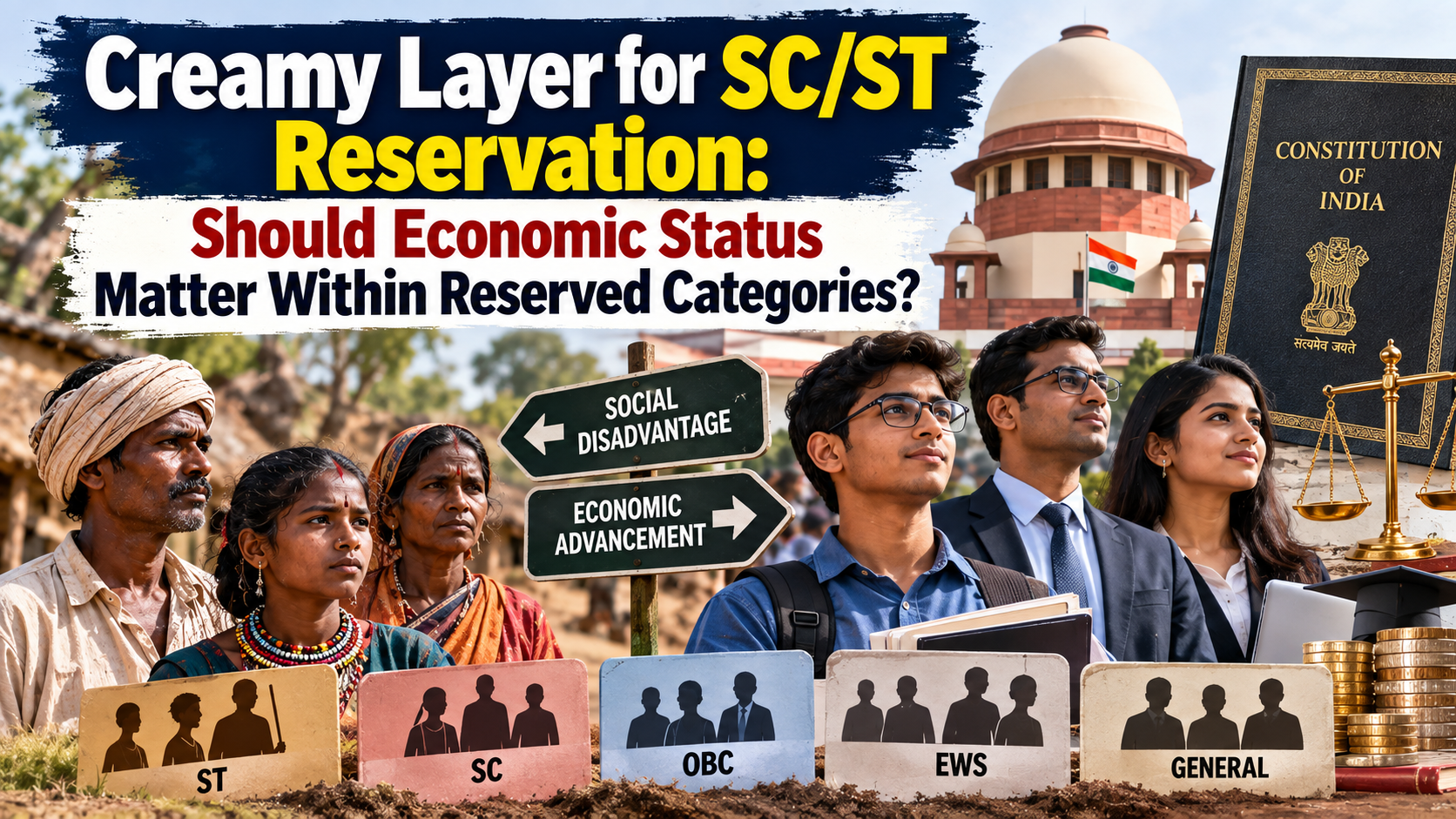
Should reservation benefits continue equally for every member of a reserved category, or should economic and educational advancement influence who receives them? India's latest reservation debate raises an important question about social justice, equality and opportunity.
India's reservation system has once again become the subject of an important constitutional debate. This time, however, the discussion is not simply about increasing or decreasing reservation.
The central question is whether economically and socially advanced members of Scheduled Castes (SCs) and Scheduled Tribes (STs) should continue receiving the same reservation benefits as the poorest members of their communities.
This debate has gained attention following proceedings before the Supreme Court. In August 2026, the Union government argued that extending the creamy-layer principle to SCs and STs would require empirical research and an appropriate policy decision by Parliament.
The issue deserves careful examination because economic advancement and freedom from caste discrimination are not necessarily the same thing.
What Is the Creamy Layer?
The creamy-layer principle is primarily associated with reservation for Other Backward Classes (OBCs).
It identifies relatively advanced members of a backward class and excludes them from certain reservation benefits.
The objective is to prevent the most advanced section of a community from repeatedly receiving opportunities while less-advantaged members remain behind.
The principle emerged from the Supreme Court's landmark Indra Sawhney judgment in 1992.
Important distinction: The creamy-layer principle applicable to OBCs does not currently operate in the same manner for SCs and STs.
That difference lies at the heart of the present controversy.
Why Is the SC/ST Creamy-Layer Debate Important?
Consider two students belonging to the same reserved category.
The first student comes from a financially secure family. Both parents are educated professionals, and the student has attended a well-equipped private school.
The second student comes from a poor rural household. Their parents have limited education, and the student is the first person in the family to attend college.
Although both students belong to the same reservation category, their educational and economic opportunities are considerably different.
The question is whether reservation policy should recognise these differences.
Supporters of a creamy layer argue that benefits should reach the most disadvantaged members of reserved communities.
Opponents argue that economic success does not automatically eliminate caste-based discrimination.
Both arguments deserve serious consideration.
What Is the Central Government's Position?
In August 2026, the Centre told the Supreme Court that extending the creamy-layer principle to SC/ST reservations should be a matter for Parliament and should follow a comprehensive empirical study.
The government emphasised that SC/ST reservation is rooted in historical and social disadvantage, not simply economic circumstances.
This position highlights an important constitutional distinction.
Reservation is not merely a programme for reducing poverty. It is also intended to address historical exclusion and inadequate representation.
The government's position does not establish a new creamy-layer law. The question remains part of an ongoing legal and policy debate.
The Argument in Favour of a Creamy Layer
Supporters argue that reservation should reach those who need it most.
When families achieve considerable economic and educational advancement, their children may enjoy opportunities that poorer members of the same community cannot access.
Quality schooling, private coaching, educated parents, financial security and professional connections can significantly influence academic and employment outcomes.
If reservation repeatedly benefits relatively advanced families, poorer members of the same community may continue to face substantial disadvantages.
Supporters therefore believe that economic and educational advancement should be considered when distributing reservation benefits.
Their argument is not necessarily that reservation should end.
Rather, they question whether its benefits could be distributed more effectively.
The Argument Against a Creamy Layer
Opponents raise a different concern.
A person's income does not determine whether they experience caste discrimination.
An SC professional may earn a high salary and still encounter prejudice because of their caste identity.
Similarly, economic improvement within an ST family does not automatically eliminate geographical, educational or social disadvantages.
Reservation for these communities was created to address historical exclusion and improve representation.
Critics therefore argue that excluding individuals simply because their families earn more money could undermine the original purpose of reservation.
Economic mobility and social equality are not interchangeable.
This distinction must remain central to any proposed reform.
Should Economic Status Matter?
Economic circumstances undoubtedly influence opportunity.
Children from financially secure families often have access to better educational resources than children from poor households.
However, income alone cannot fully measure social disadvantage.
Two families with identical incomes may live in completely different circumstances.
One may reside in a major city with excellent educational facilities. Another may live in a remote tribal region with limited access to schools, transport and healthcare.
Equal income does not necessarily mean equal opportunity.
Any future policy would therefore need to consider more than household earnings.
What About the Children of Senior Government Officials?
This question frequently appears in reservation debates.
Suppose an individual benefits from reservation and subsequently becomes a senior government officer.
Their children may grow up with considerable financial security and access to high-quality education.
Should those children receive the same reservation benefits as children whose parents never attended school?
Supporters of creamy-layer exclusion believe that differences in family advancement should matter.
Opponents maintain that parental success does not automatically eliminate historical or continuing discrimination.
The disagreement ultimately concerns the purpose of reservation: correcting social exclusion, distributing opportunity or achieving both objectives.
A meaningful policy debate must address that question directly.
Why Income Alone Is Not Enough
An income-based system may appear straightforward, but implementing it fairly would be difficult.
Household earnings can fluctuate. Property ownership does not always reflect disposable income, and the cost of living differs considerably between regions.
A more comprehensive assessment could potentially examine:
- Family income: The household's financial circumstances.
- Parental education: Whether the applicant comes from an educated family.
- Occupation: The professional and employment background of parents.
- Assets: Significant property and other financial resources.
- Educational opportunity: Access to quality schools and learning facilities.
- First-generation status: Whether the applicant is the first person in the family to pursue higher education.
- Geographical disadvantage: Barriers associated with rural and remote areas.
These are possible policy considerations, not existing SC/ST creamy-layer eligibility rules.
Could First-Generation Students Receive Greater Support?
One alternative worth examining is additional support for first-generation learners.
A student whose parents never attended college may face disadvantages that a student from a highly educated household does not.
Providing additional scholarships, preparatory programmes, accommodation and academic assistance to first-generation students could help reduce these differences.
Supporting poorer and first-generation students does not necessarily require excluding economically successful members of their communities from reservation.
This distinction could provide a constructive middle ground.
Creamy Layer and Sub-Classification Are Different
Two important legal concepts are frequently confused in public discussions.
Creamy layer: Excluding relatively advanced individuals or families from specified reservation benefits.
Sub-classification: Distributing reservation benefits among subgroups within a reserved category to address differences in disadvantage or representation.
In its 2024 judgment in State of Punjab v. Davinder Singh, the Supreme Court permitted sub-classification within Scheduled Castes, subject to constitutional requirements.
However, that judgment should not be confused with the introduction of a general income-based creamy-layer rule for SC/ST reservation.
Allowing sub-classification does not automatically establish an SC/ST creamy layer.
Why Reliable Data Is Essential
Before introducing major changes, policymakers must understand how existing reservation benefits are distributed.
Several questions require reliable answers.
Which communities remain underrepresented in education and public employment?
How many beneficiaries are first-generation graduates?
How many come from economically disadvantaged households?
Are reservation benefits concentrated among particular communities or families?
Has reservation significantly improved intergenerational mobility?
Without reliable evidence, changing reservation policy risks replacing one set of assumptions with another.
This is why the Centre's emphasis on empirical research is particularly relevant.
How Could the 2027 Caste Census Influence the Debate?
The planned inclusion of caste enumeration in India's 2027 Census could contribute important information to the broader reservation debate.
However, caste enumeration alone will not necessarily provide every detail required to evaluate creamy-layer proposals.
Policymakers would also need appropriate information about education, income, employment, representation and intergenerational mobility.
The purpose of collecting data should be to understand disadvantage more accurately, not to reach a predetermined political conclusion.
Reliable evidence could help identify communities that remain underserved and determine whether additional targeted measures are necessary.
What About EWS Reservation?
India already has a separate constitutional framework for Economically Weaker Sections (EWS).
The Constitution (103rd Amendment) Act, 2019 enabled reservation of up to 10% for eligible EWS candidates, subject to applicable conditions.
This framework applies to economically weaker people outside the existing SC, ST and relevant backward-class reservation categories.
But EWS and SC/ST reservation have different constitutional foundations.
EWS focuses on economic disadvantage, while SC/ST reservation addresses historical and social disadvantage and representation.
Their coexistence demonstrates that India's affirmative-action framework recognises different forms of inequality.
The challenge is determining how these forms of disadvantage should interact.
Reservation Alone Cannot Eliminate Inequality
The creamy-layer debate should not distract from another important issue: the unequal quality of education available across India.
A child who studies in an under-resourced school may face serious difficulties long before applying for a reserved college seat or government position.
Improving public education is therefore essential.
Better schools, scholarships, hostels, libraries, internet connectivity, academic mentoring and affordable coaching can help disadvantaged students develop their abilities.
Reservation can create opportunities, but quality education helps people become prepared to use those opportunities.
Both are important.
Should Reservation Policy Be Reviewed Periodically?
India's social and economic circumstances change over time.
Some families experience considerable upward mobility, while others continue to face severe disadvantages.
Regular policy reviews could help governments understand whether affirmative-action measures are achieving their intended objectives.
Such reviews should examine representation, educational outcomes, regional inequalities and access to opportunities.
They should also consider the continuing effects of discrimination.
Periodic evaluation should focus on improving the effectiveness of reservation, not automatically reducing or expanding it.
What Should Parliament Consider?
If Parliament eventually examines an SC/ST creamy-layer proposal, it will need to address several difficult questions.
Would an income-based exclusion genuinely improve opportunities for poorer members of reserved communities?
Could it unintentionally weaken representation?
Should occupation, education and family background matter alongside income?
Would additional support for disadvantaged subgroups be more effective than exclusion?
How would eligibility be verified without creating excessive bureaucracy?
Most importantly, any reform would need to comply with the Constitution and applicable Supreme Court judgments.
A major reservation reform should be supported by evidence, constitutional reasoning and meaningful consultation with affected communities.
The Larger Question: What Does Equality Mean?
India's reservation debate is ultimately a debate about equality.
Treating everyone identically does not necessarily create equal opportunity when people have experienced very different historical and social circumstances.
That principle helps explain the constitutional justification for affirmative action.
However, differences also exist within reserved communities.
Some families have gained considerable educational and economic advantages. Others continue to struggle.
A fair policy must recognise historical injustice without overlooking present-day inequalities.
Achieving that balance is considerably more difficult than introducing a single income threshold.
Conclusion: Economic Status Matters, but It Cannot Tell the Whole Story
The debate over introducing a creamy layer for SC/ST reservation cannot be resolved through a simple yes-or-no answer.
Economic status matters because financial resources influence educational opportunities and professional advancement.
However, economic success does not automatically eliminate caste discrimination or historical disadvantage.
A policy based exclusively on income could therefore overlook important social realities.
At the same time, ignoring substantial differences within reserved communities may prevent the most disadvantaged families from receiving adequate support.
India needs a serious, evidence-based discussion about how affirmative action can become more effective.
That discussion should examine income, education, representation, family background, geographical disadvantage and the continuing effects of discrimination.
The Centre has argued that any decision to extend the creamy-layer principle to SCs and STs should follow empirical study and parliamentary consideration.
Whatever policy emerges, its effectiveness should be measured by actual improvements in opportunity and representation.
The objective should not be to penalise families that have achieved success. It should be to ensure that disadvantaged families are not left behind.
That is the challenge at the heart of India's SC/ST creamy-layer debate.
---
Sources for further reading
- "The Indian Express: Centre's position before the Supreme Court on SC/ST creamy layer" (https://indianexpress.com/article/legal-news/extending-creamy-layer-to-sc-st-is-parliaments-call-government-to-supreme-court-10821522/)
- "Supreme Court: State of Punjab v. Davinder Singh, 2024" (https://api.sci.gov.in/supremecourt/2010/25536/25536_2010_1_1501_54462_Judgement_01-Aug-2024.pdf)
- "Press Information Bureau: Government's clarification on EWS reservation" (https://www.pib.gov.in/PressReleasePage.aspx?PRID=2295093)
Join the Conversation
Read Next
Karnataka’s 50%–70% Private-Sector Job Reservation Proposal Remains on Hold: What It Means for General Category Candidates
₹8 Lakh Income Limit and Property Restrictions Remain: Centre Says No Proposal to Change EWS Reservation Rules
EWS Quota Notification September 2026
Subscribe to GC News
Get the latest independent journalism and updates straight to your inbox.