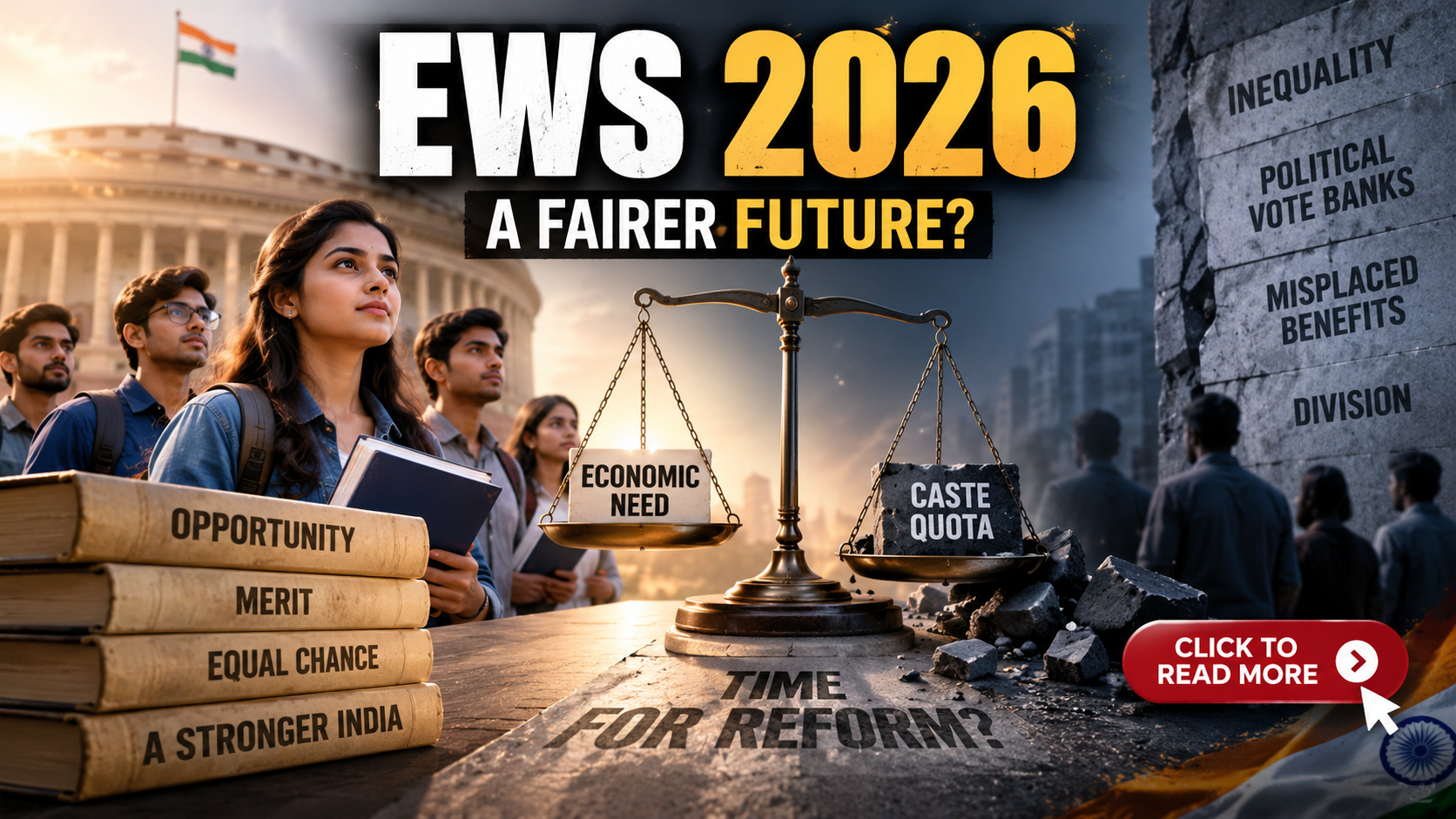
EWS Quota Notification September 2026 UPDATE:
What Has Changed, What Has Not, and Why India’s Reservation Debate Needs Reform
India’s reservation debate has entered another phase in September 2026 but there is an important distinction between new EWS-related notifications and any change to the national reservation policy.
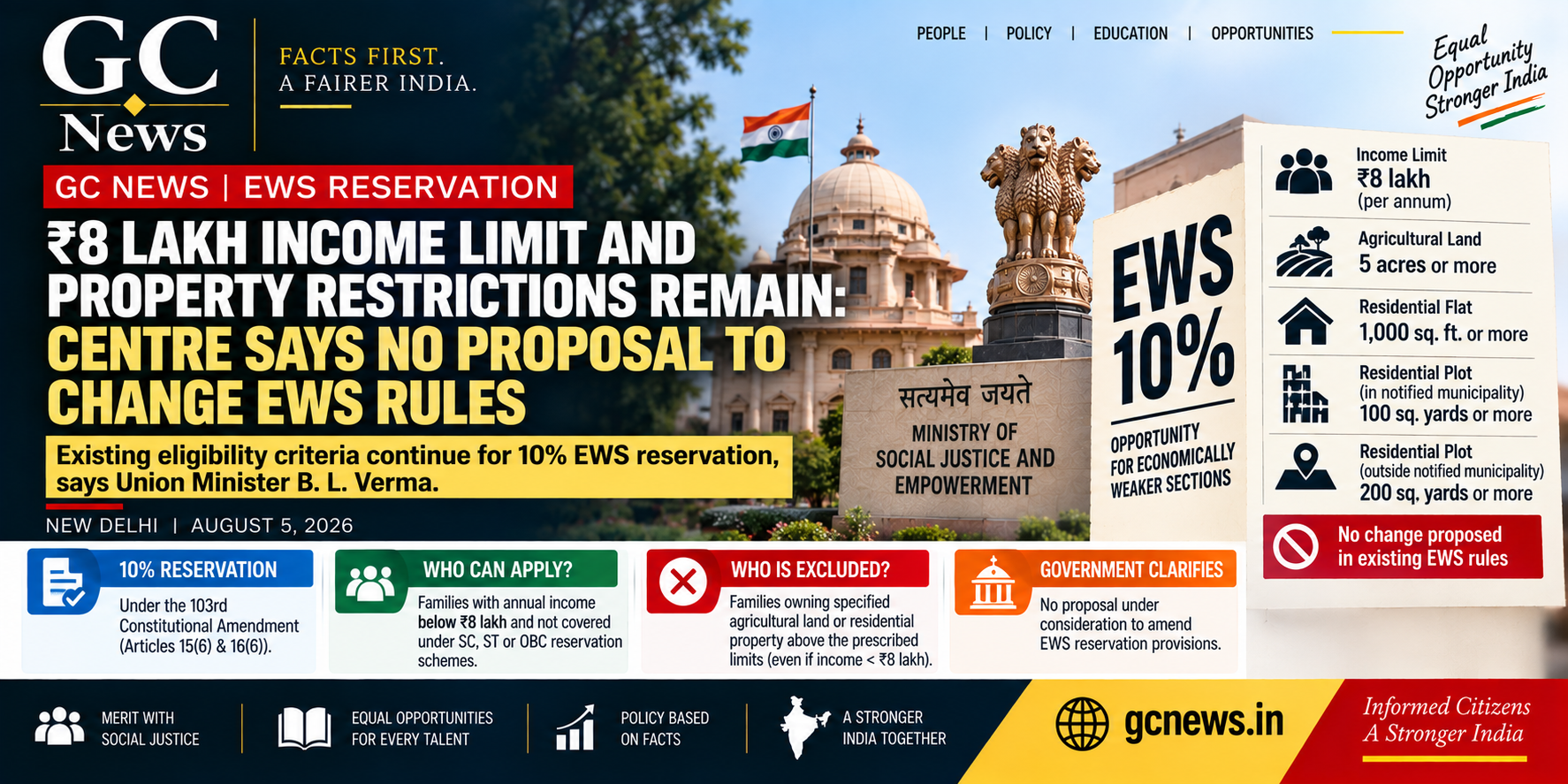
As of September 6, the latest verified position from the Union government is that the existing Economically Weaker Sections (EWS) reservation framework remains in force, with up to 10% reservation enabled by the Constitution (103rd Amendment) Act, 2019. The government said in August that no proposal was under consideration to amend the existing EWS reservation provisions.
At the state and institutional level, however, EWS rules continue to generate fresh notifications and administrative action. The Government of Goa, for example, updated its page on EWS reservation points on September 5, 2026, while Delhi schools have recently been directed to verify vacant EWS and freeship seats.
The bigger question is therefore not simply whether EWS reservation will continue. It is whether India's reservation system should gradually move from permanent caste-based categories towards a more targeted system based on measurable disadvantage, economic need and educational deprivation.


Key points
- The EWS framework permits up to 10% reservation in educational institutions and civil posts and services.
- It was enabled through Articles 15(6) and 16(6), inserted by the 103rd Constitutional Amendment in 2019.
- EWS reservation is designed for economically weaker people outside the existing SC, ST and SEBC reservation schemes.
- The central government said in August 2026 that no amendment to the existing EWS provisions was under consideration.
- The Supreme Court upheld the constitutional validity of the 103rd Amendment in 2022 by a 3-2 majority.
- The continuing policy debate concerns whether reservation should remain substantially tied to caste or become more closely targeted at current disadvantage.
What is the September 2026 EWS position?
There is no verified evidence of a new nationwide September 2026 notification abolishing, replacing or fundamentally altering the central EWS quota.
That matters because searches for an “EWS quota notification September 2026” can easily mix together central government rules, state-level orders, recruitment notices and admission instructions. They are not interchangeable.
The Union government's most recent clear statement came on August 5. The Ministry of Social Justice and Empowerment said the purpose of EWS reservation is to benefit economically weaker persons who are not covered by existing reservation schemes for SCs, STs and SEBCs. It also confirmed that the 2019 constitutional amendment enables reservation of up to 10% in educational admissions and civil posts and services.
Meanwhile, individual institutions and states continue to issue operational instructions. For example, a 2026 admission brochure from the National Council for Hotel Management-related system requires eligible candidates claiming EWS status to submit the prescribed certificate by September 30, failing which admission under the EWS category can be cancelled.
Why EWS changed the reservation debate?
The importance of EWS goes beyond its 10% figure.
For decades, Indian affirmative-action policy has primarily used social and educational backwardness, with caste playing an important role in identifying disadvantaged groups. EWS introduced a separate constitutional route based principally on economic disadvantage for people outside the existing SC, ST and SEBC categories.
That represents a significant conceptual shift.
The Union government has previously stated that the ₹8 lakh annual family-income criterion for central EWS eligibility was fixed after a detailed study.
The Supreme Court subsequently upheld the 103rd Amendment, rejecting the constitutional challenge to the EWS framework by a 3-2 majority.
The development demonstrated that affirmative action does not necessarily have to be discussed exclusively through the lens of caste. Economic disadvantage can also be relevant to public policy.
What is wrong with the present reservation model?
Criticism of reservation does not require denying the historical discrimination that made affirmative action necessary. The more difficult question is whether a policy created to address disadvantage should be continuously evaluated against present-day evidence.
One major concern is that caste can become an imperfect proxy for current disadvantage. Two people belonging to the same broad social category may have dramatically different family incomes, educational opportunities, geographic circumstances and access to professional networks.
That is one reason the Supreme Court has repeatedly dealt with the concept of the “creamy layer”. In its 2024 judgment concerning sub-classification among Scheduled Castes, the Court discussed the concern that benefits should not be monopolised by the more advanced sections of a backward class.
A second problem is targeting. If reservation is intended as affirmative action, its effectiveness should ultimately be measured by whether it reaches people who actually remain disadvantaged.
A third concern is policy rigidity. A reservation system can become difficult to reform once political and social interests become attached to particular quotas. That creates a risk that temporary corrective mechanisms turn into structures with no clear review mechanism.
These are arguments for reform, not for pretending that historical discrimination never existed.
Should caste-based reservation be replaced?
That is ultimately a constitutional and political question, not something established by the September 2026 EWS notifications.
A reform-oriented model could instead place greater emphasis on family economic circumstances, parental education, quality of schooling, geography, disability and other objectively measurable indicators of disadvantage. Caste-related disadvantage could also be studied through reliable contemporary data rather than assumed uniformly across every individual within a category.
Such a system would need strong safeguards. Income and asset verification would have to be credible, criteria would require periodic review, and historically disadvantaged communities could not simply lose protections overnight without evidence that the underlying disadvantage had disappeared.
The Supreme Court's discussion of the creamy-layer principle illustrates the underlying policy problem: affirmative action works best when benefits reach those who actually require them.

Join the Conversation