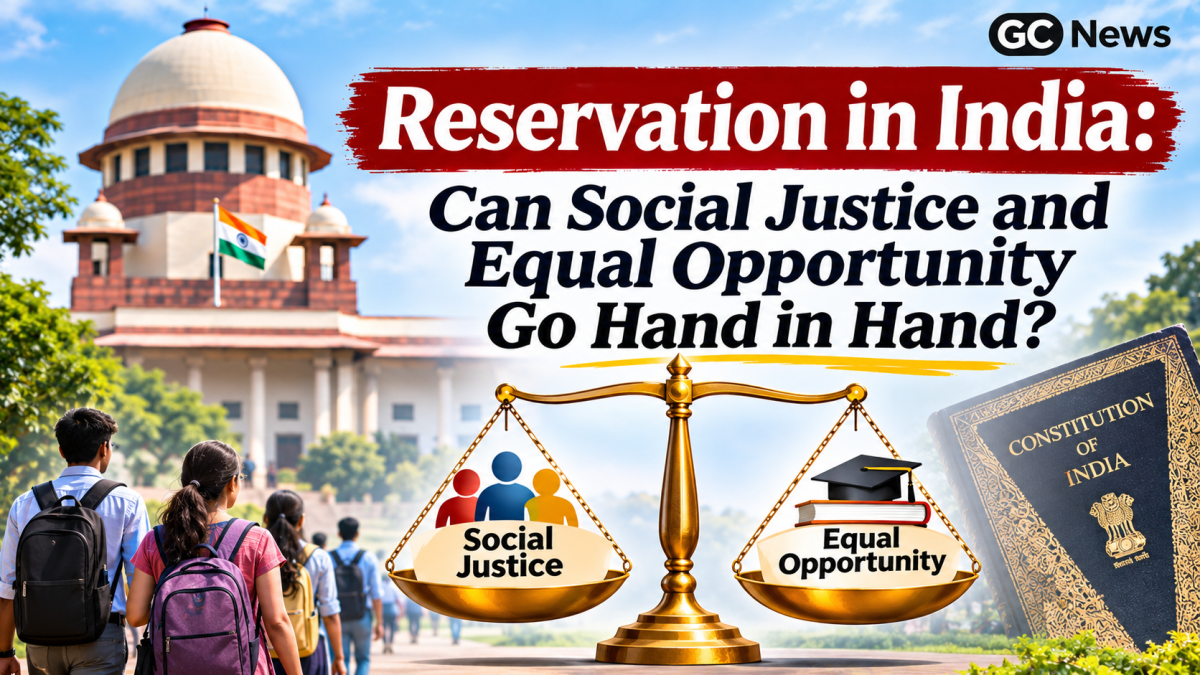
Opinion and Analysis | Indian Constitution | Education and Public Policy
India has always faced a difficult question about equality: should everyone be treated exactly the same, or should society also account for the disadvantages that prevent some people from competing on equal terms?
It is a question that goes to the heart of the Indian Constitution.
For some people, reservation represents an opportunity to overcome generations of social exclusion. For others, particularly some economically struggling candidates in the General or Unreserved Category, the current system raises difficult questions about competition, financial hardship and access to education and government employment.
These concerns often lead to heated arguments. Some defend reservation as an essential instrument of social justice, while others call for reforms that give greater weight to economic disadvantage. Between these positions lies a more complicated reality: India is trying to address historical discrimination, unequal access to opportunity and economic hardship through policies that must operate across an extraordinarily diverse population.
The question, therefore, is not simply whether reservation should exist. It is whether India's approach is delivering fair opportunities, reaching those who need support and responding adequately to changing social and economic conditions.
A serious discussion must begin with facts rather than slogans. It must examine the Constitution, court judgments, official statistics and the experiences of people from different backgrounds.
Most importantly, it must recognise that the struggle of one group does not automatically make the concerns of another group illegitimate.
Can India protect the principle of social justice while ensuring that every citizen has a fair opportunity to build a better future?
Answering that question requires a closer look at how reservation works, why it was introduced and what might need to change.
1. What Is Reservation, and Why Was It Introduced?
Reservation is a form of affirmative action through which the government sets aside a specified proportion of seats or positions for eligible members of designated groups under applicable rules.
In India, the system developed in response to long-standing inequalities associated with caste, untouchability, social exclusion and limited access to education, public institutions and employment.
For generations, many communities faced restrictions that affected their ability to obtain education, acquire property, enter certain occupations and participate equally in public life. Formal equality under the law could not, by itself, remove all those barriers.
The framers of the Constitution therefore established provisions allowing the state to take special measures to improve the position of disadvantaged groups.
Reservation became one instrument for pursuing that objective.
Today, the main categories covered by central reservation policies include Scheduled Castes (SCs), Scheduled Tribes (STs), Other Backward Classes (OBCs) and Economically Weaker Sections (EWS), although their constitutional foundations and eligibility rules differ.
These categories should not be treated as interchangeable.
SC and ST reservations are rooted in constitutional provisions addressing specific histories of social exclusion and disadvantage. OBC reservation is based on the recognition of socially and educationally backward classes, subject to the applicable legal framework. EWS reservation, introduced through the Constitution (103rd Amendment) Act, 2019, provides a separate route for economically weaker people who are not covered by the existing SC, ST and socially and educationally backward class reservation schemes.
Understanding these distinctions is essential to discussing the system fairly.
Reservation is not one single policy with identical rules everywhere. Different provisions apply to public employment, educational admissions, promotions and local bodies. Central and state governments may also operate different arrangements within the constitutional framework.
A discussion that ignores these differences risks presenting an incomplete picture of Indian law.
2. What Does the Constitution Say About Equality?
The Indian Constitution contains several provisions that must be considered together when discussing reservation.
Article 14: Equality Before the Law
Article 14 guarantees equality before the law and equal protection of the laws.
It establishes a fundamental principle: the state cannot arbitrarily deny people the protection of the law. However, constitutional equality does not necessarily require identical treatment in every situation. Different treatment can be legally permissible when it satisfies the relevant constitutional requirements.
This distinction is central to affirmative action. A measure designed to address established disadvantage is not automatically inconsistent with equality merely because it treats particular groups differently.
At the same time, reservation policies remain subject to constitutional limits and judicial review.
Article 15: Prohibition of Discrimination and Special Provisions
Article 15 prohibits the state from discriminating against citizens on specified grounds, including religion, race, caste, sex and place of birth.
Other clauses of the same article authorise special provisions in defined circumstances.
Article 15(4) permits special provisions for the advancement of socially and educationally backward classes, Scheduled Castes and Scheduled Tribes.
Article 15(5) permits specified special provisions concerning educational admissions for socially and educationally backward classes, SCs and STs, including in certain private educational institutions, subject to constitutional exceptions, including the protection of minority educational institutions under Article 30(1).
Article 15(6), introduced by the 103rd Constitutional Amendment, enables special provisions for economically weaker sections, including reservation of up to 10% of seats in educational institutions, subject to the constitutional text and applicable rules.
These provisions illustrate that the Constitution recognises more than one dimension of disadvantage.
Article 16: Equality of Opportunity in Public Employment
Article 16 addresses equality of opportunity in matters of public employment.
Article 16(4) permits reservation in appointments or posts for a backward class of citizens that, in the state's opinion, is not adequately represented in public services.
Article 16(4A) permits reservation in promotion for SCs and STs under the conditions established by the Constitution and interpreted by the courts.
Article 16(6), also introduced by the 103rd Amendment, enables reservation of up to 10% of appointments or posts for economically weaker sections, subject to the constitutional provisions.
The distinction matters because reservation in initial recruitment, reservation in promotion and reservation in educational admissions are not legally identical.
Article 46: The State's Responsibility Toward Weaker Sections
Article 46, a Directive Principle of State Policy, directs the state to promote the educational and economic interests of weaker sections of society, particularly SCs and STs, and to protect them from social injustice and exploitation.
Although Directive Principles are not enforceable in the same manner as fundamental rights, they provide important guidance for government policy.
Taken together, these constitutional provisions show that India seeks to protect equality while allowing measures intended to overcome substantial disadvantages.
The difficult question is how those measures should be designed, implemented and evaluated.
Official source: The Constitution of India — Legislative Department, Government of India.
3. What Are the Current Reservation Percentages?
One of the most common misunderstandings in public discussions is the assumption that every institution and every government follows exactly the same reservation percentages.
That is not correct.
For direct recruitment to Central Government civil posts and services on an all-India basis through open competition, the Department of Personnel and Training's consolidated instructions specify the following reservation percentages for SCs, STs and OBCs. The central EWS framework separately provides for reservation of up to 10%.
| Category | Central Government direct recruitment through all-India open competition |
|---|---|
| Scheduled Castes (SC) | 15% |
| Scheduled Tribes (ST) | 7.5% |
| Other Backward Classes (OBC) | 27% |
| Economically Weaker Sections (EWS) | Up to 10% |
Source: Department of Personnel and Training, consolidated reservation instructions dated 28 March 2024.
These figures should be interpreted within their stated scope. Rules can differ for recruitment that does not involve all-India open competition, certain posts attracting local or regional candidates, different cadres, educational institutions and state government employment. Applicable service rules and recruitment notifications must always be checked.
In central educational institutions, the Central Educational Institutions (Reservation in Admission) Act, 2006, as amended, provides the statutory framework for specified categories. EWS admission provisions have a separate constitutional and administrative basis.
The percentages do not mean that every vacancy in every institution is divided identically, nor do they necessarily describe the reservation policy of a particular state.
This distinction is important because many arguments about reservation use national figures to describe a local recruitment process without checking the applicable rules.
4. Is the General Category the Same as the Unreserved Category?
This is an important distinction that is frequently overlooked.
The term General Category is commonly used to describe people who do not belong to the SC, ST or OBC categories for the purpose of a particular reservation system. In discussions about central EWS reservation, eligible people outside the existing SC, ST and OBC reservation categories may qualify under the EWS rules.
The term unreserved, however, has a specific meaning in recruitment and admissions.
Unreserved seats are generally open to all eligible candidates, including those belonging to reserved categories. They are not exclusively the property of General Category candidates.
Where a candidate from a reserved category qualifies on open merit under the applicable selection rules, that candidate may be counted against an unreserved seat rather than consuming a reserved seat. The exact treatment depends on the rules governing the selection process, including the use of relaxations.
This does not mean every recruitment result is free from legitimate concerns about fairness. It means that the number of reserved seats and the number of people selected from a particular community are not necessarily the same thing.
For example, if a selection process has 100 posts, a category's reservation percentage does not automatically establish the final social-category composition of every selected candidate. Open-merit selection, eligibility, roster rules and the particular recruitment framework also matter.
An accurate analysis must distinguish the reservation attached to a post from the category identity of the person selected.
It must also recognise that the Unreserved Category is not economically uniform. It includes people from affluent households, middle-income families and households struggling to pay for education, rent, transport, examination fees and coaching.
The same is true of people within reserved categories: economic circumstances and access to opportunity vary significantly among individuals and communities.
Any serious reform discussion must account for both realities.
5. EWS Reservation: What Does the Law Provide?
Economically Weaker Sections reservation is particularly relevant to the debate over opportunity because it recognises economic disadvantage separately from the existing reservation schemes for SCs, STs and socially and educationally backward classes.
The Constitution (103rd Amendment) Act, 2019 introduced Articles 15(6) and 16(6), enabling reservation of up to 10% for eligible EWS candidates in educational admissions and public employment.
For the central EWS framework, the government has specified that a person's family must generally have a gross annual income below ₹8 lakh from all sources and must not fall under the excluded reservation categories.
Income alone is not sufficient.
Under the central criteria, a family is excluded from EWS eligibility, irrespective of income, if it owns or possesses any of the following:
-
Five acres or more of agricultural land.
-
A residential flat measuring 1,000 square feet or more.
-
A residential plot measuring 100 square yards or more in a notified municipality.
-
A residential plot measuring 200 square yards or more in other areas.
The relevant family and asset definitions must be read alongside the applicable government instructions. State rules and individual recruitment or admission requirements may differ.
Source: Ministry of Social Justice and Empowerment, Government of India, 5 August 2026.
The introduction of EWS reservation was significant because it created a constitutional route for economic disadvantage among people outside the existing SC, ST and socially and educationally backward class reservation schemes.
However, its design also raises legitimate questions.
Does an annual income threshold accurately capture the difference between a household that has stable access to assets and one that faces considerable financial insecurity? Does the eligibility framework account adequately for regional differences in living costs? How should assets, income volatility and family circumstances be assessed?
These questions do not establish that EWS reservation is ineffective. They show why eligibility rules and their outcomes should be evaluated with evidence.
A household's income is important, but it does not always tell the entire story of its economic security.
Equally, economic hardship does not erase the social disadvantages that reservation for SCs, STs and OBCs is intended to address.
The challenge is to recognise these different dimensions of disadvantage without pretending that one can always replace the other.
6. Why Does Reservation Remain Controversial?
The reservation debate continues because people disagree not only about policy outcomes, but also about what fairness itself requires.
For some, fairness means ensuring that historical exclusion does not continue to determine access to education, employment and positions of influence. For others, fairness also demands that present-day poverty and individual effort receive greater recognition in competitive selection.
These concerns can coexist.
The argument in favour of reservation
Supporters argue that formal equality does not automatically produce equal opportunity.
A student from a family with limited resources may attend a school with fewer teachers, less reliable infrastructure and limited access to advanced learning materials. Another student may grow up with better schools, private tutoring, educated family members and professional networks.
Both students may be subject to the same examination rules, but they may not have had the same preparation opportunities.
Caste-based exclusion can introduce another set of disadvantages. Discrimination, social barriers, underrepresentation and the effects of historical exclusion may influence access to educational and professional opportunities.
Supporters therefore view reservation as one way to improve access to institutions that have not always reflected the diversity of Indian society.
They also argue that representation matters. Public institutions can gain legitimacy when people from historically excluded communities have meaningful opportunities to participate in them.
The concerns raised by critics
Critics question whether the existing system always identifies the individuals and communities most in need of assistance.
Some economically struggling candidates outside the SC, ST and OBC reservation categories face substantial barriers to quality schooling, coaching and higher education. They may believe that their financial difficulties receive insufficient attention in a system that distinguishes between eligibility categories.
Others question whether the benefits of reservation are distributed evenly within the eligible groups, whether eligibility rules are sufficiently transparent and whether governments regularly measure the outcomes of their policies.
There are also debates about examination cut-offs, the role of economic criteria, the exclusion of the OBC creamy layer and the treatment of disadvantaged communities that remain poorly represented despite the existence of reservation.
These questions deserve careful examination.
However, it is important not to move from an individual experience to an unsupported national conclusion. A candidate's disappointing examination result does not by itself establish that reservation is responsible. Equally, evidence of historical disadvantage does not establish that every existing reservation policy is optimally designed.
Policies should be judged by their legal framework, implementation and measurable effects.
The argument should be about what the evidence supports, not about attributing the problems of an entire community to another community.
7. Does Reservation Mean Merit Is Being Ignored?
The relationship between reservation and merit is one of the most contentious parts of the debate.
Competitive examinations often use marks, rankings and eligibility criteria to identify candidates. These measures have an important role in selection. It would be inaccurate to suggest that individual performance does not matter.
However, marks alone cannot explain every difference in educational opportunity.
Preparation may depend on access to experienced teachers, stable housing, electricity, internet access, books, language support, nutritious food, time to study and the ability to pay for coaching or examination fees.
Students do not start from identical circumstances.
At the same time, these differences do not mean that academic standards should be ignored or that all candidates from any particular background perform in the same way. Individuals vary widely in their abilities, preparation and achievements.
The useful question is how selection systems can maintain appropriate standards while accounting for the disadvantages that prevent capable students from reaching their potential.
Reservation is one part of this discussion. Better public schooling, affordable coaching, scholarships, mentoring and improved access to higher education are also essential.
There is a further distinction between selection and subsequent performance. If the goal is to build effective institutions, governments should examine whether students receive appropriate academic support and whether public employees can perform their responsibilities effectively.
The discussion should move beyond the assumption that equality and merit must always be in conflict.
A more constructive approach would ask how India can broaden opportunity, maintain transparent standards and help people from disadvantaged backgrounds succeed after gaining access to education or employment.
8. What Do the Data Tell Us About Access to Education?
Statistics can help move this debate away from generalisations.
The Ministry of Education's Annual Report 2024–25, drawing on the All India Survey on Higher Education (AISHE), reported the following changes in higher-education enrolment between 2014–15 and 2022–23:
| Group | Enrolment in 2014–15 | Enrolment in 2022–23 | Reported change |
|---|---|---|---|
| Scheduled Caste students | 46.07 lakh | 69.13 lakh | +50.1% |
| Scheduled Tribe students | 16.41 lakh | 28.72 lakh | +75.0% |
| Female SC students | 21.02 lakh | 33.89 lakh | +61.2% |
| Female ST students | 7.47 lakh | 14.67 lakh | +96.3% |
Source: Ministry of Education, Annual Report 2024–25.
These figures show an increase in the number of SC and ST students enrolled in higher education during the period covered.
That is an important development, but the statistics require careful interpretation.
An increase in enrolment does not, by itself, establish that reservation caused the entire increase. Expansion in the number of higher-education institutions, broader participation, public programmes, changes in population and other factors may also contribute.
Similarly, enrolment counts do not tell us everything about the quality of education, completion rates, student debt, the availability of suitable courses or access to employment after graduation.
A student entering university is an important step. Being able to complete a degree, develop useful skills and obtain meaningful employment are equally important outcomes.
The data also do not justify assuming that all members of a category have the same circumstances. Differences within social groups, including those associated with gender, region, income and rural or urban residence, require attention.
The broader lesson is that reservation policy should be evaluated alongside the entire educational pathway.
If students are to have genuinely equal opportunities, governments must consider what happens before admission, during the course and after graduation.
9. What Do Government Employment Statistics Show?
Employment data provide another perspective on the debate.
In an answer published on 7 August 2026, the Ministry of Social Justice and Empowerment reported that SC employees accounted for 17.14% of Central Government services as of 1 January 2026. The stated reservation percentage for SCs in central government posts and services is 15%.
The same response clarified that the government does not centrally maintain data on representation within individual SC castes. Official parliamentary response.
This figure is useful, but it must not be interpreted beyond what it measures.
It is a figure for the overall representation of SC employees in Central Government services. It does not, on its own, describe representation at every level, in every department, in every state, or across private-sector employment.
Nor does it show whether opportunities are distributed evenly among all communities within the SC category.
A national figure can conceal differences between departments, occupational levels and regions. It may also conceal differences between recruitment and promotion, depending on the data being considered.
The government has also reported efforts to fill reserved backlog vacancies. In December 2025, the Ministry of Personnel stated that more than 4.80 lakh backlog vacancies had been filled since 2016. This was a cumulative figure for vacancies filled, not a statement that 4.80 lakh vacancies remained unfilled. Official parliamentary update.
These details show why good policy needs more than one headline statistic.
A serious assessment should ask how many posts are sanctioned, how many are vacant, how many reserved vacancies remain unfilled, which recruitment levels are affected, and whether the people who receive opportunities can progress through their careers.
The point is not to dismiss evidence that shows progress. It is to ensure that progress is measured accurately and that unresolved problems are not hidden by broad averages.
10. The Supreme Court's Role in Shaping Reservation Policy
Reservation in India has been shaped substantially by decisions of the Supreme Court.
Three judgments are particularly important for understanding the current debate.
Indra Sawhney v. Union of India (1992)
The nine-judge Supreme Court decision in Indra Sawhney v. Union of India is a landmark judgment concerning OBC reservation in public employment.
The Court upheld the principle of reservation for backward classes in central government services under Article 16(4), while also addressing important restrictions on how reservation could operate.
The judgment established the exclusion of the socially advanced sections of OBCs, commonly called the creamy layer, from the relevant OBC reservation benefits. It also established the general 50% ceiling on reservations under the provisions considered in the case, subject to the Court's treatment of exceptional circumstances.
The judgment's treatment of reservations in promotions was subsequently affected by constitutional amendments, including the insertion of Article 16(4A) concerning SC and ST promotions.
This is why the 50% principle should not be described as an absolute rule that automatically resolves every reservation question under every constitutional provision.
Sources: Indra Sawhney judgment and Supreme Court's EWS judgment, which discusses the earlier framework.
Janhit Abhiyan v. Union of India (2022)
In November 2022, a five-judge Constitution Bench considered challenges to the Constitution (103rd Amendment) Act, 2019, which introduced EWS reservation through Articles 15(6) and 16(6).
By a 3:2 majority, the Supreme Court upheld the constitutional validity of the amendment.
The decision is significant because it confirmed that the Constitution could provide a separate reservation framework for economically weaker sections outside the existing SC, ST and socially and educationally backward class reservation categories.
It also addressed the argument that the EWS provisions were unconstitutional because of their relationship to the earlier 50% reservation principle and because of the categories they covered.
The decision did not mean that every detail of reservation policy was beyond judicial review. Specific schemes and administrative decisions must still comply with the relevant constitutional and legal requirements.
Source: Supreme Court of India, Janhit Abhiyan judgment, 7 November 2022.
State of Punjab v. Davinder Singh (2024)
On 1 August 2024, a seven-judge Constitution Bench ruled by a 6:1 majority that states may sub-classify Scheduled Castes for reservation, subject to constitutional requirements.
The Court recognised that disadvantage is not necessarily distributed uniformly within the Scheduled Caste category. It held that sub-classification can be permissible when supported by adequate empirical evidence and designed to direct benefits towards more disadvantaged groups without improperly changing the constitutional lists.
The decision is important because it focuses attention on a question that arises within reservation systems: even when a group qualifies for support, are all members of that group equally able to access its benefits?
The judgment does not authorise arbitrary divisions. State action remains subject to legal scrutiny, and decisions must be supported by relevant evidence.
Source: Supreme Court of India, landmark judgment summary: State of Punjab v. Davinder Singh.
Together, these judgments illustrate that reservation is not a fixed policy immune from reconsideration. Its constitutional foundations remain important, but the Supreme Court has also examined eligibility, limits, distribution of benefits and the evidence required to justify particular arrangements.
11. Why India's Census 2027 Matters to This Debate
One of the most important developments for future discussions about reservation is the decision to include caste enumeration in Census 2027.
In an official response dated 4 February 2026, the Ministry of Home Affairs confirmed that caste would be enumerated during the second phase of Census 2027. Later government updates described preparations for the census, while DD News reported that caste-related questions had been included in the population-enumeration schedule. Individual-level and comprehensive caste-wise results are not yet available as a completed national dataset. <sup>[1][2]</sup>
This matters because debates over the design of reservation policy often depend on questions about population, representation, education, occupation, income and access to public institutions.
Reliable data can help governments and researchers examine these questions more carefully.
For example, data could help assess whether different communities experience different educational outcomes, whether access to government employment varies between groups, and whether disadvantages are concentrated in particular regions or among particular sections of a community.
However, census data alone cannot answer every question.
Population counts do not automatically reveal the causes of disadvantage. Information about caste must be considered alongside education, employment, income, geography and other relevant indicators. Data quality, privacy, methodology and transparent interpretation also matter.
The census should not be treated as a shortcut to a predetermined political conclusion. Its value will depend on how carefully the information is collected, analysed and applied.
If the resulting information is reliable and made available through appropriate, transparent processes, it could provide a stronger empirical basis for future debate.
Source: Ministry of Home Affairs, Government of India — Caste-Based Census, 4 February 2026.
12. Is the Current Reservation System Enough?
The answer depends partly on what we expect the system to achieve.
If the objective is to improve access for historically disadvantaged groups, reservation is one important mechanism. But it cannot, by itself, provide every student with a good school, every family with financial security or every graduate with suitable employment.
Consider a student who receives a place in a university but has attended a school with limited facilities. Admission alone may not address gaps in academic preparation, access to digital resources or the cost of living away from home.
Consider another student from a low-income household who does not qualify for an existing reservation category. That student may also face serious barriers to higher education and competitive examinations.
These examples illustrate different forms of disadvantage. They do not prove that one policy should replace another.
A more comprehensive system would address barriers at different stages of life.
School education matters. Students need qualified teachers, reliable infrastructure, safe learning environments and access to the resources required to develop foundational skills.
Financial support matters. Scholarships, fee assistance, affordable accommodation and access to learning materials can make a real difference to students who struggle to meet the costs of education.
Preparation matters. Access to quality coaching, career guidance and mentoring should not depend entirely on a family's ability to pay.
The transition to employment matters. Governments and institutions should monitor whether students can complete their education and whether graduates from different backgrounds can access suitable jobs.
Anti-discrimination measures matter. Formal access is not enough if people continue to encounter unlawful discrimination or other barriers in educational and professional environments.
These measures can complement reservation rather than necessarily compete with it.
The broader objective should be to prevent disadvantage from becoming a permanent barrier to participation.
13. What Reforms Could Make Reservation Policy Fairer?
Reform should begin with evidence rather than the assumption that one uniform solution will work for every group, institution and state.
Several areas deserve serious consideration.
Better and More Transparent Data
Governments should publish reliable information about recruitment, admissions, representation, vacancies and progression wherever legally appropriate and operationally feasible.
Data should distinguish between different levels of employment and education rather than relying entirely on national averages.
Where data are available, they should be examined alongside information on income, geography, gender and other relevant circumstances.
This would make it easier to identify where policy is working and where significant gaps remain.
Periodic, Evidence-Based Reviews
Reservation policies should be administered within the Constitution and existing legal framework, with appropriate reviews of their implementation and outcomes.
Such reviews should not become an excuse for arbitrary exclusion. They should establish what the evidence shows, identify problems and determine whether measures are reaching their stated objectives.
Any changes to eligibility or allocation must comply with constitutional requirements and relevant court judgments.
Improve the Distribution of Benefits
The Supreme Court's decision in Davinder Singh demonstrates that unequal access to benefits within a broader eligible group is a legitimate policy question.
Where the law permits it, governments should use credible evidence to assess whether some communities face substantially greater disadvantage than others.
Such assessments must be rigorous. Historical disadvantage, educational outcomes and representation should not be reduced to assumptions about individual communities.
The purpose should be to identify genuine gaps, not to create new divisions without supporting evidence.
Evaluate Economic Eligibility Carefully
EWS reservation provides a distinct route to support eligible economically weaker people outside the existing SC, ST and socially and educationally backward class reservation schemes.
The government should be able to explain how the income and asset criteria operate, how certificates are verified and what evidence supports the framework.
Any proposed revision should consider household circumstances, regional differences, asset ownership and the effect of eligibility rules on genuinely disadvantaged applicants.
It is equally important to distinguish EWS eligibility from the OBC creamy-layer framework. They serve different legal purposes and should not be treated as interchangeable.
Address Unfilled Vacancies
A reservation policy cannot deliver its intended benefits effectively if eligible vacancies remain unfilled for long periods.
Government departments should identify the causes of backlog vacancies, improve recruitment administration and publish clear information about progress.
Measures should also ensure that recruitment processes are timely, transparent and consistent with applicable rules.
Invest in Opportunity Before Selection
Reservation is often discussed only when examination results or admission lists are released. Yet many of the inequalities that influence these outcomes develop much earlier.
Investment in public schools, higher-education institutions, scholarships and skills training can expand the number of people who are prepared to compete successfully.
The government should also consider the needs of students from low-income households across social categories.
This is not an argument that all forms of disadvantage are identical. It is an argument that a policy aimed at fair opportunity must also improve the conditions in which people learn, prepare and work.
Make Evaluation a Public Exercise
Reservation policy affects education, employment, social mobility and public institutions. Its results should therefore be assessed through transparent methods and reliable evidence.
Independent research, parliamentary scrutiny, audits and well-designed surveys can help identify progress and shortcomings.
The public debate would become more constructive if governments consistently explained not only what a policy provides, but also what outcomes it is intended to achieve and how those outcomes will be measured.
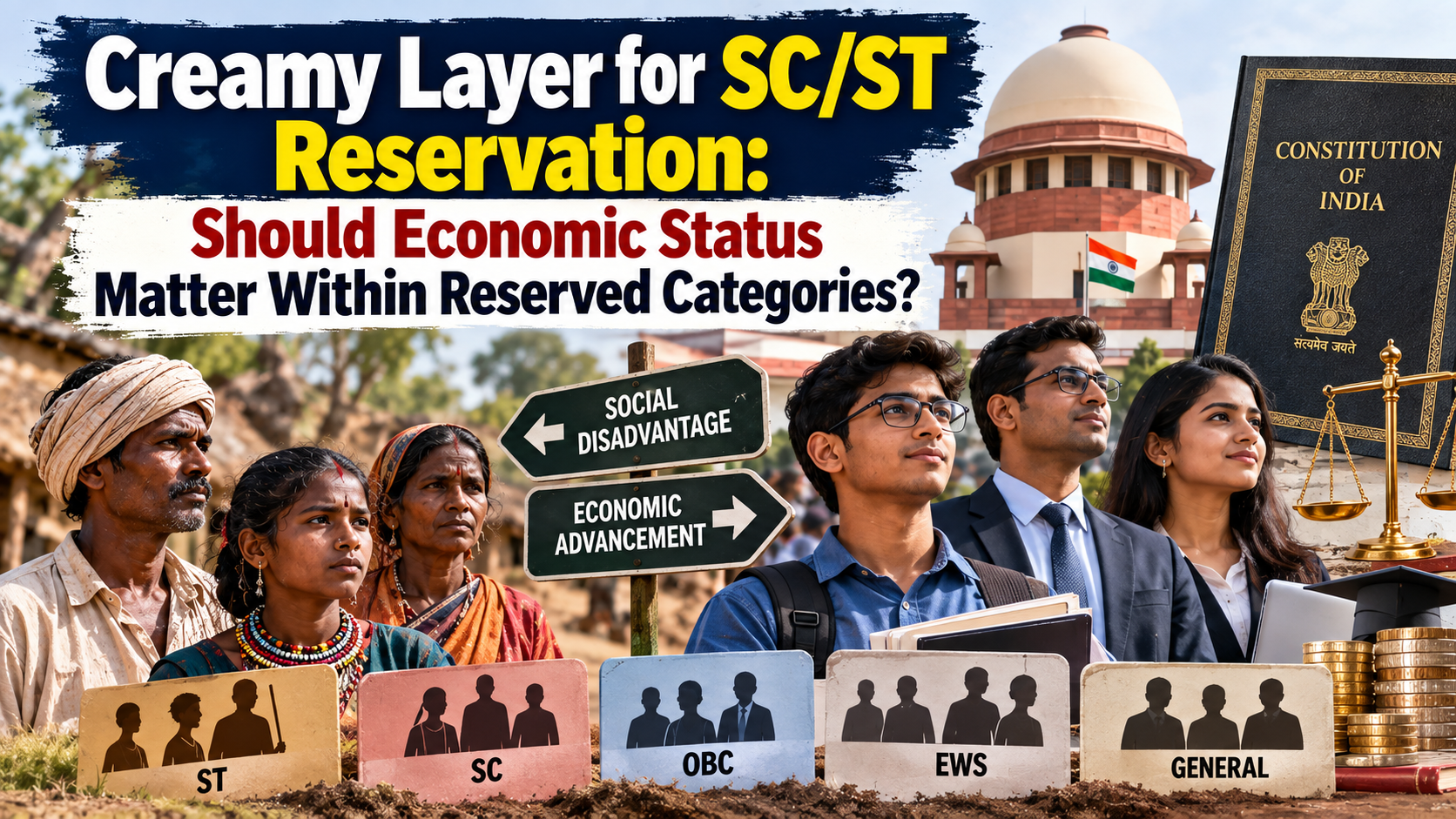
14. The General Category and the Question of Economic Hardship
No discussion of reservation is complete without considering economically struggling people outside the SC, ST and OBC reservation categories.
A student may belong to an Unreserved Category household and still face serious financial limitations. Family income may be unstable, parents may have limited formal education, and the student may lack access to expensive coaching, private institutions or professional networks.
These circumstances should not be dismissed simply because the student does not belong to a particular reservation category.
At the same time, economic hardship does not erase the distinct forms of historical and social disadvantage that reservation for SCs, STs and OBCs is intended to address.
The Constitution's EWS provisions recognise this distinction by establishing a separate eligibility framework.
The policy question is how to ensure that the rules work as intended and that economically weaker eligible candidates can access the support available to them.
The ₹8 lakh family-income threshold and asset exclusions in the central EWS framework are particularly important in this context. Their practical effects should be examined using reliable data and the experiences of applicants, not only political claims.
If there are gaps in implementation, governments should identify them and consider lawful, evidence-based improvements.
The objective should be to address genuine hardship without incorrectly treating different forms of disadvantage as identical.
15. Social Justice and Equal Opportunity Are Not Necessarily Opposing Goals
Much of the public discussion presents social justice and equal opportunity as if the country must choose one at the expense of the other.
That is an unnecessarily narrow way to frame the issue.
Social justice is concerned with whether people who have experienced exclusion and disadvantage can participate fully in society. Equal opportunity is concerned with whether individuals have a fair chance to develop their abilities and pursue their ambitions.
In a constitutional democracy, these objectives can support one another.
Reservation seeks to address particular barriers to access and representation. Better public education, financial assistance, transparent selection, effective anti-discrimination measures and reliable data can help strengthen the broader conditions for opportunity.
The policies are not interchangeable, but they can form part of a wider strategy.
There will still be disagreements about how eligibility should be defined, how benefits should be distributed and what percentage of seats or posts should be reserved. Those questions require careful legal and empirical assessment.
The existence of disagreement does not mean that every policy criticism is an attack on social justice. Nor does criticism of a particular rule establish that reservation as a whole is unnecessary.
The quality of the debate depends on whether people are willing to examine evidence, recognise different experiences and revise their conclusions when the facts require it.
India's challenge is not to eliminate disagreement. It is to make decisions through a process that is constitutional, transparent and informed by evidence.
Conclusion: Can India Build a Fairer System for Everyone?
Reservation in India is a complex constitutional and social policy with a history that cannot be reduced to a single slogan.
It was developed in response to deep and persistent inequalities. Its legal foundations recognise that equal treatment on paper may not be sufficient when access to opportunity has been unequal for generations.
At the same time, the system raises important questions about eligibility, implementation, economic hardship, distribution of benefits and the measurement of outcomes. These questions deserve serious answers.
The data show that participation in higher education among SC and ST students has increased over the period reported by the Ministry of Education. Government employment statistics also provide information about representation and the continuing administrative work required to fill reserved vacancies.
But these figures are not a complete assessment of the system. They do not, by themselves, establish how much progress can be attributed to reservation, whether access is equitable within each category or whether all eligible candidates have a fair opportunity to succeed.
The Supreme Court's judgments demonstrate that reservation policy operates within a constitutional framework that continues to be interpreted and applied to difficult questions.
The inclusion of caste enumeration in Census 2027 creates an opportunity for a better-informed discussion, provided the resulting data are reliable and interpreted responsibly.
India should use that opportunity to ask better questions. Are opportunities reaching the people who face the relevant disadvantages? Are schools and universities providing the support students need? Are vacancies being filled transparently? Are income and asset criteria operating fairly? Are public institutions measuring their results properly?
These are more useful questions than simply asking which community benefits more.
A society becomes fairer when it acknowledges disadvantages honestly, makes decisions through transparent rules and provides people with meaningful opportunities to improve their lives.
Reservation may remain an essential part of India's approach to social justice, but it should exist within a broader commitment to quality education, economic mobility, institutional accountability and equal protection under the law.
The real goal should not be to make one community feel that it has defeated another. It should be to build a system in which historical injustice is addressed, economic hardship is taken seriously and every eligible individual has a fair chance to realise their potential.
Social justice and equal opportunity should not be treated as enemies. The task before India is to make both principles work together, using constitutional safeguards, reliable evidence and policies that can be evaluated honestly.
Sources and Further Reading
The following sources provide the principal legal texts, court judgments, official policies and statistics used in this article. Readers should consult the original documents when evaluating specific legal claims.
Constitutional and Legal Sources
1. Constitution of India — Legislative Department, Government of India
The primary source for Articles 14, 15, 16, 46 and related constitutional provisions.
https://www.legislative.gov.in/
2. Department of Personnel and Training — Central Government Reservation Instructions, 28 March 2024
Official consolidated instructions covering reservation for SCs, STs, OBCs, EWS and other eligible groups in Central Government services.
https://doptcirculars.nic.in/OM/ViewOMNew.aspx?id=471
3. Central Educational Institutions (Reservation in Admission) Act, 2006 — India Code
The statutory framework for specified reservation arrangements in central educational institutions.
https://www.indiacode.nic.in/indiacode/handle/123456789/2091?view_type=browse
4. Indra Sawhney v. Union of India (1992)
Landmark Supreme Court decision on reservation for backward classes in public employment, creamy-layer exclusion and the general 50% ceiling.
https://indiankanoon.org/doc/1363234/
5. Janhit Abhiyan v. Union of India (2022)
Supreme Court judgment concerning the constitutional validity of the 103rd Constitutional Amendment and EWS reservation.
https://api.sci.gov.in/supremecourt/2019/1827/1827_2019_1_1501_39619_Judgement_07-Nov-2022.pdf
6. State of Punjab v. Davinder Singh (2024)
Supreme Court judgment on sub-classification within the Scheduled Castes for reservation, including the requirement for evidence supporting such measures.
https://www.sci.gov.in/landmark-judgment-summaries/?judgment_year=2024
Official EWS and Reservation Policy Sources
7. Ministry of Social Justice and Empowerment — EWS Eligibility Clarification, 5 August 2026
Official explanation of the central EWS reservation framework, the ₹8 lakh family-income threshold and the applicable asset exclusions.
https://www.pib.gov.in/PressReleasePage.aspx?PRID=2295093&lang=1®=6
8. Press Information Bureau — Reservation Policy
Government information on reservation percentages for central government recruitment and provisions for different eligible groups.
https://www.pib.gov.in/Pressreleaseshare.aspx?PRID=1564231&lang=2®=3
9. Department of Personnel and Training — EWS Instructions
Official guidance on income and asset certificates and the administration of EWS reservation in Central Government employment.
https://doptcirculars.nic.in/OM/ViewOMNew.aspx?id=471
Education and Employment Data
10. Ministry of Education — Annual Report 2024–25
Contains reported higher-education enrolment statistics, including changes in SC and ST enrolment between 2014–15 and 2022–23.
11. Ministry of Social Justice and Empowerment — SC Representation in Central Government Services, 7 August 2026
Official parliamentary response reporting 17.14% overall SC representation in Central Government services as of 1 January 2026 and explaining the limits of available caste-wise data.
https://www.pib.gov.in/PressReleasePage.aspx?PRID=2296291&lang=1®=3
12. Ministry of Personnel, Public Grievances and Pensions — Backlog Vacancies, 3 December 2025
Official update stating that more than 4.80 lakh backlog vacancies had been filled since 2016.
https://www.pib.gov.in/PressReleasePage.aspx?PRID=2198725&lang=2®=48
13. Ministry of Statistics and Programme Implementation — Periodic Labour Force Survey 2025
Official employment and labour-force statistics. The report includes social-group indicators and methodological notes that readers should consider when interpreting comparisons.
Census and Demographic Data
14. Ministry of Home Affairs — Caste-Based Census, 4 February 2026
Government statement confirming that caste enumeration is planned as part of Census 2027.
https://www.pib.gov.in/PressReleasePage.aspx?PRID=2223099&lang=2®=3
15. Ministry of Home Affairs — Census 2027 Preparations, 12 August 2026
Official update on preparations for Census 2027 and the collection of population information.
https://www.pib.gov.in/PressReleasePage.aspx?PRID=2298340&lang=1®=3
16. DD News — Census 2027 and Caste Enumeration
Reporting on the inclusion of caste-related questions in the population-enumeration schedule.
Additional Background
17. National Commission for Backward Classes
Official information on the constitutional body responsible for matters concerning socially and educationally backward classes within its mandate.
18. India Code — Official Central Legislation Portal
A searchable repository for central Acts, amendments and related legal material.
Editorial note: This article reflects information available as of 24 October 2026. Percentages and eligibility rules must be read in their specific legal context. Statistical changes should not be interpreted as proof of causation unless supported by appropriate research. The article presents arguments and policy considerations for public discussion; it does not constitute legal advice.

We'll explain about the fact's. Each and every fact's is too the point.
Good