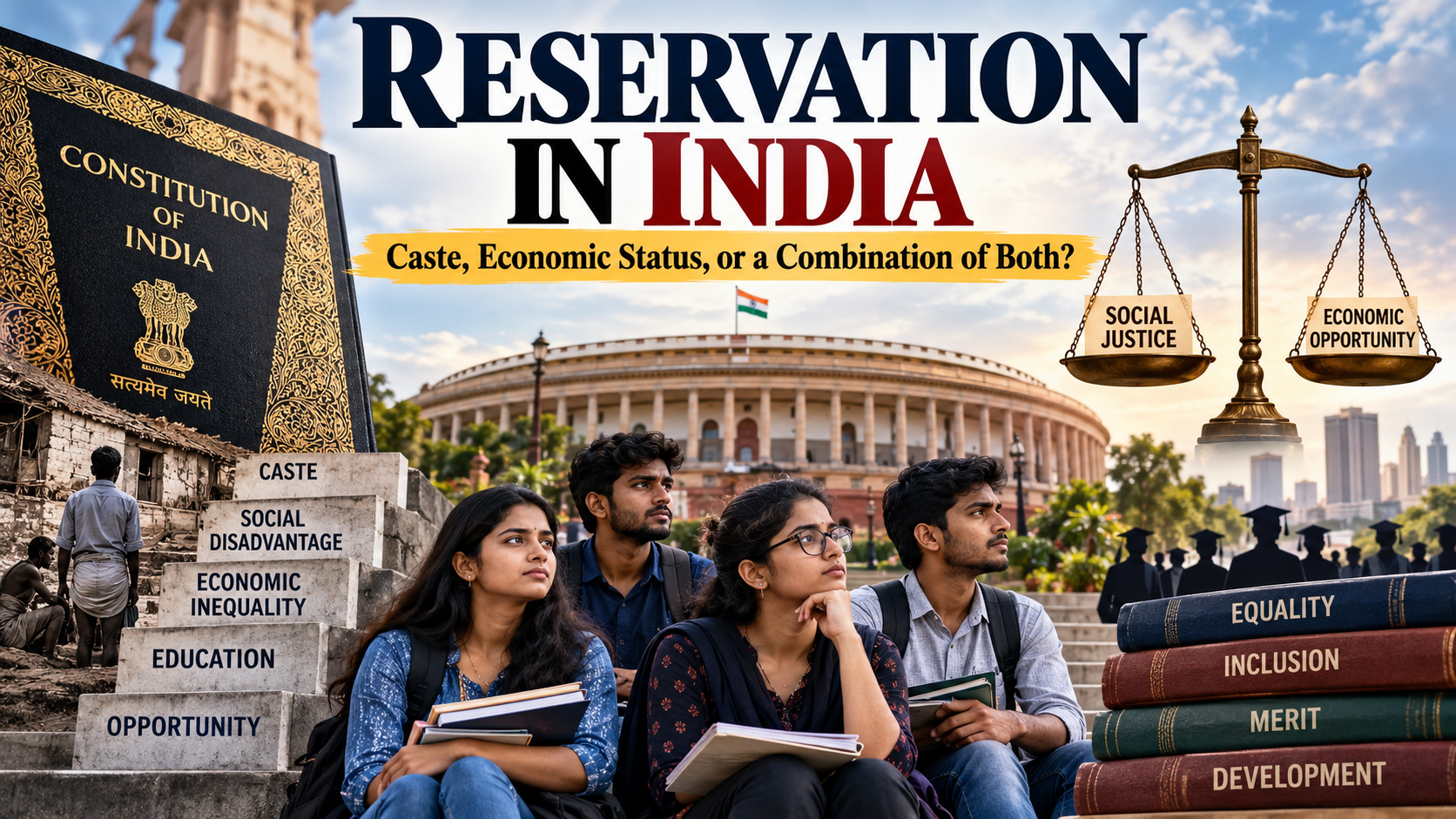
Reservation in India: Should the System Be Based on Caste, Economic Status, or a Combination of Both?
Reservation remains one of the most consequential and contested questions in contemporary India. It sits at the intersection of constitutional equality, social justice, educational opportunity, political representation and economic mobility. Few public policies have generated such sustained debate across generations, and few are as frequently discussed in terms that reduce a complex constitutional question to a simple choice between “merit” and “reservation”.
The reality is considerably more complicated.
India's reservation framework emerged from a historical context in which social identity could determine access to education, employment, public institutions and social dignity. The Constitution recognised that formal equality alone could not necessarily produce substantive equality in a society marked by entrenched social hierarchies. Consequently, it enabled the State to adopt special measures for disadvantaged sections of society.
More than seven decades later, however, India is a substantially different country. Economic mobility has increased, access to education has expanded, urbanisation has transformed social relations, and millions of people from historically disadvantaged communities have entered professions and institutions that were once largely inaccessible to them. At the same time, poverty, educational inequality and unequal access to opportunities remain significant.
The introduction of reservation for Economically Weaker Sections (EWS) added another dimension to this debate. It demonstrated that economic disadvantage could also be recognised within the constitutional framework of affirmative action. The Supreme Court subsequently upheld the constitutional validity of the 103rd Amendment in Janhit Abhiyan v. Union of India in 2022.
The question confronting India today is therefore not simply whether reservation should exist. A more fundamental question is this:
Should India's reservation policy be primarily based on caste and historical social disadvantage, should economic status play a much larger role, or should the two approaches be integrated into a more comprehensive framework?
There is no easy answer. Any serious discussion must begin by understanding why reservation was created, what it seeks to accomplish, where the existing system has succeeded, where it faces criticism, and what reforms might make it more effective.
Reservation and the Constitutional Idea of Equality
The debate over reservation begins with the Constitution itself.
Article 14 establishes equality before the law and equal protection of the laws. Articles 15 and 16 establish important principles concerning non-discrimination and equality of opportunity. At the same time, the Constitution contains provisions permitting special measures for particular disadvantaged groups.
Article 16(1), for example, establishes equality of opportunity in matters of public employment. Article 16(4) permits the State to provide reservation of appointments or posts in favour of a backward class of citizens that, in the State's opinion, is not adequately represented in public services.
This constitutional structure reveals an important principle: equality does not always mean identical treatment.
If individuals or communities have experienced substantially different historical circumstances, treating everyone identically from the beginning may reproduce rather than eliminate inequality.
Imagine two students entering a race. One has had access to good schools, private tutoring, stable housing, educated parents and extensive educational resources. The other has attended an under-resourced school and had limited access to books, technology and coaching.
Giving both students exactly the same examination may satisfy a narrow definition of formal equality. But it does not necessarily mean that both had an equal opportunity to prepare for the examination.
This is one of the philosophical foundations of affirmative action.
The objective is not necessarily to guarantee identical outcomes. Rather, it is to address conditions that prevent meaningful equality of opportunity.
The Historical Context of Caste-Based Disadvantage
Caste cannot be understood simply as an economic category.
India's caste system historically affected occupation, social status, access to education and patterns of social interaction. For certain communities, exclusion was not merely a consequence of being poor; it was connected to their social identity.
This distinction remains central to the reservation debate.
Economic circumstances can change. A family that is poor in one generation can become financially secure in the next. However, social identity and the effects of historical exclusion can be considerably more persistent.
A person may acquire a professional degree, move to a city and achieve financial success, yet still belong to a community that has historically been underrepresented in particular institutions.
This does not mean that every member of a historically disadvantaged community experiences disadvantage in exactly the same way.
It means that caste and economic status measure different things.
Caste can provide information about historical and structural social disadvantage.
Income can provide information about present economic circumstances.
Neither measurement necessarily captures everything.
The Case for Continuing Caste-Based Reservation
Those who defend caste-based reservation generally make several interconnected arguments.
The first is historical. Reservation is partly a response to discrimination that cannot be understood through income alone.
The second is representational. Reservation was also connected with the problem of inadequate representation in public institutions.
The third is intergenerational. Social disadvantage can have consequences that extend beyond a single generation.
The fourth concerns social mobility. Representation in education, government employment and public institutions can help communities gain access to professional networks, institutional authority and greater social mobility.
From this perspective, replacing caste-based criteria entirely with income would risk changing the purpose of reservation.
If the State were to ask only whether an applicant's family earns below a certain amount, it could identify poverty but potentially miss other forms of social disadvantage.
A poor person from a socially dominant community and a poor person from a historically disadvantaged community may face some common economic difficulties, but they may not face identical social circumstances.
Therefore, supporters of caste-based reservation argue that economic criteria should complement—not necessarily replace—social criteria.
The Argument for Giving Economic Status Greater Importance
The opposing argument has also become increasingly prominent.
India today contains substantial economic inequality within almost every social group.
A family may have a recognised social identity associated with reservation but may have achieved considerable educational and economic mobility. Meanwhile, a poor family outside the reservation framework may struggle to afford even basic educational resources.
This creates a question of distributive fairness.
If two students are both economically disadvantaged, should one receive additional institutional support solely because of caste while the other receives none?
The introduction of EWS reservation was partly an institutional response to this broader concern.
The 103rd Constitutional Amendment inserted Article 15(6) and Article 16(6), enabling the State to make special provisions, including reservation, for economically weaker sections. The constitutional framework specifies that EWS is for citizens other than the groups already covered by the specified SC, ST and non-creamy-layer OBC categories.
The Supreme Court upheld the constitutional validity of the amendment in 2022 by a 3:2 majority.
The significance of the EWS framework goes beyond the additional category itself.
It demonstrates that the Indian reservation debate has evolved from an almost exclusive focus on social and educational backwardness towards a framework that also recognises economic disadvantage.
Why Income Alone May Not Be Sufficient
Yet, making income the sole basis for reservation would raise another set of difficulties.
Income is not always a complete measure of disadvantage.
Two households with similar annual incomes can have very different circumstances.
One family may own property, have educated parents, live in a city with good schools and have access to professional networks.
Another family with the same income may live in a remote area, have limited educational infrastructure and lack access to quality coaching or higher education.
Similarly, family income can fluctuate.
A person may cross an income threshold in one year and fall below it in another. This raises difficult questions about how eligibility should be calculated and verified.
There is also the problem of inherited social capital.
A child whose parents are doctors, lawyers, civil servants or academics may possess forms of educational and professional support that cannot easily be captured by an income certificate.
Consequently, a purely economic model could become administratively convenient while failing to capture the full range of disadvantage.
The EWS Experiment and Its Broader Significance
The emergence of EWS reservation has nevertheless changed the conceptual landscape.
Before its introduction, the constitutional reservation debate was strongly associated with social and educational backwardness and representation. EWS brought economic disadvantage into the reservation framework in a more direct way.
The Supreme Court's decision upholding the 103rd Amendment was therefore constitutionally significant.
The Court's judgment considered challenges concerning the use of economic criteria and the exclusion of SC, ST and non-creamy-layer OBC citizens from EWS eligibility. The amendment was ultimately upheld.
The development does not settle the larger policy debate.
Instead, it raises another question: How should economic disadvantage interact with existing forms of affirmative action?
That question is likely to remain important as India continues to debate the future design of reservation.
The Creamy Layer Question
Within the OBC reservation framework, the concept of the creamy layer has become particularly important.
The underlying idea is that relatively advanced sections of a backward class should not necessarily continue to receive the same reservation benefits intended to address persistent disadvantage.
This principle reflects an attempt to recognise that communities are not internally homogeneous.
An OBC community can contain families with dramatically different educational, professional and economic circumstances.
The creamy-layer concept attempts to account for some of these differences.
But implementing such a principle is not straightforward.
What should count as sufficient economic advancement?
Should income alone determine the creamy layer?
Should parental occupation matter?
Should educational attainment matter?
Should assets and property be considered?
How frequently should eligibility be reviewed?
These questions demonstrate that designing an equitable reservation system is as much an administrative challenge as a constitutional one.
The Problem of Treating Communities as Homogeneous
One of the most important issues in the reservation debate is the tendency to treat large social categories as if every individual within them has the same experience.
That is rarely the case.
Within any broad category there can be significant differences in income, education, geography, occupation and access to opportunities.
A student from a remote rural household may have a different experience from a student from a highly educated urban family even if both belong to the same broad social category.
Similarly, two families with similar incomes can have dramatically different levels of social capital.
This raises a broader policy question:
How precisely should affirmative action identify disadvantage?
The answer cannot simply be to keep adding categories indefinitely.
At some point, excessive complexity can make the system difficult to administer and understand.
The challenge is to identify meaningful indicators without creating an unworkable bureaucracy.
Reservation and the Meaning of Merit
The most emotionally charged part of the debate concerns merit.
Critics sometimes argue that reservation compromises merit by allowing candidates with lower examination scores to enter educational institutions or public employment.
Supporters respond that examination marks are influenced by unequal opportunities and that merit cannot be separated entirely from social circumstances.
Both arguments deserve to be examined carefully.
Academic standards matter.
A doctor, engineer, civil servant, teacher or other professional must meet the requirements of their profession. Public institutions also have a legitimate interest in maintaining educational and professional standards.
But it is equally difficult to argue that examination scores exist in a social vacuum.
Preparation requires resources.
Students differ in the quality of schools they attend, the availability of coaching, access to technology, family support, language environment, financial stability and time available for study.
The more sophisticated position is therefore not that merit is irrelevant.
It is that merit and social opportunity are not necessarily independent variables.
A student who succeeds despite severe disadvantages may demonstrate qualities that a raw score does not fully capture.
At the same time, affirmative action must be designed carefully enough to ensure that students admitted to demanding programmes receive adequate academic support and that professional standards remain strong.
Open Competition and Reservation
Another common misunderstanding concerns the relationship between reservation and open competition.
The open category is not simply a separate category reserved for people who do not belong to SC, ST or OBC communities.
Open competition is available to eligible candidates irrespective of social category.
This distinction is important because a candidate belonging to a reserved community can also compete for an open position based on merit.
Understanding this principle changes the way the reservation debate is often presented.
The system is not necessarily a simple division in which one group competes only for reserved seats and another group competes only for unreserved seats.
The actual mechanisms are more complex.
Public debate should therefore be based on an accurate understanding of how selection and reservation operate in practice.
Reservation Cannot Substitute for Good Education
Perhaps the most important limitation of reservation is that it operates relatively late in the educational journey.
By the time a student applies for a university seat or government examination, years of inequality may already have accumulated.
If a child receives poor-quality primary education, inadequate nutrition, limited access to books and technology and little academic support, reservation at the university level can address only part of the disadvantage.
This is why India's social policy must look beyond reservation.
Improving government schools may be more transformative than simply increasing the number of reserved seats.
Scholarships can reduce financial barriers.
Digital infrastructure can reduce the technology gap.
Affordable coaching can reduce differences in competitive-examination preparation.
Better transport can help students in rural areas attend schools and colleges.
Vocational education can create alternatives to conventional academic pathways.
Reservation should therefore be understood as one component of a larger equality strategy.
The Role of Data in Reservation Policy
A modern reservation policy requires modern data.
Policy decisions should ideally answer basic empirical questions.
How represented is a particular community in higher education?
How represented is it in government employment?
What is its school completion rate?
What proportion of students reach higher education?
What is the level of household income and wealth?
How many beneficiaries repeatedly receive benefits?
Are benefits concentrated among relatively better-off sections?
Are there communities that remain severely underrepresented despite existing policies?
Without credible data, governments cannot evaluate whether a reservation policy is working.
The debate can then become dominated by competing anecdotes.
One person may point to a successful individual from a reserved community as evidence that reservation is no longer necessary.
Another may point to an instance of continuing discrimination as evidence that no reform is required.
Neither anecdote can substitute for systematic evidence.
Public policy requires measurement.
Should Reservation Be Periodically Reviewed?
One of the strongest arguments for periodic review is that reservation is intended to respond to social conditions.
If conditions change, policy should be capable of changing as well.
Periodic review does not necessarily mean automatically reducing reservation.
It means examining whether the policy is achieving its stated objectives.
A serious review could examine several indicators:
-
Representation in educational institutions
-
Representation in public employment
-
Educational attainment
-
Household economic conditions
-
Social mobility
-
Access to professional occupations
-
Geographic disparities
-
Distribution of benefits within communities
Such reviews could help policymakers distinguish between areas where reservation remains necessary and areas where other interventions may be more effective.
Should Reservation Have a Fixed Expiry Date?
The question of an expiry date is more complicated than it initially appears.
A fixed deadline could encourage governments to improve underlying social conditions. If policymakers knew that reservation would eventually expire, they might have stronger incentives to invest in education and social development.
However, a rigid deadline could also be problematic.
Social inequalities do not necessarily disappear according to a predetermined calendar.
The Constitution itself has treated different reservation provisions differently over time. For example, Article 334 contains a time-bound framework concerning reservation of seats for Scheduled Castes and Scheduled Tribes in the Lok Sabha and State Legislative Assemblies, with the constitutional period having been amended over time.
This demonstrates that the constitutional treatment of reservation has never been entirely static.
A more practical approach may therefore be periodic constitutional and policy review rather than an arbitrary sunset date.
The Federal Dimension
Reservation in India also cannot be understood entirely through a single national lens.
States have different histories, caste compositions, educational patterns and social structures.
A reservation policy that may be politically and socially significant in one state may operate differently in another.
This is particularly relevant when considering backward-class identification, state-level quotas and educational institutions.
The Constitution itself operates through both Union and State institutions, and the legal framework allows differences in how various policies are implemented.
Therefore, a national discussion should recognise India's federal diversity rather than assuming that one formula will produce identical results everywhere.
Reservation and Political Mobilisation
Reservation is inseparable from Indian democratic politics.
Communities have organised movements seeking inclusion in reservation categories, while governments have responded through legislation, commissions and policy changes.
This is not unusual in a democracy.
When access to education and employment is scarce, decisions about eligibility naturally become politically important.
However, there is a danger when reservation becomes primarily a tool of political mobilisation rather than a carefully designed instrument of social policy.
If eligibility is expanded without credible evidence, the system may become increasingly difficult to justify.
If genuine disadvantage is ignored because it is politically inconvenient, the constitutional objective of social justice may also be weakened.
The challenge is therefore to create institutions capable of making evidence-based decisions even when the subject is politically sensitive.
Is the 50 Per Cent Ceiling the Right Benchmark?
The question of the permissible extent of reservation has generated extensive constitutional litigation.
The 50 per cent figure has historically been treated by the Supreme Court as an important principle in reservation jurisprudence, although the legal framework has developed through subsequent constitutional amendments and judicial decisions.
The introduction of EWS reservation added another dimension to this debate.
The Supreme Court's 2022 judgment in Janhit Abhiyan upheld the 103rd Constitutional Amendment, which enabled up to 10 per cent EWS reservation in the circumstances specified by the amendment.
The significance of the decision goes beyond the EWS category itself because it demonstrates how constitutional amendments can alter the structure of affirmative-action policy.
Whether reservation ceilings should remain fixed, be modified or be interpreted differently remains a matter of constitutional law and public policy rather than something that can be settled simply through political rhetoric.
What Would a More Comprehensive System Look Like?
If India were to think about reservation policy from first principles, the objective would not necessarily be to choose one indicator and discard all others.
A more comprehensive system could recognise several dimensions of disadvantage while keeping the legal purpose of each category distinct.
Caste and social background could remain relevant for addressing historical discrimination and inadequate representation.
Economic criteria could address current financial disadvantage.
Educational indicators could identify students who have come from severely under-resourced schooling environments.
Geographic criteria could recognise regional inequalities.
Targeted scholarships could address financial barriers without necessarily converting every disadvantage into a reservation category.
This could create a broader architecture of affirmative action in which reservation is only one instrument.
What Should Be Reformed?
Several reforms deserve serious consideration.
Better Data
Reservation policies should be supported by credible and regularly updated data.
Stronger School Education
The best way to reduce inequality is to improve educational quality before students reach competitive examinations.
Transparent Eligibility Rules
Eligibility criteria should be clear, measurable and periodically reviewed.
Effective Creamy-Layer Implementation
Where creamy-layer provisions apply, their implementation should ensure that benefits reach those who remain disadvantaged.
Economic Support Beyond Reservation
Poor students should have access to scholarships, affordable education and other assistance regardless of whether they qualify for reservation.
Expansion of Educational Capacity
If India increases the number of high-quality colleges and professional institutions, competition for limited seats will become less intense.
More Employment Opportunities
Reservation debates become particularly intense when public-sector jobs are scarce. Expanding productive employment across sectors can reduce the pressure placed on government recruitment.
A Combination of Caste and Economic Criteria?
Returning to the central question, should India's reservation system be based on caste, economic status or a combination?
The strongest argument for a combination is that disadvantage itself is multidimensional.
A caste-only framework may fail to adequately recognise economic hardship within communities.
An income-only framework may fail to recognise historical social discrimination and underrepresentation.
A combination can potentially recognise both.
But combination does not mean simply adding more reservation percentages.
It means designing different forms of support for different forms of disadvantage.
For example, social disadvantage may justify one form of affirmative action, while poverty may justify scholarships or financial assistance. Educational disadvantage may justify preparatory programmes, bridge courses or targeted academic support.
This approach could allow the State to address inequality without assuming that every form of disadvantage requires exactly the same remedy.
The Larger Question: What Kind of Equality Does India Want?
Ultimately, the reservation debate is a debate about the meaning of equality.
There is one conception of equality that focuses on treating everyone identically.
There is another conception that focuses on ensuring that people have a genuine opportunity to compete despite unequal starting conditions.
The Indian Constitution reflects elements of both.
It guarantees equality while permitting special provisions designed to address disadvantage.
This is not necessarily a contradiction.
It reflects the recognition that a society can be formally equal while remaining substantially unequal.
The challenge is determining how long special measures should continue, whom they should benefit and how they should be designed.
Those questions cannot be answered through ideology alone.
They require evidence.
Conclusion: From Reservation Politics to Equality of Opportunity
The debate over reservation in India is unlikely to disappear.
It should not.
A policy that affects access to education, employment and representation deserves sustained public scrutiny.
But the quality of the debate matters.
Reducing the issue to slogans such as “reservation versus merit” does not help.
Nor does assuming that caste alone can explain every form of disadvantage in twenty-first-century India.
India's reservation system was created in response to genuine historical inequalities. Those inequalities cannot be erased simply by declaring that everyone is equal today.
At the same time, India cannot ignore the reality that economic disadvantage affects people across communities. A poor student may lack the resources necessary to compete effectively regardless of social background.
The introduction of EWS reservation has already brought economic disadvantage more directly into the constitutional conversation. The Supreme Court's decision upholding the 103rd Amendment further confirmed that economic criteria can form part of the constitutional framework for affirmative action.
The central challenge now is to determine how different forms of disadvantage should be recognised without turning reservation into an endlessly expanding system of competing claims.
The answer may lie neither in abandoning caste as a criterion nor in treating caste as the only meaningful measure of disadvantage.
Instead, India could move towards a more evidence-based framework in which historical discrimination, social disadvantage, economic hardship and unequal educational opportunity are recognised as distinct but interconnected problems.
Reservation can remain one instrument of social justice, but it should not be expected to solve every form of inequality.
A child who receives a good education should not need reservation simply because the government school they attended was inadequate.
A poor student should not have to depend entirely on a quota because affordable higher education is unavailable.
A historically disadvantaged community should not remain underrepresented because formal equality is mistaken for substantive equality.
The larger objective should therefore be much broader than reservation itself.
It should be the creation of a society in which a person's caste, family income, birthplace or social background has progressively less influence over the opportunities available to them.
That will require reservation where evidence and constitutional principles justify it. But it will also require better schools, affordable higher education, scholarships, healthcare, infrastructure, employment opportunities and social mobility.
The most useful question for India's future may therefore not be “Who should get reservation?”
It may be:
“What kind of society do we need to build so that reservation becomes less necessary over time, while ensuring that historical and present inequalities are not ignored?”
That is a more difficult question.
But it is also a more important one.
Because the ultimate objective of social justice should not simply be the distribution of reserved seats. It should be the creation of genuine equality of opportunity—where a person's circumstances of birth do not determine the boundaries of their ambition, education or future.
And that is ultimately the larger promise of the Indian Constitution: not merely equality written on paper, but the continuing effort to make equality meaningful in the lives of ordinary citizens.
Join the Conversation
Read Next
Government Hospitals in Rural Areas: Good Staff, But Better Facilities Are Needed
One Nation, One Election: Can India Synchronise Lok Sabha and State Elections?
सुप्रीम और हाई कोर्ट से मेरा निवेदन और आग्रह है।
Subscribe to GC News
Get the latest independent journalism and updates straight to your inbox.