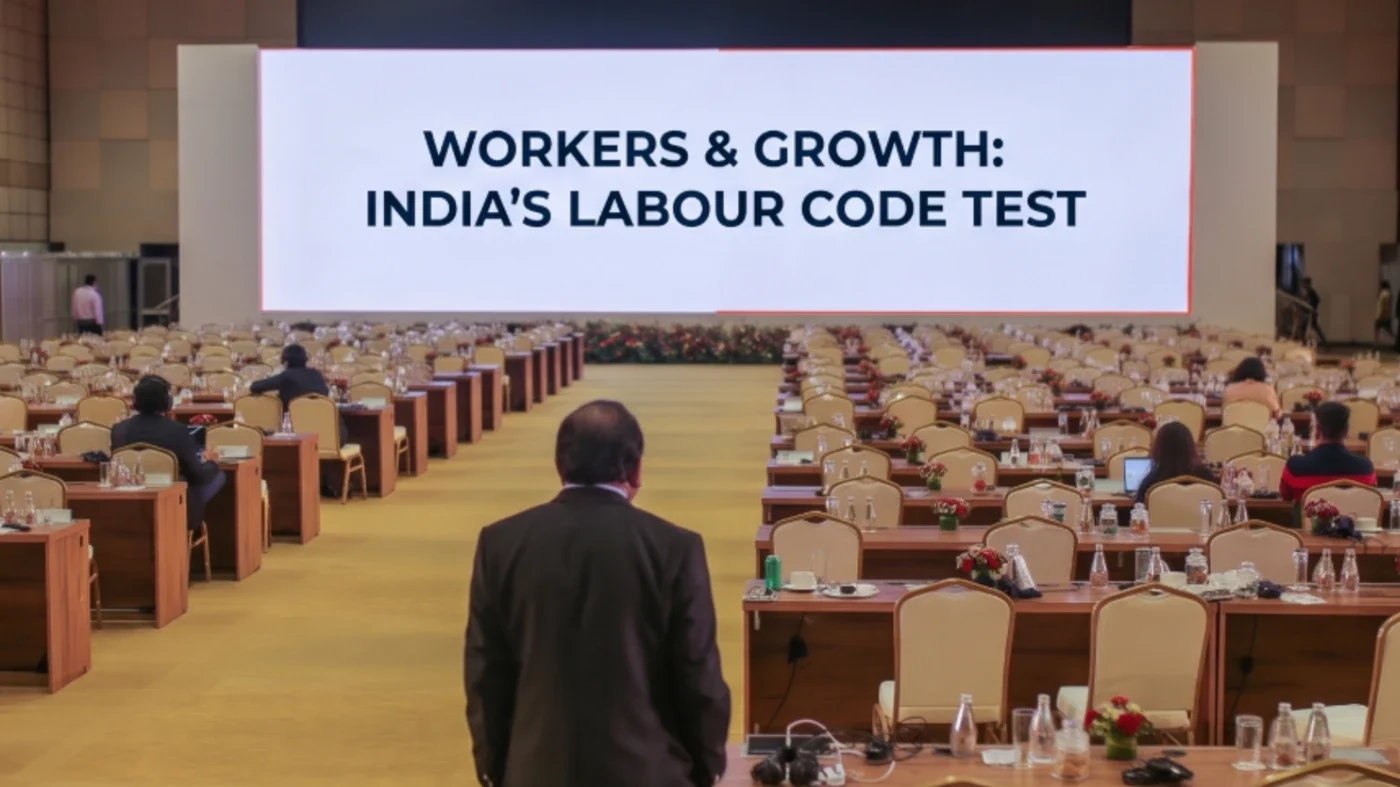
A two-day Chintan Shivir of Labour, Employment, and Industry Ministers from States and Union Territories concluded on November 22, 2026, at Mahatma Mandir in Gandhinagar, Gujarat. Convened by the Union Ministry of Labour and Employment (MoLE) under Union Minister Dr. Mansukh Mandaviya, with participation from Minister of State Sushri Shobha Karandlaje, Gujarat Chief Minister Bhupendra Patel, and State/UT officials, the meeting marked one year since India's four consolidated Labour Codes took effect on November 21, 2025. Rather than functioning as a routine conference, the conclave sought to align Centre–State execution, expand digital employment tools, and review social security delivery toward the government's Viksit Bharat goal.
The Core Issue and Background Data
At the heart of the Gandhinagar discussions is a long-standing policy tension in India's economy: how to simplify compliance and support industrial expansion while widening legal protections and social security for a predominantly informal workforce. According to a summary of the conclave's policy context compiled by Shanmugam IAS Academy (2026) citing government and International Labour Organization (ILO) data, social security coverage in India rose from 19% in 2015 to 64.3% in 2025, reaching an estimated 101 crore people in 2026. In practical terms, this expansion reflects efforts to bring formal and non-traditional workers—such as gig and platform workers—under statutory safety nets, even as most Indian workers remain in the unorganised sector.
Stakeholder Perspectives and Policy Gains
During the meeting, Dr. Mansukh Mandaviya described workers' welfare and industrial growth as "twin wheels" of national progress, arguing that protecting workers and strengthening enterprise competitiveness reinforce one another. Minister of State Sushri Shobha Karandlaje emphasised strong Centre–State coordination and proactive grievance redressal, while participating State ministers—including Mizoram's Labour, Employment, Skill Development and Entrepreneurship Minister Lalnghinglova Hmar—highlighted state-level priorities such as worker safety, skill upgradation, and international labour mobility. On the second day, MoLE unveiled the NCS ONE Portal (featuring a Voice Bot, Chat Bot, and Occupational Shortage Index), the e-Shram Livelihood Profile Module, two publications, and the virtual launch of eight Career Lounges, alongside sessions on Employees' Provident Fund Organisation (EPFO) and Employees' State Insurance Corporation (ESIC) reforms and trust-based electronic compliance.
Structural Challenges and Implementation Hurdles
Moving from legislative consolidation to uniform ground-level practice presents practical hurdles across India's diverse states. Breakaway sessions for State and UT field officials focused on MSME (Micro, Small and Medium Enterprises) engagement, electronic compliance, and implementation gaps, underscoring that smaller enterprises often face higher administrative adjustment costs than large firms. Furthermore, extending social security and formal wage or safety standards to unorganised, seasonal, and platform workers requires reliable registration, portable records, and consistent state-level enforcement—areas where administrative capacity differs widely across States and Union Territories.
Constitutional, Legal, and Institutional Framework
Under the Constitution of India, labour and welfare of labour fall primarily under the Concurrent List (Seventh Schedule, Entry 24), meaning both Parliament and State legislatures can make laws, while executive enforcement relies heavily on States and Union Territories. The four Labour Codes—the Code on Wages, the Industrial Relations Code, the Code on Social Security, and the Occupational Safety, Health and Working Conditions (OSH) Code—consolidate central labour laws to streamline definitions, wages, industrial dispute mechanisms, workplace safety, and social security (including provisions covering gig and platform workers). Key institutional pillars discussed at the conclave include EPFO for retirement savings, ESIC for medical and cash benefits, e-Shram and National Career Service (NCS) for worker registration and job matching, and knowledge partners V. V. Giri National Labour Institute (VVGNLI) and Gujarat National Law University (GNLU).
Way Forward and What to Watch Next
The Gandhinagar Chintan Shivir signals a shift from initial rollout of the Labour Codes toward operational fine-tuning, digital integration, and state-level accountability. Whether these deliberations translate into measurable gains will depend on how quickly States align their rules and inspection systems, how effectively MSMEs adopt trust-based digital compliance, and whether new tools like the NCS ONE Portal and e-Shram livelihood profiles improve job placement and benefit access for informal workers. Observers should watch state-wise implementation reports on the Labour Codes, EPFO and ESIC service metrics, and early usage trends from the newly launched digital modules and Career Lounges.
Key Facts and Figures
-
64.3% social security coverage in 2025 (up from 19% in 2015), covering an estimated 101 crore people in 2026 (Source: Shanmugam IAS Academy policy brief citing ILO and government figures, 2026): Indicates substantial growth in formal and statutory social protection coverage over a decade, though full coverage across every informal livelihood remains an ongoing policy task.
-
Four Labour Codes in force since November 21, 2025 (Source: Ministry of Labour & Employment / PIB releases, November 2026): Marks one year of operationalising India's consolidated framework on wages, industrial relations, social security, and occupational safety and health.
Credible Sources Used
-
Press Information Bureau (PIB), Ministry of Labour & Employment, Government of India (2026) — Releases on the Two-Day Chintan Shivir of Labour, Employment & Industry Ministers of States/UTs in Gandhinagar (November 19, November 21, and November 22, 2026, including Release ID 2338562, Release ID 2339467, and Release ID 2339938).
-
Directorate of Information and Public Relations (DIPR), Government of Mizoram (2026) — Report on State participation, NCS One Portal launch, and Career Lounges at the Gandhinagar conclave (November 22, 2026).
-
Shanmugam IAS Academy Current Affairs Brief (2026) — Summary of Chintan Shivir themes, Labour Codes background, and ILO social security coverage figures (November 21–22, 2026).
Join the Conversation