France Braces for Fresh Protests After Violent Riots Leave Cities Damaged
Paris, October 22, 2026 | International News
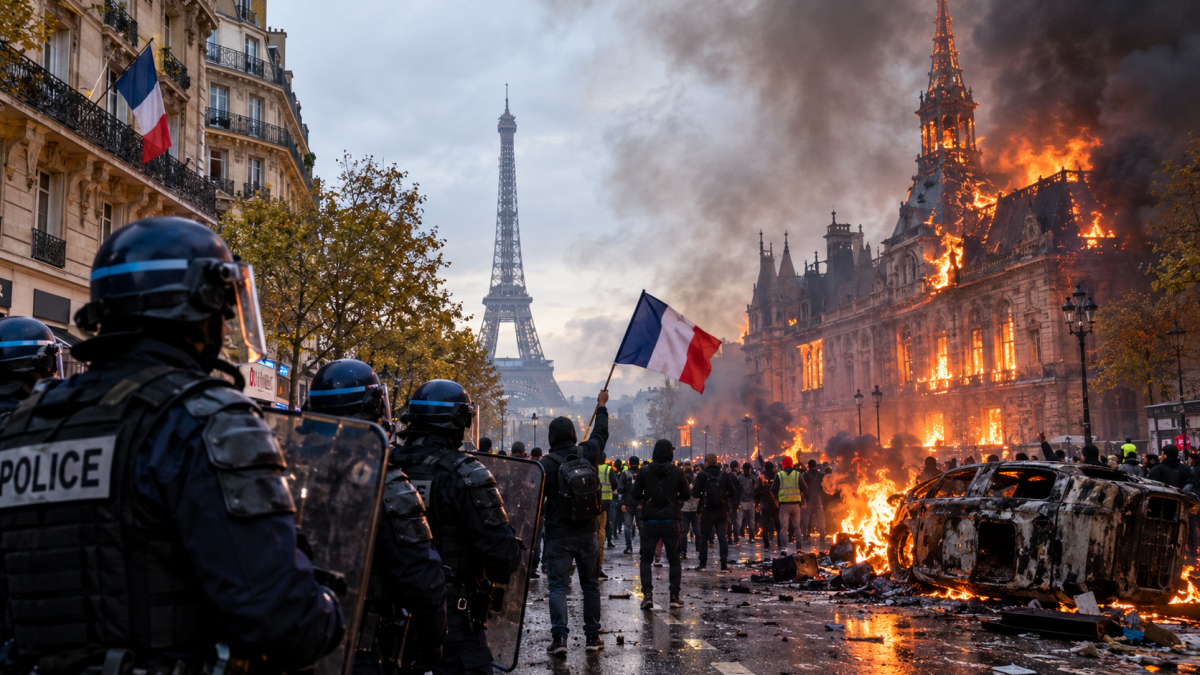
France is preparing for another round of demonstrations this Saturday as authorities work to restore order following a wave of violent unrest that swept across the country on October 17. The protests, which began over concerns about education and public services, escalated into some of France's most serious episodes of rioting in recent years, leaving damaged buildings, looted businesses, and thousands of arrests.
What started in late September as student-led strikes over deteriorating school facilities, teacher shortages, and poor learning conditions has developed into a wider movement involving teachers, trade unions, and Yellow Vest activists. Demonstrators have also raised concerns about the rising cost of living, economic inequality, and pressure on public services.
According to figures cited in reports on the October 17 demonstrations, authorities estimated that approximately 550,000 people participated in around 110 marches nationwide, including about 110,000 in Paris. Organisers, including the CGT trade union, put the overall turnout closer to 800,000.
Although many demonstrations remained peaceful during the day, the situation deteriorated in several cities later in the evening. Fires, looting, and confrontations with police turned a day of protest into a major public-order crisis.
With another large demonstration planned for October 24, the French government is facing mounting pressure to prevent further violence while addressing the public dissatisfaction behind the protests.
1. Violent Unrest Leaves Buildings and Businesses Damaged
The October 17 demonstrations took a violent turn after nightfall, with several cities reporting arson, vandalism, looting, and clashes between protesters and security forces.
In Limoges, a fire reportedly caused extensive damage to the historic 19th-century town hall, with its spire collapsing during the blaze. In Lyon, the city's tourist office was reportedly set on fire, while protesters entered Marseille's city hall. Paris and other urban centres also experienced vehicle fires and damage to commercial properties.
Businesses were among the main targets of the unrest, with shops looted and storefronts smashed. Police faced fireworks and other projectiles, while officers used tear gas and crowd-control measures to disperse violent groups.
Authorities reported more than 2,000 arrests, with some estimates reaching approximately 2,400. Hundreds of police officers, gendarmes, and firefighters were reportedly injured during the disturbances.
Reports also linked the unrest to at least two deaths and severe injuries, including cases involving people who reportedly lost hands after incidents involving crowd-control grenades. In Paris alone, around 300 businesses were said to have suffered damage.
The scale of the destruction has intensified questions about public safety, policing strategies, and the ability of authorities to manage large demonstrations without allowing violence to spread.
2. Protests Grow Beyond Student Grievances
The current movement began with students highlighting problems in France's education system. Poor classroom conditions, shortages of teachers, and concerns about the quality of education helped bring young people onto the streets in late September.
Over time, however, the demonstrations attracted a wider range of participants. Teachers, trade unions, and Yellow Vest activists joined the protests, bringing broader economic and social concerns into the movement.
Rising living costs have become a major source of frustration. Many demonstrators argue that households are struggling to manage everyday expenses while public services face increasing pressure.
Education funding is another central issue. Students and teachers have called attention to the condition of school buildings, staffing shortages, and the resources available to support learning.
The participation of Yellow Vest activists has also connected the protests to longstanding concerns about inequality and the relationship between ordinary citizens and political leaders.
The movement is not necessarily united around a single demand. Different groups have their own priorities, ranging from improvements in education and public services to wider economic reforms and political change.
Nevertheless, the growing participation of different groups demonstrates how specific grievances can develop into a broader expression of dissatisfaction with government policy.
3. Macron Government Faces Pressure Over Security Failures
President Emmanuel Macron has condemned the violence and called for a review of intelligence and policing arrangements following the October 17 unrest.
Macron's second presidential term is due to end in 2027, and he cannot seek a third consecutive term under France's constitutional rules. The latest unrest has added to the political challenges facing his administration as it attempts to maintain public order and respond to economic concerns.
Prime Minister Sébastien Lecornu and Interior Minister Laurent Nuñez have acknowledged shortcomings in the handling of the disturbances, including the positioning of security personnel and the failure to act effectively on certain warning signs.
The government has promised a significantly strengthened security operation for the next round of demonstrations. Plans outlined in the supplied reports include deploying troops alongside police forces to support security arrangements.
Authorities have also imposed localised curfews in areas particularly affected by the violence.
The challenge for the government is to prevent a repeat of the destruction without unnecessarily restricting peaceful demonstrations. France has a long tradition of street protests, and the right to demonstrate remains an important part of its democratic system.
The coming days will test whether improved intelligence, better coordination, and additional security personnel can prevent further disorder.
4. Government Blames Extremist Groups as Public Anger Persists
French authorities have blamed groups they describe as ultra-left extremists, along with opportunistic criminals, for some of the most serious acts of violence.
The government has also recognised that the unrest has emerged against a backdrop of genuine public frustration. Concerns about fuel prices, inflation, education funding, and the quality of public services have contributed to the demonstrations.
Distinguishing peaceful protesters from individuals involved in violence has become a central challenge for the authorities. While criminal acts have drawn widespread condemnation, many participants say their concerns about economic hardship and public services deserve serious attention.
The destruction of buildings and businesses has also created a risk that the original issues raised by demonstrators will receive less attention than the violence itself.
For residents and business owners affected by the unrest, restoring safety and repairing damaged property are immediate priorities. For the government, the broader task is to address the concerns driving public anger while ensuring that demonstrations do not descend into further violence.
5. Economic Uncertainty Adds to the Political Challenge
The protests are unfolding at a difficult time for the French economy and government finances.
The minority government is working on a 2027 budget that seeks savings worth tens of billions of euros. The proposed fiscal measures are part of a wider effort to manage public finances, but spending decisions can become politically contentious when households are already concerned about the cost of living and the quality of public services.
The unrest has also coincided with rising bond yields, according to the reports cited in the supplied material. Market movements can reflect a range of factors, including fiscal expectations, economic conditions, and political uncertainty.
If instability continues, businesses may face disruptions, consumer confidence could weaken, and investors may become more cautious about the country's economic outlook.
At the same time, the government's budget decisions could influence the wider debate over public spending, social protection, and the resources available for education and other essential services.
This creates a difficult balancing act for policymakers. They must address fiscal pressures while responding to demands for better public services and relief from rising living costs.
6. Yellow Vest Activists and Student Groups Prepare for Another Demonstration
Attention is now turning to Saturday, October 24, when another major demonstration is expected in Paris.
According to the supplied reports, representatives of the Yellow Vest movement have formally requested permission to organise a large march. Student groups are also preparing to mobilise, with some organisers using slogans calling for Macron to step aside.
Trade unions are planning further action, including demonstrations or other industrial activity scheduled for November 5.
Lecornu is also meeting union representatives to discuss how the government can protect the right to protest while preventing further disorder.
The scale and nature of Saturday's demonstration will depend on participation levels, the response of the authorities, and whether organisers can maintain peaceful conditions.
The government is preparing for the possibility of renewed clashes, particularly in locations where previous demonstrations resulted in serious damage.
For protesters, the next demonstration will provide another opportunity to express their concerns. For the authorities, it will be an important test of their ability to manage a large public gathering without a repeat of the previous weekend's violence.
7. Young People and Workers Voice Frustration About the Future
Behind the immediate security concerns lies a wider debate about economic opportunity, public services, and confidence in France's political institutions.
Young protesters have expressed anxiety about their future, particularly in relation to education, employment prospects, and the rising cost of living.
Teachers and other public-sector workers have highlighted concerns about working conditions, staffing shortages, and the resources available to deliver essential services.
Other demonstrators have focused on economic inequality and the perception that the burdens of economic change are not shared equally across society.
These concerns are not necessarily identical, and the movement includes people with different priorities. However, their participation in the same demonstrations has brought several longstanding issues into a single national debate.
The violence on October 17 has complicated that debate. Images of burning buildings, damaged shops, and confrontations with police have dominated attention, potentially overshadowing the demands that initially brought many people onto the streets.
The government now faces the challenge of addressing legitimate public concerns while holding those responsible for violence accountable under the law.
8. What Happens Next?
France faces several important challenges in the coming days as authorities prepare for another wave of demonstrations.
Security preparations: Police and other security personnel will need to coordinate their response carefully to protect residents, businesses, and peaceful demonstrators while responding to violent incidents.
Public participation: The turnout on October 24 will help indicate whether the movement is gaining momentum or losing support following the destruction and injuries associated with the previous demonstrations.
Government negotiations: Meetings between the government and trade union representatives could help identify ways to reduce tensions and address concerns over public services and living costs.
Economic policy: The debate over the 2027 budget is likely to remain important as the government weighs spending priorities against fiscal constraints.
Accountability and public confidence: Investigations into the violence and the handling of the protests may influence public confidence in law enforcement and government decision-making.
A peaceful demonstration would help ease immediate security concerns, although it would not automatically resolve the underlying grievances. Further violence, by contrast, could deepen political divisions and increase pressure on the government.
The situation remains uncertain, and developments over the coming weekend will provide a clearer indication of the direction of the protests.
Conclusion: France Faces a Crucial Test as Protests Approach
France is preparing for another major demonstration on October 24 following the violent unrest that swept through several cities on October 17.
The protests began with concerns about education and public services but have expanded to include frustration over living costs, inequality, and the country's broader economic outlook. The destruction of buildings and businesses, injuries among security personnel and civilians, and thousands of arrests have added urgency to the government's efforts to restore order.
President Emmanuel Macron and Prime Minister Sébastien Lecornu now face the difficult task of preventing further violence while responding to the concerns that have brought students, teachers, trade unions, and Yellow Vest activists onto the streets.
The next demonstration will be an important test of the government's security preparations and its ability to protect peaceful protest. However, a lasting reduction in tensions may also depend on whether meaningful progress can be made on the economic and public-service issues at the centre of the movement.
As France prepares for another tense weekend, the challenge will be to restore public safety without allowing the debate over the country's social and economic problems to be lost amid the violence.
Sources and Further Reading
-
Reuters — France's Macron vows no repeat of riots as Yellow Vests mobilise, October 21, 2026.
-
Reuters — France to deploy troops, admits to failures over weekend unrest, October 20, 2026.
-
Al Jazeera — Tear gas and unrest as hundreds of thousands protest for reforms in France, October 17, 2026.
-
The Washington Post — Violent protests spread in France, October 18, 2026.
-
CNBC — France hit by worst unrest in years as Macron condemns violence, October 19, 2026.
-
France 24 — Live: French PM Lecornu to meet with unions ahead of new protests, October 21, 2026.
Join the Conversation