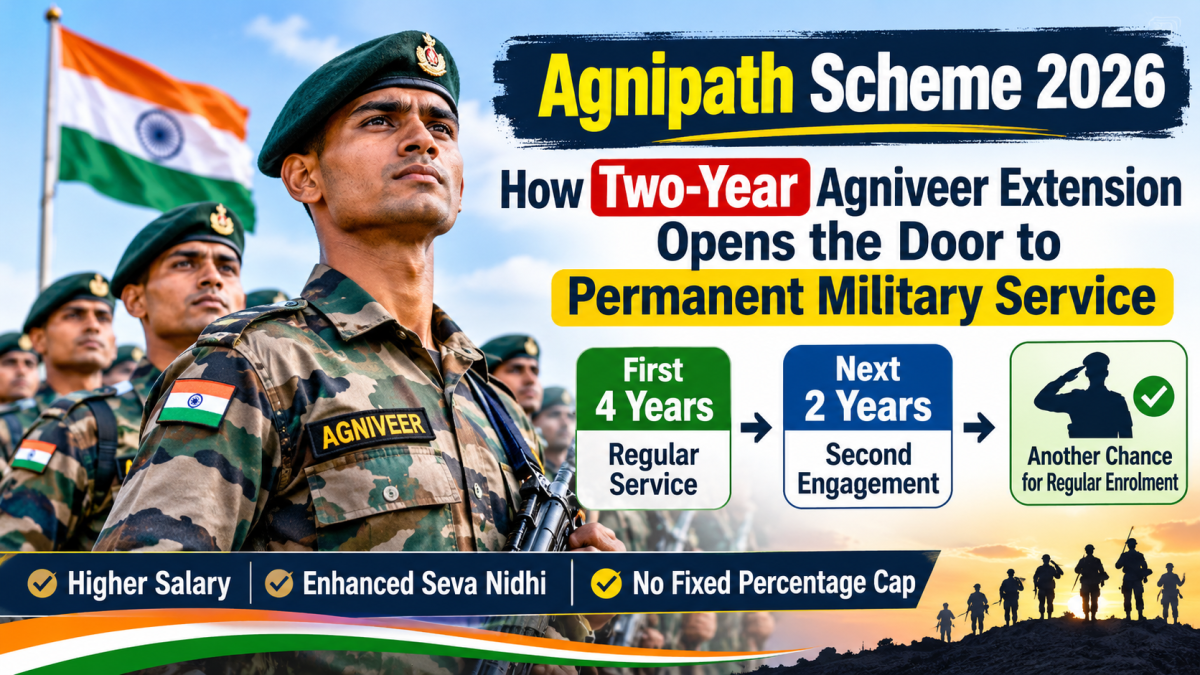
Agnipath Scheme 2026: How the Two-Year Agniveer Extension Opens a New Route to Regular Service
The Centre has introduced a significant change to the Agnipath scheme, bringing new opportunities for thousands of young people serving in the Indian Armed Forces as Agniveers. In a major decision approved by the Union Cabinet on November 4, 2026, the government has introduced an additional two-year engagement period for Agniveers who are not selected for regular service after completing their initial four-year tenure.
The decision changes one of the most important aspects of the original Agnipath recruitment policy. Earlier, only 25 per cent of Agniveers could be selected for permanent enrolment, while the remaining 75 per cent were expected to leave the Armed Forces after four years. Under the revised arrangement, those who are not initially selected will get another opportunity to continue serving for two additional years and subsequently seek regular enrolment.
This means the total engagement period for eligible Agniveers can now extend from four to six years before the second opportunity for regular military service.
However, the additional two years do not automatically guarantee a permanent position. Final enrolment will depend on the individual's willingness and the selection criteria prescribed by the respective Armed Forces.
What Is the New Agnipath Scheme Update in 2026?
The Union Cabinet approved the revised arrangement on November 4, 2026, following an assessment of the performance of Agniveers during the first four years of the scheme.
Under the new arrangement, the existing selection process will continue. Around 25 per cent of Agniveers will be offered regular employment after completing their initial four-year tenure, based on merit.
The remaining 75 per cent will be offered another two-year engagement period, subject to their willingness. After completing this additional period, they will have an opportunity to join the regular cadre of the Armed Forces, provided they meet the prescribed selection requirements.
The most important development is that the second stage creates a pathway for all willing and eligible Agniveers to compete for regular enrolment, rather than facing mandatory exit after four years.
The government has also confirmed that the Agnipath scheme itself will continue. The latest decision changes its retention and absorption structure rather than replacing the entire recruitment programme.
How Does the New Four-Plus-Two-Year Agniveer System Work?
To understand the revised policy, it is important to look at how the recruitment and retention process will operate.
The new arrangement creates two stages of opportunity for Agniveers who want to build a long-term military career.
Stage 1: First Four Years of Service
Agniveers will continue to join the Army, Navy and Air Force under the existing Agnipath recruitment framework.
During their first four years, they will receive military training, perform their assigned duties and undergo regular performance assessments.
At the end of the initial four-year period, 25 per cent will be selected for regular enrolment based on merit and the requirements of the Armed Forces.
Those selected will move into the regular military cadre under the applicable service rules.
Stage 2: Additional Two Years of Engagement
The biggest change concerns the remaining 75 per cent who are not selected during the first stage.
Previously, these personnel were required to leave the Armed Forces after completing four years and receive their Seva Nidhi package.
Under the revised system, they will be offered an opportunity to serve for another two years.
This additional period will allow the Armed Forces to retain trained personnel while giving Agniveers more time to demonstrate their capabilities, discipline, professional skills and operational experience.
Stage 3: Opportunity for Regular Military Service
After completing the additional two-year period, willing Agniveers can be considered for regular enrolment.
An important clarification came from an Indian Air Force senior official on November 5, 2026. The official stated that there would be no percentage cap at this second stage. This means that all Agniveers who opt for the additional engagement could potentially be absorbed into regular service if they meet the prescribed assessment criteria.
Selection will still depend on factors such as discipline, medical fitness and performance during service.
Therefore, the revised arrangement creates a possible six-year pathway towards regular military service, but permanent enrolment remains conditional on selection.
Agniveer Salary After the Two-Year Extension: What Will Change?
Financial benefits are another important part of the revised Agnipath scheme.
The government has announced higher remuneration for Agniveers who enter the additional two-year engagement period. This is intended to recognise their experience and continued contribution to the Armed Forces.
The reported monthly remuneration is:
| Service period | Monthly remuneration |
|---|---|
| Fifth year | ₹43,500 |
| Sixth year | ₹47,500 |
These figures represent the reported monthly salary package, apart from applicable allowances. They should not automatically be treated as the exact take-home amount.
The increase provides an additional financial incentive for Agniveers who choose to continue serving beyond their original four-year tenure.
The extension also introduces an enhanced Seva Nidhi arrangement.
What Happens to the Seva Nidhi Package?
Seva Nidhi is an important financial benefit under the Agnipath scheme. Under the original arrangement, Agniveers and the government contributed towards a corpus that was paid after completion of the four-year engagement.
The revised arrangement provides for a fresh Seva Nidhi package for the additional two-year period.
According to details reported by Moneycontrol, the contribution during this second engagement will follow a 30:70 structure:
-
Agniveer's contribution: approximately ₹3.28 lakh.
-
Government contribution: approximately ₹7.64 lakh.
The revised contribution structure gives the government a larger share of the Seva Nidhi corpus, with its contribution accounting for 70 per cent.
The purpose is to provide better financial support to personnel who complete the additional engagement but do not proceed into regular military service.
The government has also announced seniority-related benefits under the revised arrangement. Detailed implementation rules will be important in determining how these benefits are calculated.
Does the New Agnipath Policy Guarantee a Permanent Job?
This is perhaps the most important question for existing Agniveers and young people preparing for defence recruitment.
The answer requires an important distinction.
The revised policy creates an opportunity for regular military enrolment for all eligible Agniveers, but it does not mean that every person will automatically receive a permanent job.
The process involves performance assessment and selection.
The first 25 per cent will continue to be selected for regular service after four years. Those outside this group can undertake the additional two-year engagement and seek regular enrolment at the end of six years.
According to the Indian Air Force official's clarification, there will be no fixed percentage ceiling at this second stage. However, individual candidates must satisfy the prescribed standards.
Discipline, medical fitness, professional performance and the organisational requirements of the Armed Forces will remain important.
In simple terms, the government has expanded the opportunity for regular service without removing the selection process.
Why Has the Government Changed the Agnipath Scheme?
The decision follows four years of experience with the Agnipath recruitment model.
The Armed Forces have assessed Agniveers in areas such as physical fitness, motivation, morale, discipline, technical skills and adaptability.
According to the Ministry of Defence, the feedback has been positive, particularly regarding the physical standards, technological capabilities and motivation of Agniveers.
The additional engagement period is intended to address two important objectives.
First, retaining trained military personnel.
Training a soldier requires considerable time and resources. By allowing experienced Agniveers to serve for another two years, the Armed Forces can retain trained manpower and benefit from the skills and experience already developed.
Second, providing more opportunities for young people.
The original four-year arrangement created uncertainty for Agniveers who were not selected for regular service. The revised policy gives them another opportunity to establish themselves within the military system.
It also gives the Armed Forces a longer period to assess their performance before making decisions about permanent enrolment.
The government believes that this approach can help balance the need for a younger military workforce with the importance of retaining experienced personnel.
What Does the Agnipath Extension Mean for Future Defence Aspirants?
The revised policy is also important for young people preparing to join the Indian Army, Navy and Air Force.
The four-year initial engagement under Agnipath will continue, meaning the fundamental recruitment structure remains in place.
However, the possibility of an additional two-year engagement and a second opportunity for regular enrolment changes the long-term outlook for recruits.
For future Agniveers, the message is clear: performance throughout the engagement period will matter.
Physical fitness, discipline, technical skills, professional conduct and the ability to adapt to military responsibilities can influence future selection opportunities.
At the same time, aspirants should understand that the revised arrangement does not eliminate competition or make permanent military employment automatic.
The respective services will implement the applicable selection and engagement requirements.
Agnipath Scheme 2026: Old Rules vs New Rules
The following comparison explains the major changes introduced by the government.
| Policy feature | Earlier arrangement | Revised arrangement |
|---|---|---|
| Initial engagement | Four years | Four years |
| First regular selection | Up to 25% after four years | Continues |
| Remaining Agniveers | Exit after four years | Offered another two-year engagement |
| Total possible engagement before second selection | Four years | Six years |
| Second opportunity for regular service | Not available under the original structure | Available after additional engagement |
| Monthly remuneration during years five and six | Not applicable | ₹43,500 and ₹47,500 |
| Seva Nidhi | Original four-year package | Enhanced package for second engagement |
| Permanent enrolment | Limited to first-stage selection | Further opportunity subject to selection criteria |
Frequently Asked Questions (FAQs)
1. Has the Agnipath scheme been extended by two years?
The Union Cabinet approved an additional two-year engagement for the 75 per cent of Agniveers who are not selected for regular enrolment after completing their initial four-year tenure. The original four-year recruitment arrangement continues.
2. Can Agniveers now serve for six years?
Yes. Agniveers who are not selected for regular service in the first stage can be offered an additional two-year engagement, taking their total service under the engagement arrangement to six years.
3. Will all Agniveers get permanent jobs after six years?
All eligible and willing Agniveers completing the additional engagement will have an opportunity for regular enrolment. However, selection criteria, medical fitness, discipline and service performance will determine their eligibility. It is not an unconditional guarantee of permanent employment.
4. What is the Agniveer salary during the additional two years?
The reported monthly remuneration is ₹43,500 during the fifth year and ₹47,500 during the sixth year, along with applicable allowances.
5. What percentage of Agniveers can join regular service after six years?
A senior Indian Air Force official stated on November 5, 2026, that there would be no percentage cap at the second selection stage. All willing candidates who meet the prescribed criteria could potentially be considered for regular service.
6. Will the Agnipath scheme be discontinued?
No. The government has confirmed that the Agnipath scheme will continue. The latest decision changes the opportunities available to Agniveers after their initial four-year engagement.
7. What happens to Agniveers who do not want to continue after four years?
The additional two-year engagement is based on willingness. Those who do not opt for it will follow the applicable exit and Seva Nidhi provisions.
A Significant Change in the Future of Agniveer Recruitment
The Centre's decision to introduce a two-year second engagement marks an important development in the Agnipath scheme.
By creating an additional opportunity for regular enrolment, the government has addressed one of the biggest concerns surrounding the original four-year recruitment arrangement: the limited opportunity for Agniveers to continue their military careers.
The revised system allows the first 25 per cent to pursue regular service after four years, while the remaining 75 per cent can continue for another two years and seek enrolment through a second selection stage.
For the Armed Forces, the change offers an opportunity to retain trained and experienced personnel. For Agniveers, it provides additional service experience, higher remuneration, improved Seva Nidhi benefits and another opportunity to build a long-term career in the military.
The real impact of the revised Agnipath scheme will depend on how the three services implement the new engagement and selection arrangements. Nevertheless, the decision represents a major shift in the career pathway available to India's Agniveers.


Join the Conversation