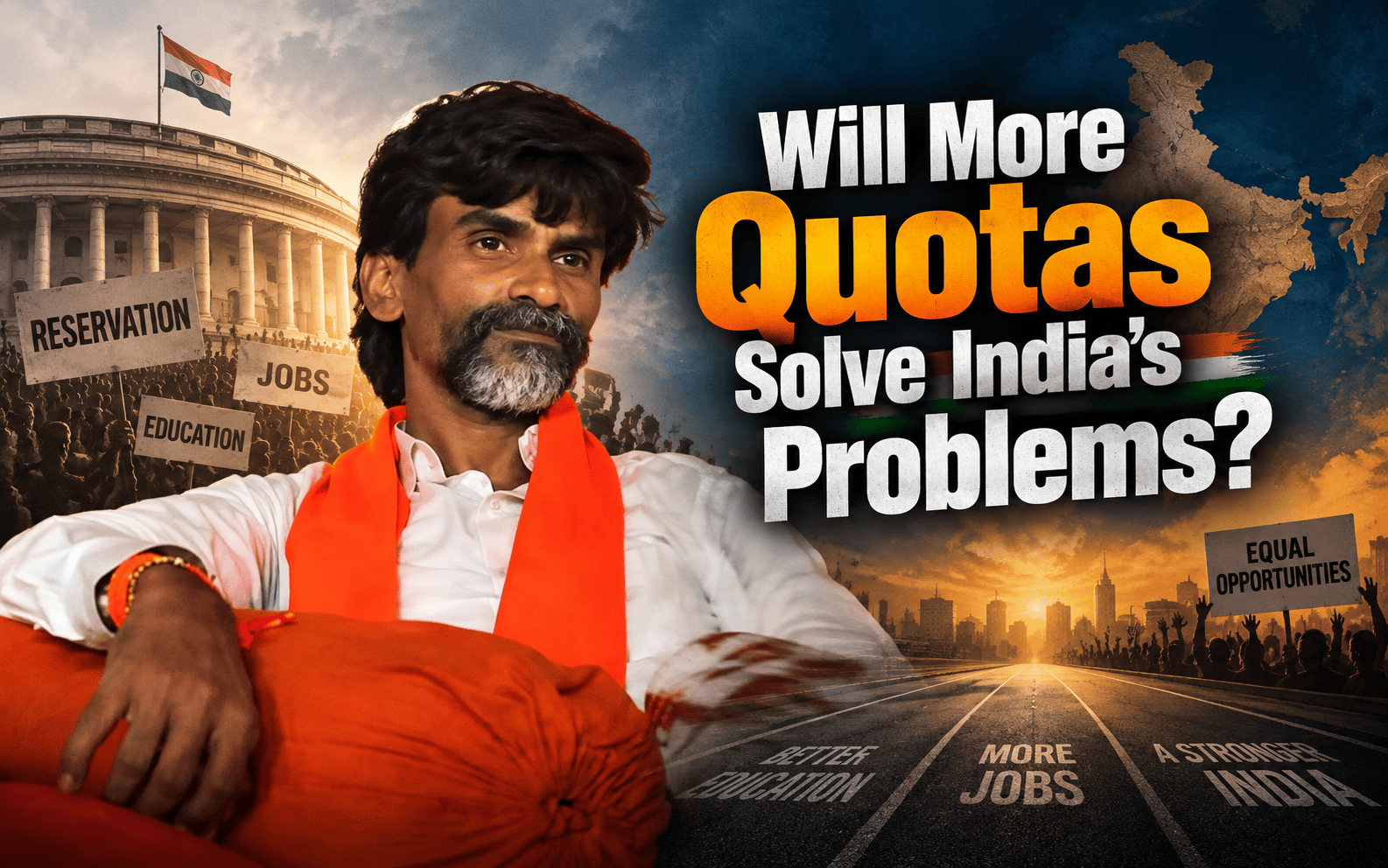
🚨 The Immediate Trigger: Maharashtra Is Facing Another Reservation Flashpoint
Maharashtra's Maratha reservation controversy has entered another intense phase.
Maratha reservation activist Manoj Jarange Patil is continuing his hunger strike at Antarwali Sarati in Jalna district and has given the Maharashtra government a deadline of September 11. He is demanding action on the Maratha community's reservation demands, including the issuance of Kunbi certificates to eligible Marathas, which can enable access to benefits available to -> Other Backward Classes (OBC) category.
The Maharashtra government says it has identified approximately 58 lakh Kunbi records and is working to accelerate the certificate process. Officials have also indicated that special camps will be held to process applications.
But there is another side to the story.
OBC organisations and leaders are concerned that a large expansion of Kunbi certificates could increase competition within the existing OBC reservation framework. The debate has therefore moved beyond one community's demand. It raises a much larger national question:
If more and more communities seek entry into reservation categories, will reservation remain a tool of social justice, or will it become a competition for a limited number of government seats?
And an even more uncomfortable question follows:
Can reservation alone solve unemployment, educational inequality and economic distress?
First, What Exactly Is Happening?
There are two different reservation questions in Maharashtra:
1. The separate Maratha quota
In February 2024, Maharashtra enacted the Maharashtra State Reservation for Socially and Educationally Backward Classes Act, 2024.
The law provides 10% reservation for the Socially and Educationally Backward Classes in educational institutions and in direct recruitment to state government posts.
The law specifically says this reservation is separate from the existing OBC reservation framework.
However, the law has been challenged in court, and its long-term constitutional validity remains under judicial scrutiny. The Bombay High Court has continued to hear challenges to the 2024 law.
2. The Kunbi-certificate route
The present agitation is also focused on recognising eligible Marathas as Kunbis on the basis of historical records.
This matters because Kunbi is included within the OBC category.
The government says around 58 lakh Kunbi records have been traced and that eligible people can apply through the prescribed process.
That distinction is crucial.
A person receiving a certificate based on a legally established historical record is one issue. Automatically treating an entire community as belonging to another category would be a completely different proposition.
Therefore, the certificate process has to be based on documentary evidence, transparent rules and individual eligibility, not political pressure.
How Did Maharashtra Reach Here? A Short History
The Maratha reservation issue did not begin in 2026.
2014: The First Major Quota Law
Maharashtra introduced reservation for Marathas in 2014.
The measure was challenged in court.
2016–17: Large Maratha Mobilisation
The Maratha Kranti Morcha organised a remarkable series of protests across Maharashtra.
The movement became one of the state's most significant reservation movements, with 58 silent marches reported during 2016–17.
The demand was primarily centred around education and government employment.
2018: Maharashtra Grants 16% Reservation
Following the Maharashtra State Backward Class Commission's assessment, the state enacted a law granting 16% reservation to Marathas.
The commission's work included surveys and empirical data. Contemporary reporting said it examined around 45,000 families and received roughly 2 lakh memorandums.
The commission's findings also documented substantial economic and educational difficulties within sections of the community.
Among the findings reported from the Gaikwad Commission were:
76.86% of Maratha families were engaged in agriculture or agricultural labour.
Around 70% lived in kutcha houses.
71% owned less than 2.5 acres of land.
The commission reported significant educational disadvantages.
It estimated the Maratha population at approximately 30% of Maharashtra's population.
The question is whether reservation is the most effective long-term solution to all of these problems.
⚖️ 2021: The Supreme Court Changes the Legal Picture
In Jaishri Laxmanrao Patil v. State of Maharashtra, the Supreme Court struck down the 2018 Maratha reservation law.
The Court held that the constitutional conditions required for exceeding the established 50% ceiling had not been satisfied and also found that the Maratha community did not meet the required standard of inadequate representation in public employment under the evidence before it.
The Supreme Court record contained an important piece of evidence.
For the data examined by the Court, Maratha representation in state services was reported as:
| Government service level | Maratha representation |
|---|---|
| Grade A | 33.23% |
| Grade B | 29.03% |
| Grade C | 37.06% |
| Grade D | 36.53% |
The Court described this representation as “adequate and satisfactory” in the context of the constitutional requirement being considered.
This is important because reservation policy should ultimately be based on current, measurable disadvantage, not merely political influence or the size of a protesting crowd.
2024: Maharashtra Tries Again
In February 2024, Maharashtra enacted the new SEBC law providing 10% reservation for Marathas in education and state government direct recruitment.
The state's commission argued that the community's circumstances had deteriorated in certain respects since the earlier assessment.
According to reporting based on the 2024 commission's findings, Maratha representation in government employment had declined by about 4 percentage points over five years, while the commission cited economic and educational difficulties.
The 2024 report also cited:
84% of Marathas falling below the applicable creamy-layer threshold in the report's assessment.
21.22% being below the poverty line according to the report.
Continued agricultural distress.
Educational participation lower than that of other communities in the open category.
These are serious indicators.
But they also lead us to a bigger question.
The Question India Must Ask: What Are We Actually Trying to Fix?
Suppose a young person is unemployed.
What does that young person actually need?
A caste certificate?
Or:
a good school,
quality teachers,
affordable higher education,
professional skills,
access to technology,
an internship,
a growing economy,
a productive industry,
and finally, a well-paying job?
The answer is obvious.
A reservation can change only a person's access to a seat.
It cannot manufacture the seat.
🎓 India's Bigger Problem Is Not Just Access. It Is Quality.
India has made substantial progress in educational participation.
The latest All India Survey on Higher Education reports that higher-education enrolment reached about 4.33 crore students in 2021–22, compared with 3.42 crore in 2014–15.
The government has also released the AISHE 2022–23 and 2023–24 reports, demonstrating the continued expansion of India's higher-education system.
But enrolment is not the same as employability.
The ASER 2024 survey provides an important reminder. It found improvements in basic learning among government-school children, but learning levels remain a central issue that India must continue addressing. ASER 2024 covered nearly 6.5 lakh children across 605 districts.
A country cannot become a developed economy simply by increasing the number of certificates.
Degrees must translate into skills.
Skills must translate into productivity.
Productivity must translate into jobs.
And jobs must translate into dignified incomes.
🧠 What Happens If Every Community Demands More Reservation?
If one community demands reservation because it faces economic distress, another community can make the same argument.
If another community faces unemployment, it may demand the same protection.
Soon the political competition becomes:
“How much quota can our community receive?”
instead of:
“How many new jobs can our economy create?”
That is dangerous.
Not because any particular community is wrong to demand justice.
But because a democracy should not encourage citizens to see one another primarily as competitors for government benefits.
India's unity cannot depend on each community calculating whether another community has received “more.”
🚜 The Maratha Case Shows Why Economic Development Matters
The data cited by Maharashtra's commissions point toward a deeper problem: rural economic distress.
If a farming family is struggling because of:
fragmented land,
low agricultural income,
crop failure,
debt,
inadequate irrigation,
weak market access,
giving one member a reserved government job may change that family's life.
But it does not fix the underlying agricultural economy.
The sustainable solution requires:
better irrigation + modern agriculture + food processing + rural industries + skill development + infrastructure + credit + market access.
Reservation can help an individual BUT Development can change an entire generation.
🏭 India Needs More Jobs, Not Merely More Competition for Government Jobs
This may be the most important point in the entire debate.
Government employment is valuable, stable and desirable.
But India cannot employ hundreds of millions of people through government departments.
The country needs:
manufacturing jobs,
semiconductor and electronics jobs,
construction and infrastructure employment,
tourism,
logistics,
healthcare,
education,
IT and digital services,
defence manufacturing,
renewable energy,
food processing,
modern agriculture,
small businesses,
startups,
skilled trades.
A young Indian should not have to believe that a government exam is the only respectable path to a secure life.
That mindset itself needs to change.
A Better National Formula
India does not need to choose between social justice and merit.
It needs to improve both.
A better policy framework would have five pillars:
1. Evidence-based reservation
Reservation should be based on credible, updated social, educational and representation data.
2. Strong government schools
A child's postcode should not determine the quality of his education.
3. Massive skill development
Degrees without employable skills will not solve unemployment.
4. Private-sector job creation
India needs millions of productive jobs outside government recruitment.
5. Targeted economic support
Poor families need scholarships, coaching, hostels, healthcare, nutrition, loans and employment support regardless of whether their primary disadvantage is social, educational or economic.
📌 Four Questions Maharashtra Should Force India to Debate
Question 1
- If reservation is increased, how many new jobs are being created at the same time?
Question 2
- If more students receive quota access to colleges, are we increasing the number of high-quality college seats?
Question 3
- Are we measuring actual social and educational backwardness with fresh data?
Question 4
- Why should a young Indian have to fight another young Indian for a government job when the real national objective should be creating millions of productive jobs?
The Real Meaning of Development
India's goal cannot be to create a society where every citizen spends his youth asking:
“Which category will give me the best chance?”
The goal should be to create a society where a young person asks:
“What can I learn, build and contribute?”
That requires something much bigger than reservation.
It requires world-class schools.
It requires affordable higher education.
It requires research and innovation.
It requires industries that hire.
It requires farmers who earn enough to invest.
It requires entrepreneurs who can build businesses.
It requires skilled workers who can command good wages.
And above all, it requires a country where opportunity expands faster than competition for opportunity.
For the Nation, the Goal Should Be Opportunity, Not Perpetual Competition
Reservation should remain a legitimate instrument for correcting genuine disadvantage.
But it should operate alongside a much larger national mission:
Better schools. Better universities. Better skills. Better industries. Better jobs. Better rural incomes. Better opportunities.
The ultimate measure of equality should not be how many people received a quota.
It should be how many young Indians eventually reach a point where they no longer need to depend on quota, privilege or political pressure to have a fair chance at a good life.
That is not anti-reservation.
That is pro-opportunity, pro-development and pro-India.
~ Because the best reservation policy, ultimately, is an economy and education system strong enough that every Indian has a real opportunity to succeed.
Sources: The economic times, Indiacode
Join the Conversation