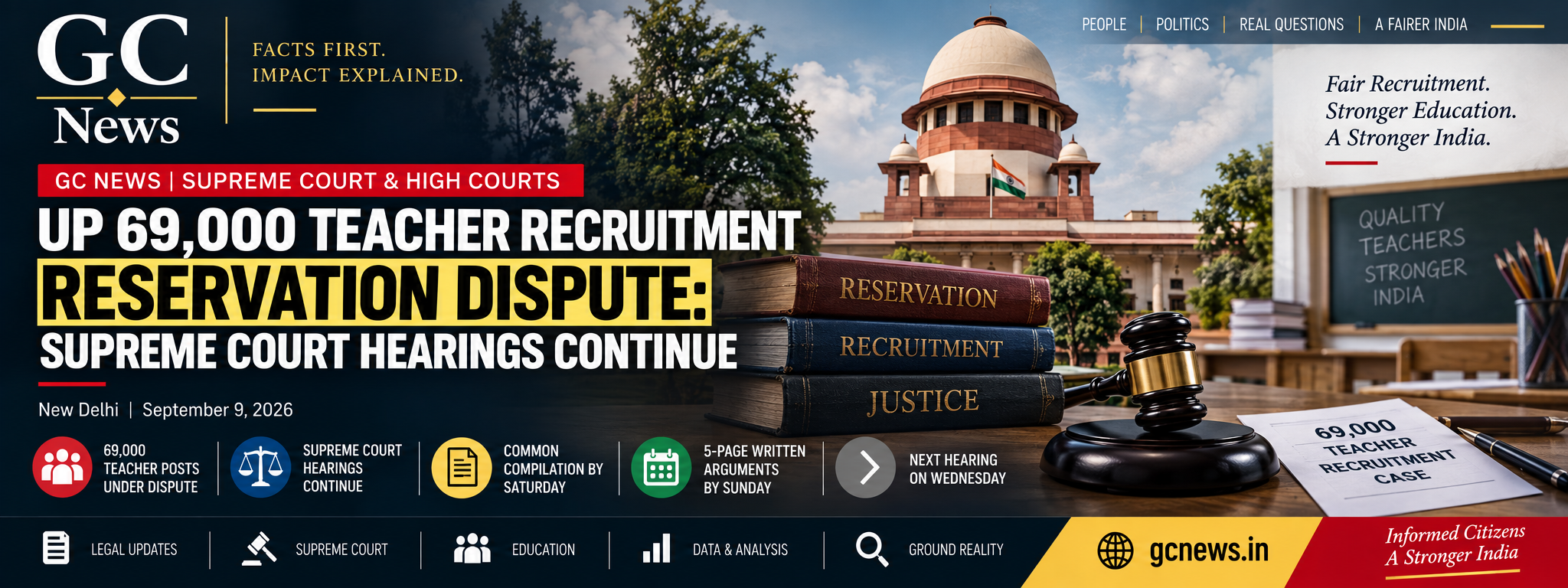
The Supreme Court continued hearing the long-running reservation dispute involving the recruitment of 69,000 assistant teachers in Uttar Pradesh, with arguments taking place for the second consecutive day.
The case concerns allegations that reservation rules were not correctly implemented during the recruitment process, potentially affecting the selection of thousands of candidates.
According to a report by Dainik Bhaskar, the Court has asked all sides to prepare a common compilation containing their main arguments and relevant documents so that the dispute can be examined in a more organised manner.
The compilation has been directed to be filed by Saturday, while parties have also been asked to submit concise written arguments, limited to five pages, by Sunday.
The matter is expected to be taken up again on Wednesday.
What Is the 69,000 Teacher Recruitment Dispute?
The controversy relates to the recruitment of 69,000 assistant teachers in Uttar Pradesh.
Petitioners have alleged irregularities in the implementation of reservation rules during the selection process and claim that the issue affected approximately 19,000 posts.
Reserved-category petitioners, including Sushil Kashyap and Rajesh Chaudhary, have maintained that they have been pursuing the matter through the courts since 2020.
Their argument is that the reservation framework was not correctly applied, affecting the selection prospects of eligible candidates belonging to reserved categories.
What Does It Mean for General Category Candidates?
The case is also important for candidates selected or competing in the unreserved category.
Any judicially ordered revision of the recruitment process or merit lists could potentially affect candidates across categories, depending on the Supreme Court's eventual findings and directions.
However, the Court has not yet delivered a final judgment, so it would be premature to say that any particular group will gain or lose seats.
Why Is This Case Important?
Beyond these 69,000 appointments, the case raises an important question about how reservation rules should be implemented in large government recruitment exercises.
When thousands of appointments are involved, even a dispute over the method used to calculate or apply reservation can potentially affect a significant number of candidates.
For candidates who have been involved in the recruitment process for years, the Supreme Court proceedings could therefore have major consequences.
For now, the legal battle continues.
The central question before the Court remains whether reservation rules were correctly applied in the recruitment process—and, if not, what corrective action should now be taken without unfairly affecting candidates whose appointments or selections have already taken place.
Status: Supreme Court Case — Ongoing
This report is based on proceedings reported by Dainik Bhaskar. The matter remains sub judice and no final determination on the competing claims has yet been made.
Join the Conversation
Read Next
Centre Seeks Two Years to Frame OBC Creamy Layer Criteria for Children of PSU & Private-Sector Employees
20 Years Behind Bars: The Untold Story of Vishnu Tiwari
“Youth for Equality, Political Associations and Fundraising: Questions Neha Das Should Answer
Subscribe to GC News
Get the latest independent journalism and updates straight to your inbox.