Does Social Media Strengthen or Weaken Democracy?
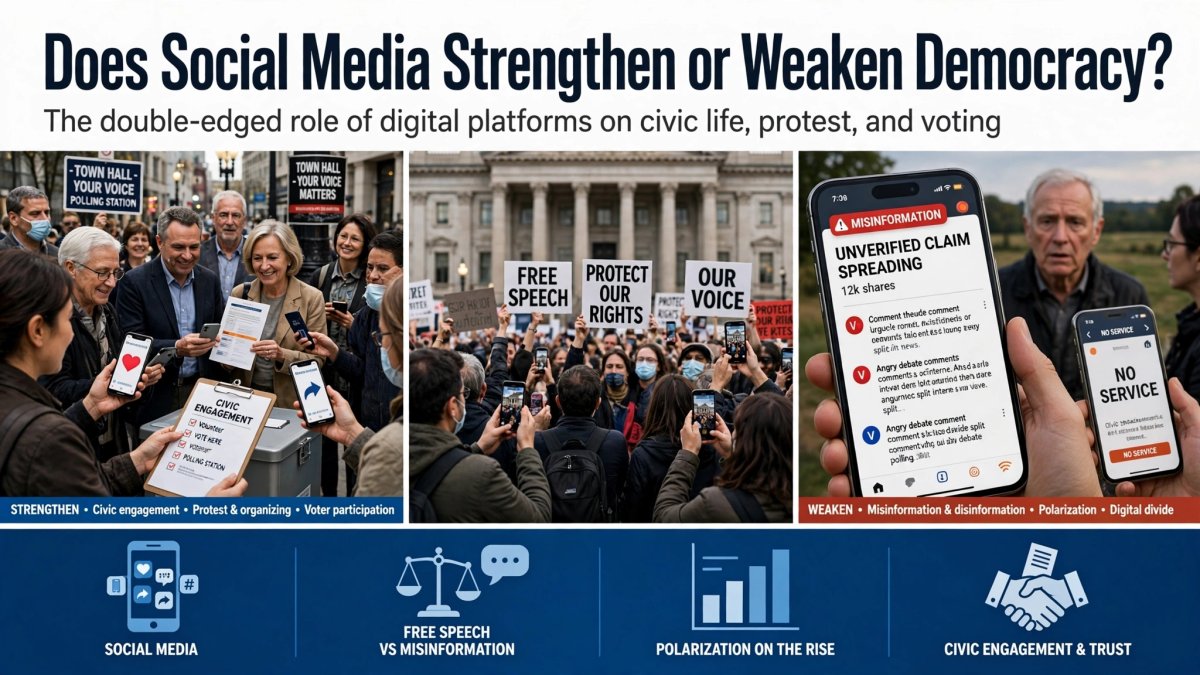
Social media has transformed the way people communicate, access information and participate in public debate. Platforms that once served primarily as spaces for personal interaction have become influential channels for political discussion, public campaigns and civic engagement. Citizens can now question government decisions, share information and participate in national conversations without depending entirely on traditional media.
However, the growing influence of social media has also raised concerns about misinformation, political polarisation, online harassment and the manipulation of public opinion. Its impact on democratic institutions is therefore increasingly debated. While digital platforms have expanded opportunities for participation, they have also created challenges for the quality and reliability of public discourse.
1. Social Media as a Tool for Democratic Participation
Social media has lowered barriers to political participation by allowing individuals, organisations and community groups to communicate directly with large audiences. Public issues that might previously have received limited attention can now reach national and international audiences within hours.
Expanding Public Awareness
Platforms such as Facebook, Instagram, YouTube and X enable citizens to follow political developments, government announcements and public-interest discussions. People can access different viewpoints, examine policy debates and participate in conversations about issues affecting their communities.
A "Pew Research Center survey published in October 2026" https://www.pewresearch.org/global/2026/10/01/across-the-globe-people-increasingly-say-social-media-is-harming-democracy/ found that a median of 77% of respondents across 37 countries believed internet and social media access had made people better informed about current events.
Encouraging Civic Engagement
Social media also provides opportunities for citizens to raise concerns, support public campaigns and draw attention to issues such as education, employment, environmental protection and governance. It allows smaller organisations and independent voices to communicate without requiring the resources traditionally associated with large media institutions.
In democratic societies, these platforms can strengthen public participation by making political communication more accessible.
2. The Growing Challenge of Misinformation
Despite its advantages, social media has become a major channel through which misleading information can circulate. Unverified claims, manipulated images, misleading videos and fabricated reports can spread rapidly, sometimes reaching large audiences before corrections become available.
The Speed of False Information
The speed of online communication creates difficulties for fact-checking. Users may share sensational claims without examining their original source or verifying the information. During elections, public emergencies and periods of political tension, misleading content can create confusion and weaken confidence in institutions.
The same 2026 Pew Research Center survey found that a median of 79% across the surveyed countries believed social media had made it easier to manipulate people through false information and rumours.
Implications for Public Trust
Repeated exposure to misleading information can make it difficult for citizens to distinguish credible reporting from propaganda or fabricated claims. It can also damage the reputation of public institutions, journalists and democratic processes.
Addressing misinformation requires stronger fact-checking practices, responsible platform policies and greater public awareness about verifying information before sharing it.
3. Political Polarisation and the Decline of Civil Debate
Social media has expanded political discussion, but it has also contributed to increasingly confrontational online environments. Political disagreements that could otherwise encourage constructive debate may turn into personal attacks, hostility and the circulation of divisive content.
Echo Chambers and Selective Exposure
Users often engage with content that reflects their existing beliefs and political preferences. Recommendation systems may repeatedly present similar material, limiting exposure to alternative perspectives.
This can create echo chambers in which individuals become more confident in their own positions while becoming less receptive to opposing arguments. Such environments can deepen divisions between political groups and reduce opportunities for meaningful discussion.
The Impact on Democratic Dialogue
According to Pew Research Center's 2026 findings, a median of 68% across 37 countries believed social media had made people more divided in their political opinions.
Democracy depends not only on the freedom to express opinions but also on the willingness to listen, question arguments and respect disagreement. When online political communication becomes dominated by hostility, the quality of public debate can suffer.
4. India's Experience with Social Media and Democracy
India provides an important example of the opportunities and challenges associated with digital political communication. With a large and diverse population, social media has become an influential space for public discussion, political campaigning and the circulation of information.
Citizens use digital platforms to discuss government policies, raise local concerns and follow developments across the country. Political parties, elected representatives, journalists and civil society organisations also use these platforms to communicate with the public.
Public Participation and Political Communication
Social media has made political communication more direct. Citizens can question public representatives, discuss policy decisions and bring local issues to wider attention. It has also created opportunities for smaller organisations and independent commentators to participate in national conversations.
According to the "Pew Research Center's 2026 Global Attitudes Survey" https://www.pewresearch.org/global/2026/10/01/americans-are-negative-about-social-medias-impact-on-democracy-and-the-rest-of-the-world-is-catching-up/ , 66% of Indian respondents viewed social media as more of a positive than a negative influence on democracy, while 23% considered its impact more negative.
These findings indicate that many Indian respondents recognise the democratic opportunities offered by social media, although concerns about its wider effects remain.
Addressing Digital Challenges
India's digital public sphere also faces challenges involving misleading content, online abuse, political polarisation and the rapid circulation of unverified information. Addressing these issues requires cooperation among technology companies, policymakers, journalists, educational institutions and citizens.
Efforts to improve digital literacy and strengthen access to reliable information are essential to ensuring that online participation contributes positively to democratic life.
5. The Role of Regulation and Digital Responsibility
The debate over social media regulation involves balancing two important democratic principles: protecting citizens from harmful information practices and preserving freedom of expression.
Governments have a responsibility to address unlawful content and protect citizens' rights. However, regulatory measures must be transparent, proportionate and subject to appropriate safeguards to prevent arbitrary restrictions on legitimate criticism and public debate.
Technology companies also have responsibilities. Greater transparency in content recommendation systems, effective reporting mechanisms and consistent enforcement of platform policies can contribute to a healthier digital environment.
Citizens have an equally important role. Verifying information before sharing it, consulting credible news organisations and engaging respectfully with different viewpoints can help reduce the circulation of misleading content.
6. The Future of Democracy in the Digital Age
Social media is unlikely to lose its influence on democratic societies. Its future impact will depend on how governments, technology companies, institutions and citizens respond to the opportunities and risks created by digital communication.
Media literacy, independent journalism, transparent governance and responsible platform management will remain important to maintaining an informed public. Digital platforms should support open discussion rather than replace critical thinking or established standards of evidence.
Ultimately, social media is neither inherently democratic nor inherently harmful. It is a powerful communication tool whose effects depend on how it is designed, regulated and used. Its contribution to democracy will be measured not simply by the number of people who participate online, but by whether that participation strengthens informed debate, accountability and respect for democratic principles.
Conclusion
Social media has become an important part of modern democracy, creating new opportunities for public participation, political awareness and government accountability. At the same time, misinformation, political polarisation and irresponsible content sharing continue to challenge the quality of democratic debate.
The solution is not to restrict digital platforms unnecessarily, but to encourage transparency, accountability and responsible use. Governments must protect freedom of expression while addressing unlawful content, technology companies must improve platform transparency, and citizens must develop stronger digital literacy.
Ultimately, social media can strengthen democracy when it promotes informed participation, constructive debate and public accountability. Its influence will depend on whether society uses this powerful communication tool to encourage democratic values rather than deepen divisions.
Sources and Further Reading
1. "Pew Research Center – Across the Globe, People Increasingly Say Social Media Is Harming Democracy (2026)" https://www.pewresearch.org/global/2026/10/01/across-the-globe-people-increasingly-say-social-media-is-harming-democracy/
2. "Pew Research Center – Americans Are Negative About Social Media’s Impact on Democracy (2026)" https://www.pewresearch.org/global/2026/10/01/americans-are-negative-about-social-medias-impact-on-democracy-and-the-rest-of-the-world-is-catching-up/
3. "Pew Research Center – Social Media Platform Use Around the World (2026)" https://www.pewresearch.org/global/2026/10/01/social-media-platform-use-around-the-world/
4. "India Today – Is Social Media Good for Democracy? Nearly 2 in 3 Indians Say Yes (2026)" https://www.indiatoday.in/diu/story/social-media-and-democracy-in-india-nearly-2-in-3-say-it-does-more-good-than-bad-3015454-2026-10-12
Join the Conversation