The debate over Lok Sabha expansion has raised an important question about Tamil Nadu’s future parliamentary representation.
While the DMK has historically expressed concerns over population-based delimitation, a uniform 50% increase in existing Lok Sabha seats could actually protect Tamil Nadu’s parliamentary influence more effectively than a purely population-based allocation.
An analysis based on the 2011 Census reveals a significant difference between the two models.
Tamil Nadu Could Benefit More From a Uniform 50% Increase
Tamil Nadu currently has 39 Lok Sabha seats and a population of approximately 7.21 crore, according to the 2011 Census.
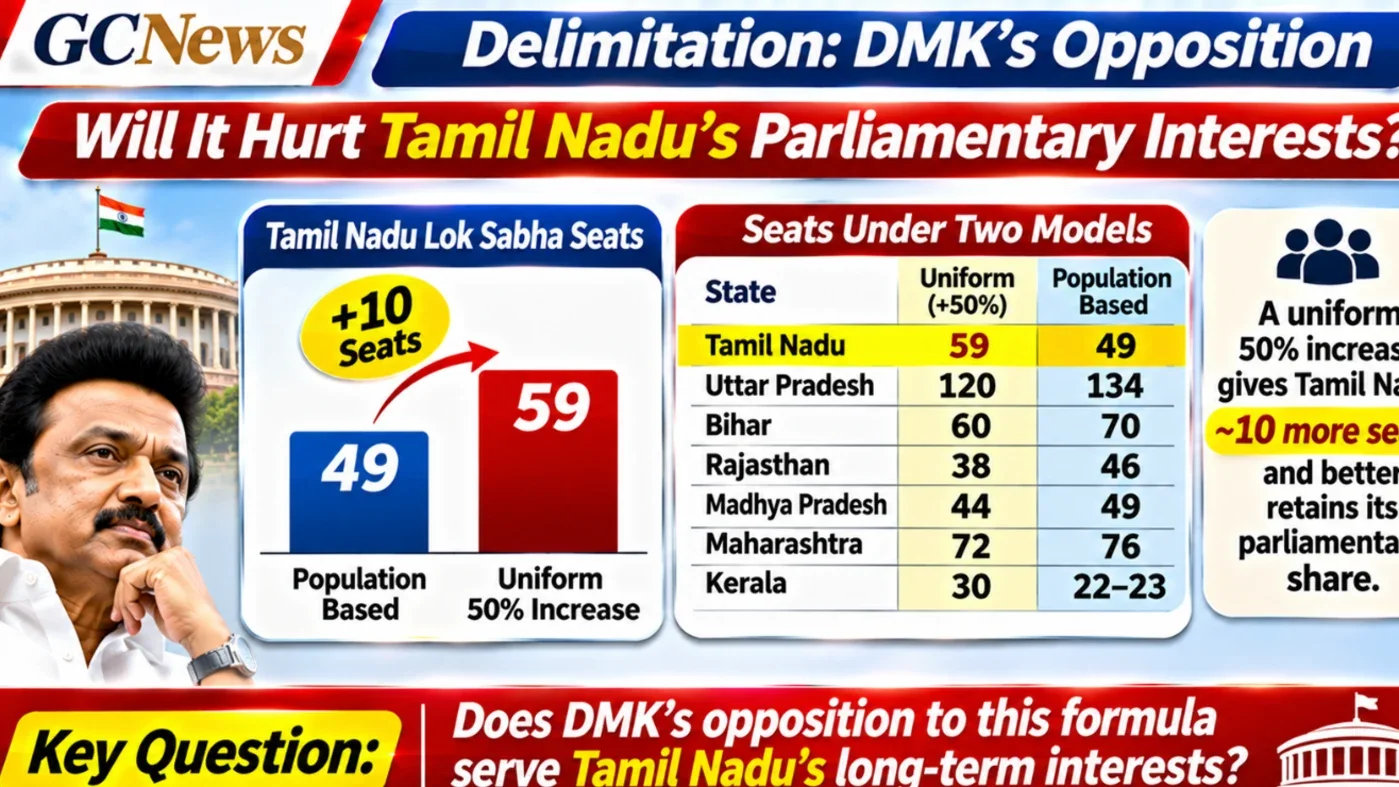
If every state receives a uniform 50% increase, Tamil Nadu would receive approximately 59 seats. However, if the expanded Lok Sabha of approximately 815 seats were distributed according to population, Tamil Nadu would receive approximately 49 seats.
| Particular | Uniform 50% increase | Population-based expansion |
|---|---|---|
| Existing seats | 39 | 39 |
| Expected seats | 59 | 49 |
| Additional seats | 20 | 10 |
| Parliamentary share | 7.18%* | 5.96%* |
*Approximate shares before whole-seat adjustments.
Tamil Nadu could therefore receive around 10 more seats under the uniform expansion model than under a purely population-based model.
Which States Would Receive Fewer Seats Under the Uniform Formula?
| State | Uniform 50% increase | Population-based allocation |
|---|---|---|
| Uttar Pradesh | 120 | 134 |
| Bihar | 60 | 70 |
| Rajasthan | 38 | 46 |
| Madhya Pradesh | 44 | 49 |
| Maharashtra | 72 | 76 |
| Tamil Nadu | 59 | 49 |
| Kerala | 30 | 22–23 |
The uniform expansion formula broadly preserves existing parliamentary representation ratios rather than correcting population-based disparities between states.
Would Opposing This Formula Serve Tamil Nadu’s Interests?
If the DMK opposes a uniform 50% expansion that preserves existing interstate representation ratios, it raises an important policy question: what alternative would better protect Tamil Nadu’s parliamentary influence?
The uniform expansion model addresses one of the principal concerns raised by southern states — the possibility of losing their proportional representation in Parliament because of slower population growth.
Tamil Nadu would gain additional MPs while broadly retaining its existing parliamentary share.
Conclusion
The mathematical comparison suggests that a uniform 50% expansion would be more favourable to Tamil Nadu than purely population-based redistribution within a Lok Sabha of the same size.
However, the merits of any proposed legislation must also be assessed against its complete provisions, constitutional implications and long-term safeguards.
The debate should therefore focus not merely on opposition to delimitation, but on which allocation formula best balances equal citizen representation with the interests of states that have successfully controlled population growth.
Data source: Census 2011 and existing Lok Sabha seat allocation. Figures represent hypothetical mathematical projections, not officially announced constituency allocations.
GC News Editorial Board


Join the Conversation