New Delhi | September 10, 2026
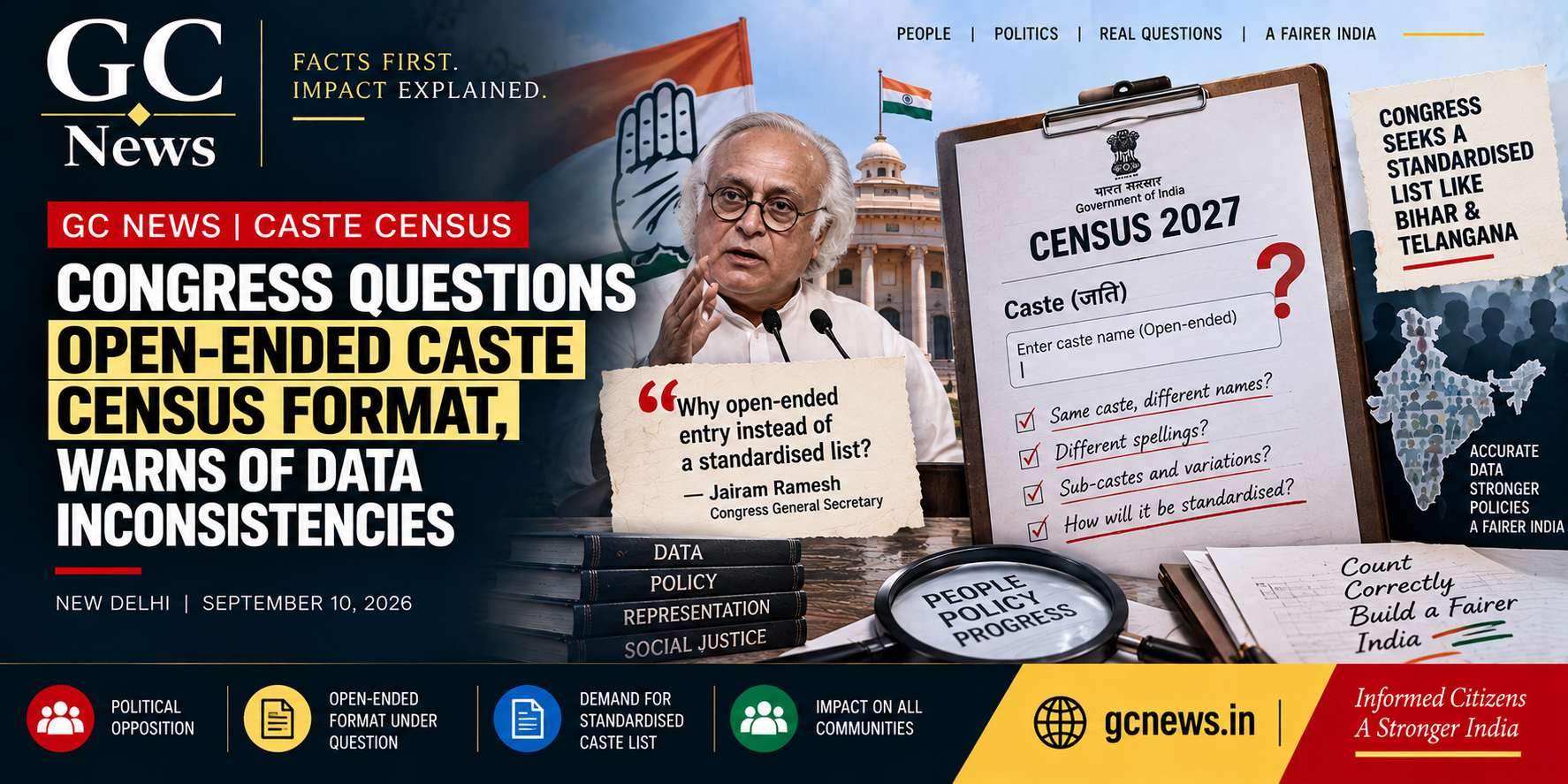
The Congress has stepped up its criticism of the Centre's methodology for recording caste in Census 2027, arguing that allowing caste names to be entered through an open-ended field could create inconsistencies in the final data.
Congress general secretary Jairam Ramesh has questioned why the government has chosen an open-entry system instead of providing enumerators with a standardised list from which a respondent's caste could be selected.
The party argues that the same caste could be entered under different names, sub-castes, regional descriptions or spellings, making subsequent classification and analysis more difficult.
Congress has alleged that the methodology raises serious questions about the government's approach to the caste enumeration exercise.
These remain political allegations, and do not by themselves establish that the census data will be inaccurate or that the government intends the exercise to fail.
What Has the Government Actually Notified?
The Centre has notified a 40-question schedule for the population-enumeration phase of Census 2027.
The questionnaire includes caste enumeration, with respondents' caste to be recorded based on the information they provide.
This open-ended approach is now at the centre of the political controversy.
The concern raised by opposition parties is simple:
If one community is known by multiple names or sub-castes—or if its name is entered using different spellings—how will those entries eventually be standardised into reliable national data?
What Does Congress Want?
Congress has called for a pre-defined or certified list of castes to be incorporated into the enumeration system.
Under such an approach, enumerators would select the appropriate caste from a standardised list rather than entering every response as free text.
The party has pointed towards state-level caste surveys, including those conducted in Bihar and Telangana, while arguing for a more standardised national methodology.
Congress leaders have been holding press conferences across the country to raise concerns over the census format.
PMK Also Raises Similar Concerns
The criticism is not coming from Congress alone.
PMK president Anbumani Ramadoss has also urged the Centre to replace the open-ended entry mechanism with a pre-defined caste-selection system.
Ramadoss has argued that manual entry could result in the same community being recorded under different caste names, sub-castes, local identities and spellings.
He has asked the government to integrate official Central and State OBC lists into the census software so that caste names and corresponding codes can be selected in a standardised manner.
What Could It Mean for General Category Communities?
The methodology matters to every community whose population is being counted.
For communities generally described as General or unreserved, accurate enumeration could become important if caste population data is subsequently used in debates over reservation policy, representation, welfare schemes or the distribution of government benefits.
However, the caste census itself does not automatically change reservation percentages.
Any future changes to reservation policy would require separate legal and policy decisions.
What Does It Mean for OBC Communities?
The issue is particularly significant for OBC enumeration because the country contains numerous communities appearing under Central and State backward-class lists.
Different regional names, sub-castes and spellings could make classification more complicated if the raw responses are not subsequently standardised properly.
Supporters of a drop-down system argue that predefined codes would reduce this problem.
An open-ended system, however, could potentially capture identities that do not fit neatly into existing government lists.
The real question is therefore not simply open field versus drop-down menu, but how the government plans to clean, classify, verify and publish the caste data after enumeration.
Why This Debate Matters
A caste census is ultimately useful only if the resulting data can be reliably interpreted.
A drop-down system could improve standardisation but also requires the government to decide beforehand which caste names and classifications belong on the official list.
An open-ended system provides respondents greater freedom to state their identity but creates a much larger challenge when millions of responses have to be standardised later.
That leaves an important question for the government to answer:
How will millions of caste names, sub-castes, regional identities and spelling variations be standardised so that Census 2027 produces reliable and comparable caste data?
Status: Census Questionnaire Notified / Political Opposition Ongoing
Based on the Census 2027 notification and reporting on statements by Congress leaders and PMK president Anbumani Ramadoss.
Join the Conversation
Read Next
Centre Seeks Two Years to Frame OBC Creamy Layer Criteria for Children of PSU & Private-Sector Employees
20 Years Behind Bars: The Untold Story of Vishnu Tiwari
“Youth for Equality, Political Associations and Fundraising: Questions Neha Das Should Answer
Subscribe to GC News
Get the latest independent journalism and updates straight to your inbox.