Date: October 22, 2026
Also Read: AI Agents: Privacy Risks, Jobs and the Future of the Internet
Artificial intelligence is moving beyond simple question-and-answer tools. Today's AI systems can write articles, generate computer code, analyse large amounts of information and assist researchers with complex problems. These developments have brought one question into sharper focus: how close are we to creating Artificial General Intelligence (AGI)?
The prospect of AGI has attracted attention from technology companies, researchers and governments around the world. Some believe that continued advances in AI could eventually lead to machines capable of performing most intellectual tasks at a level comparable to humans. Others caution that impressive results in specific areas do not necessarily mean that machines can think, learn and adapt as flexibly as people.
The uncertainty is reflected in the Centre for a New American Security's (CNAS) report, The AGI Moment, which examines the strategic importance of increasingly capable AI and the challenges governments may face as the technology develops.
Despite rapid progress, there is no universally accepted definition of AGI and no confirmed date for its arrival. Understanding what AGI means, what current systems can accomplish and what challenges remain is essential to separating genuine technological progress from speculation.
1. What Exactly Is Artificial General Intelligence?
Artificial General Intelligence refers to a proposed form of artificial intelligence that can learn, reason and solve problems across a wide range of tasks rather than being restricted to a particular function.
Most existing AI tools are designed to support several activities, including writing, translation, programming, image generation and data analysis. Their versatility is impressive, but performing well across these applications does not automatically establish that they possess intelligence comparable to human intelligence.
One reason the debate continues is that researchers and technology companies do not use a single definition of AGI. OpenAI's charter, for example, describes AGI in terms of highly autonomous systems that outperform humans at most economically valuable work. Other approaches place greater emphasis on general learning, adaptability and the ability to handle unfamiliar problems.
These differences matter because the definition determines how researchers assess progress. A system that performs exceptionally well on a collection of tests might still struggle with practical situations that require sustained reasoning, independent learning or reliable decisions over an extended period.
For this reason, identifying AGI is not simply a matter of developing a more powerful chatbot. It requires a clearer understanding of what general intelligence involves and how it can be evaluated.
2. Why Is the Technology Industry Pursuing AGI?
The interest in AGI is closely connected to the growing usefulness of AI in everyday life and professional work. Businesses are exploring how these systems can reduce routine workloads, support decision-making and improve productivity. Researchers are investigating whether advanced models can help solve scientific problems that would otherwise require considerable time and resources.
For technology companies, the next stage of AI development involves more than making systems better at responding to prompts. There is increasing interest in tools that can plan tasks, work through several stages of a problem, use software and assist with complicated projects.
Such capabilities could change how people interact with computers. Instead of using separate applications for every task, individuals might increasingly rely on AI systems to coordinate multiple activities and provide assistance throughout a process.
However, greater capability does not automatically translate into general intelligence. AI systems must still be assessed for accuracy, consistency and their ability to recognise when they lack sufficient information.
The industry's focus on AGI therefore reflects both the potential commercial value of advanced AI and the possibility that the technology could influence science, education, healthcare and other areas of society.
3. How Close Are We to Human-Level AI?
There is currently no definitive answer to how soon AGI might become a reality.
Some researchers believe that modern AI systems already display important elements of general-purpose intelligence. They point to their ability to work across different subjects, generate computer programs, interpret information and assist with complex intellectual tasks.
Others argue that these achievements should not be confused with human-level general intelligence. AI systems can still produce incorrect information, struggle with unfamiliar situations and fail to complete tasks that require consistent reasoning over multiple steps.
The CNAS report The AGI Moment examines possible developments in advanced AI and their implications for national security, government decision-making and technological competition. Its subject reflects a broader concern: even without agreement on when AGI will arrive, governments may need to prepare for the consequences of increasingly capable systems.
Predictions about AGI timelines should therefore be approached carefully. Technological development does not always progress at a steady rate, and breakthroughs in one area may not resolve difficulties in another.
Rather than relying on a particular forecast, it is more useful to examine what AI systems can demonstrate today, which limitations remain and whether their capabilities are improving in ways that can be independently verified.
4. Understanding the Difference Between Narrow AI, AGI and Superintelligence
Discussions about artificial intelligence often use several terms interchangeably, even though they describe different levels or types of capability.
Narrow AI: These systems are designed to perform particular tasks or groups of tasks. Examples include image recognition, language translation, recommendation systems and tools that generate text or computer code.
Artificial General Intelligence: AGI describes a proposed system capable of learning and performing a broad range of intellectual tasks with a degree of generality comparable to human intelligence, depending on the definition used.
Artificial Superintelligence: This hypothetical form of AI would substantially surpass human intellectual capabilities across many important areas.
The distinctions help explain why a highly capable AI tool does not necessarily qualify as AGI, and why AGI would not automatically mean that machines had become superintelligent.
Google DeepMind has also explored frameworks for describing levels of AGI, considering factors such as capability, generality and autonomy. These approaches illustrate the importance of evaluating AI along several dimensions instead of treating intelligence as a single, easily measured quality.
For the public, the central point is straightforward: AI progress can be substantial without establishing that either AGI or superintelligence has been achieved.
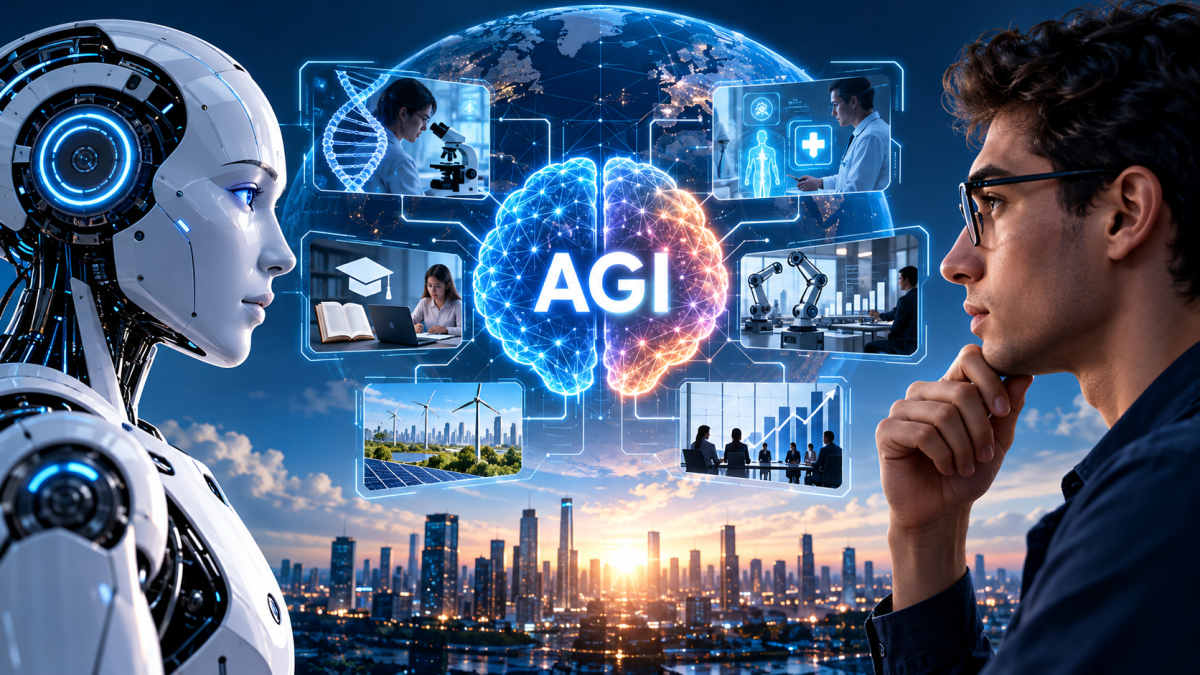
5. How Could AGI Benefit Society?
If researchers eventually develop AGI systems that are safe, reliable and useful, their potential applications could extend across many areas. However, these benefits remain possibilities, not guaranteed outcomes.
Scientific Research and Discovery
Advanced AI could help scientists analyse complex datasets, identify patterns, develop hypotheses and explore possible solutions to difficult research questions. It might also assist with simulations and other stages of scientific investigation.
The extent of its contribution would depend on whether AI-generated findings can be tested, reproduced and supported by reliable evidence.
Healthcare and Medical Research
More capable AI could assist researchers in analysing medical information, studying diseases and identifying patterns that deserve further investigation. It might also support certain clinical workflows and help healthcare professionals process complex information.
Medical decisions would still require appropriate validation, professional judgement and safeguards to protect patients.
Education and Personalised Learning
AI systems could help students understand difficult subjects through individual explanations, practice exercises and language support. Teachers might also use them to prepare educational materials and adapt lessons to different learning needs.
These benefits would depend on the accuracy of the systems, access to suitable technology and the ability of students and educators to use AI responsibly.
Business and Economic Productivity
Advanced AI could automate selected routine activities, assist with research and analysis, and help organisations manage complicated workflows. This could allow some workers to spend more time on tasks requiring judgement, creativity and direct human interaction.
However, productivity gains would not necessarily be shared equally. Their distribution would depend on business decisions, public policy, access to technology and the wider economic environment.
Ultimately, the value of AGI would depend not only on what the technology could do, but also on how effectively its benefits could be delivered to individuals and communities.
6. What Could AGI Mean for Jobs and the Economy?
The future of employment is one of the most important questions surrounding increasingly capable AI.
As systems become better at handling analytical, administrative and creative tasks, businesses may change how certain jobs are organised. Some responsibilities could be automated, while others might require workers to collaborate with AI tools, review their outputs or manage more complex processes.
The effects are unlikely to be identical across industries. The pace of adoption will depend on the reliability and cost of AI systems, the nature of individual occupations and the willingness of organisations to change their existing operations.
Several developments deserve attention.
Changes to existing jobs: Certain tasks may require less manual effort as AI takes on more routine work. In some occupations, this could change employees' responsibilities without eliminating their positions entirely.
New career opportunities: As AI adoption expands, organisations may need people with expertise in system development, evaluation, cybersecurity, implementation and governance.
Education and reskilling: Schools, universities and employers may need to strengthen programmes that help people develop digital literacy, analytical abilities and skills relevant to changing workplace demands.
Economic inequality: The distribution of productivity gains will be important. If the benefits of advanced AI are concentrated among a small number of companies or individuals, existing inequalities could become more pronounced.
There is no sound basis for assuming that AGI will inevitably eliminate all jobs or automatically create widespread prosperity. The actual outcome will depend on how the technology develops and how governments, businesses and workers respond.
Preparing for change requires examining evidence from individual industries and supporting people who may be affected by automation.
7. AI Safety, Ethics and Global Regulation
As AI systems become more capable, ensuring that they operate safely and responsibly becomes increasingly important. Their use raises questions about reliability, privacy, accountability and the concentration of technological power.
An AI system that performs well under controlled conditions may still behave unpredictably in unfamiliar circumstances. This makes careful testing particularly important when systems are used in areas where mistakes could have serious consequences.
The CNAS report The AGI Moment examines the strategic implications of advanced AI and the decisions facing governments and technology companies. These questions extend beyond technical development to include public policy, international competition and the management of potential risks.
Several issues require continued attention:
AI safety: Researchers need effective methods for testing advanced systems, identifying weaknesses and reducing the likelihood of harmful outcomes.
Accountability: Organisations must establish who is responsible when AI systems contribute to important decisions or cause harm.
Privacy and data protection: The collection, processing and use of personal information require appropriate safeguards, particularly when AI systems handle sensitive data.
International cooperation: Countries could benefit from sharing research, improving safety evaluations and developing common approaches to managing risks. At the same time, competition over technological leadership may make cooperation difficult.
Responsible deployment: Organisations should consider the consequences of introducing AI into real-world settings, rather than relying solely on performance demonstrations or commercial promises.
Effective governance does not have to mean stopping innovation. The challenge is to encourage useful development while ensuring that the risks are identified, evaluated and managed appropriately.
8. Why Is It So Difficult to Measure AGI?
One of the biggest challenges in AI research is deciding what evidence would demonstrate that a system has achieved general intelligence.
Examinations and benchmarks can provide valuable information about specific abilities. However, strong results on a test do not necessarily show that a system can adapt to unfamiliar problems, learn new skills independently or complete complicated tasks reliably over time.
For example, an AI system might solve a difficult programming problem but struggle when the requirements change unexpectedly. Another system might perform well in a controlled environment but make repeated mistakes when asked to manage a longer sequence of tasks.
Google DeepMind has explored frameworks for measuring progress towards AGI through multiple dimensions of capability and generality. This reflects a broader recognition that intelligence cannot be assessed adequately through a single score.
Several factors are particularly important when evaluating advanced AI.
Broad performance: Systems should be tested across a diverse range of intellectual and practical tasks rather than relying on one benchmark.
Learning and adaptability: Evaluations should examine how well systems respond to unfamiliar situations and acquire new capabilities.
Reliability over time: Researchers need to assess whether systems can complete extended tasks consistently, especially when mistakes carry significant consequences.
Comparison with human abilities: Carefully designed tests can help researchers understand how AI performance compares with human performance across different activities.
Transparency and independent verification: Clear evaluation methods and reproducible results can help distinguish demonstrated capabilities from exaggerated claims.
These challenges explain why there is still disagreement about the arrival of AGI. A meaningful assessment requires not only impressive performance, but also evidence that the system can operate with sufficient flexibility and reliability across a broad range of circumstances.
9. What Should the World Expect From AI in the Coming Years?
Further improvements in reasoning, programming, research assistance and multistep task execution could make AI more useful in the years ahead. Such progress may influence how people study, work, conduct research and interact with digital services, regardless of whether experts agree that AGI has been achieved.
Businesses are likely to continue exploring AI applications that improve efficiency and support decision-making. Universities and research institutions may investigate new ways to use advanced systems in scientific work, while governments will need to consider questions involving employment, education, privacy and public safety.
The pace and direction of these developments remain uncertain. Some capabilities may improve quickly, while others may prove more difficult to develop than expected.
For this reason, discussions about AGI should focus on measurable progress rather than predictions alone. Researchers need to explain what their systems can actually do, what limitations remain and how their results have been evaluated.
Businesses and policymakers should take a similarly practical approach. Preparing for increasingly capable AI does not require certainty about when AGI will arrive. It requires understanding current capabilities, identifying potential risks and developing policies that can adapt as the evidence changes.
The broader question is not simply whether machines will become more intelligent. It is whether increasingly powerful AI can be used reliably, responsibly and in ways that provide meaningful benefits to society.
Conclusion
Artificial General Intelligence remains one of the most significant and uncertain possibilities in modern technology. Today's AI systems can perform an expanding range of intellectual tasks, but their achievements do not establish that human-level general intelligence has been reached.
Questions about adaptability, reliability, independent learning and the measurement of intelligence remain central to the debate. Researchers continue to disagree about how close current systems are to AGI, and no universally accepted timeline can establish when it will arrive.
At the same time, the potential consequences are too important to ignore. Advanced AI could create opportunities in scientific research, healthcare, education and business, while also introducing challenges involving employment, inequality, privacy and safety.
Governments, companies and educational institutions should prepare by investing in research, strengthening AI evaluation, supporting workforce development and establishing appropriate safeguards.
Ultimately, the future of AGI will not be determined by technological progress alone. The decisions made by researchers, businesses, governments and the wider public will help shape how advanced AI is developed, governed and used.
Sources and Further Reading
-
OpenAI — OpenAI Charter
-
Centre for a New American Security (CNAS) — The AGI Moment
-
Google DeepMind — Research on measuring progress towards AGI and cognitive capabilities.
-
Google DeepMind — Research on levels of AGI and the evaluation of AI capabilities.


Join the Conversation