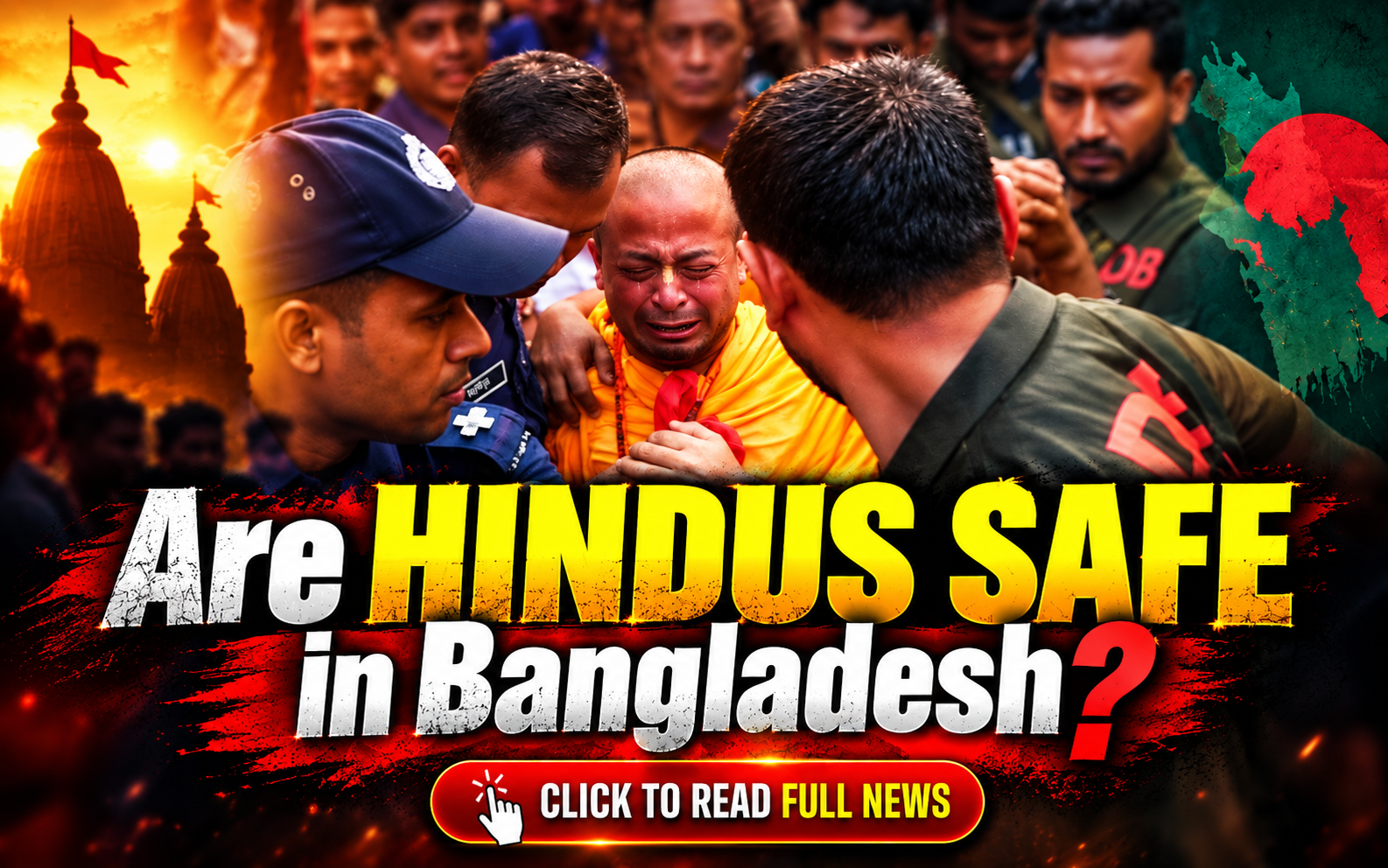
Chinmoy Krishna Das: A Hindu Monk’s Arrest and the Question of Minority Rights in Bangladesh
The arrest of Hindu monk Chinmoy Krishna Das became a major flashpoint in Bangladesh’s treatment of religious minorities. His case is not simply about one individual. It raises a larger question:
when a Hindu religious leader is arrested, denied bail, and associated with a serious criminal allegation, are the rights of Bangladesh’s Hindu minority being protected equally?

Chinmoy Krishna Das

The arrest followed a rally in Chattogram where Das and other Hindu leaders had been demanding protection for the minority community. The sedition case was filed by a local BNP leader against 19 people. Das’s supporters rejected the allegations and called for the case to be withdrawn.
Who Is Chinmoy Krishna Das?
Chinmoy Krishna Das Brahmachari is a Hindu monk and a prominent voice in Bangladesh’s Sanatani Hindu community. He was formerly associated with the International Society for Krishna Consciousness (ISKCON) and became known for advocating minority protection after the fall of Sheikh Hasina’s government in August 2024.
As spokesperson for the Bangladesh Sammilito Sanatani Jagaran Jote, he helped lead rallies calling for an end to attacks on Hindus and demanding stronger protection for temples, homes, and religious communities.
The Arrest: What Happened?
On 25 November 2024, Das was arrested at Dhaka’s Hazrat Shahjalal International Airport. The arrest stemmed from a sedition case filed in connection with an October rally in Chattogram.
The following day, a Chattogram court denied him bail and ordered his detention. Supporters gathered outside the court, where clashes broke out between protesters and security forces.
The Court Violence and the Death of Saiful Islam Alif
The arrest and bail denial were followed by serious violence outside the Chattogram court complex on 26 November 2024.
Lawyer Saiful Islam Alif was killed during the unrest. Authorities subsequently arrested suspects in connection with his death, and the incident led to additional criminal cases. Das’s supporters denied responsibility and called for an investigation.
In January 2026, a Chattogram tribunal formally framed charges against Das and others in the lawyer’s murder case. Das was charged under Sections 302 and 109 of Bangladesh’s Penal Code. These are prosecution charges, not a judicial finding that he committed the killing.
Why This Matters?
The murder of a lawyer is a grave matter and must be investigated and prosecuted. But the same principle must apply to the accused: a Hindu religious leader cannot be treated as guilty merely because he is unpopular, politically inconvenient, or associated with a minority-rights movement.
The central questions are whether the evidence is credible, whether the investigation is impartial, and whether Das receives a fair trial.
Bail Granted in Four Cases, Yet He Remains in Jail
The legal proceedings have continued for nearly two years.
- In August 2026, the High Court granted Das bail in two cases involving allegations including vandalism, assault, and obstruction of government duties.
- On 6 September 2026, the High Court granted bail in two additional cases involving alleged vandalism and obstruction of police duties.
- His bail in the sedition case remains stayed.
- The murder trial concerning Saiful Islam Alif is still underway.
As a result, Das remains in custody despite securing bail in four cases.
A Humanitarian Question: His Mother’s Funeral
In September 2026, reports stated that Das’s mother, Sandhya Rani Dhar, died after a prolonged illness. He was reportedly granted only five hours of parole to attend her funeral.
The decision drew criticism because of the circumstances: a detained religious leader was permitted to attend his mother’s final rites only under tightly restricted conditions. The parole itself was a humanitarian concession, but the episode also highlighted the human cost of prolonged detention.
The Larger Hindu Minority Question in Bangladesh
Das’s case cannot be separated from the broader concerns of Bangladesh’s Hindu minority.
Following the fall of Sheikh Hasina’s government in August 2024, Hindu groups reported attacks on homes, businesses, temples, and religious sites. The interim government said it was addressing the violence and that the scale of some claims had been exaggerated. Independent reporting documented both the unrest and the government’s response.
The arrest of a prominent Hindu leader who had publicly demanded minority protection therefore carried consequences beyond the courtroom. It intensified fears among Hindus that speaking out against attacks could expose them to further legal or political pressure.
Is This Proof of Anti-Hindu Discrimination?
A responsible Hindu news report should be clear about what can and cannot be established.
Established facts:
- Das was arrested in a sedition case after leading or participating in Hindu minority-rights mobilization.
- His initial bail was denied.
- Violence followed the bail hearing, and lawyer Saiful Islam Alif was killed.
- Das faces multiple criminal cases, including a murder case.
- He has received bail in four cases but remains detained because other proceedings continue.
- His supporters and Hindu organizations have disputed the allegations and demanded due process.
What remains to be proven:
- Whether Das personally committed any of the alleged offenses.
- Whether the sedition allegation is supported by sufficient evidence.
- Whether the murder prosecution establishes his individual responsibility.
- Whether the legal process has been conducted without political pressure or discrimination.
The strongest factual criticism is not that every charge is fabricated. It is that the treatment of a Hindu minority leader must be examined for fairness, proportionality, and equal protection under the law.
Sources
- Reuters: Bangladesh steps up security, arrests six for lawyer’s killing amid protests
- AP: Lawyers in southeastern Bangladesh boycott courts after violence kills one
- bdnews24: Court orders to send Sanatani leader Chinmoy Krishna to jail
- ThePrint/PTI: Bangladeshi court opens Hindu monk’s trial over murder of lawyer
- Loksatta: Chinmoy Krishna Das receives parole for mother’s funeral

Join the Conversation