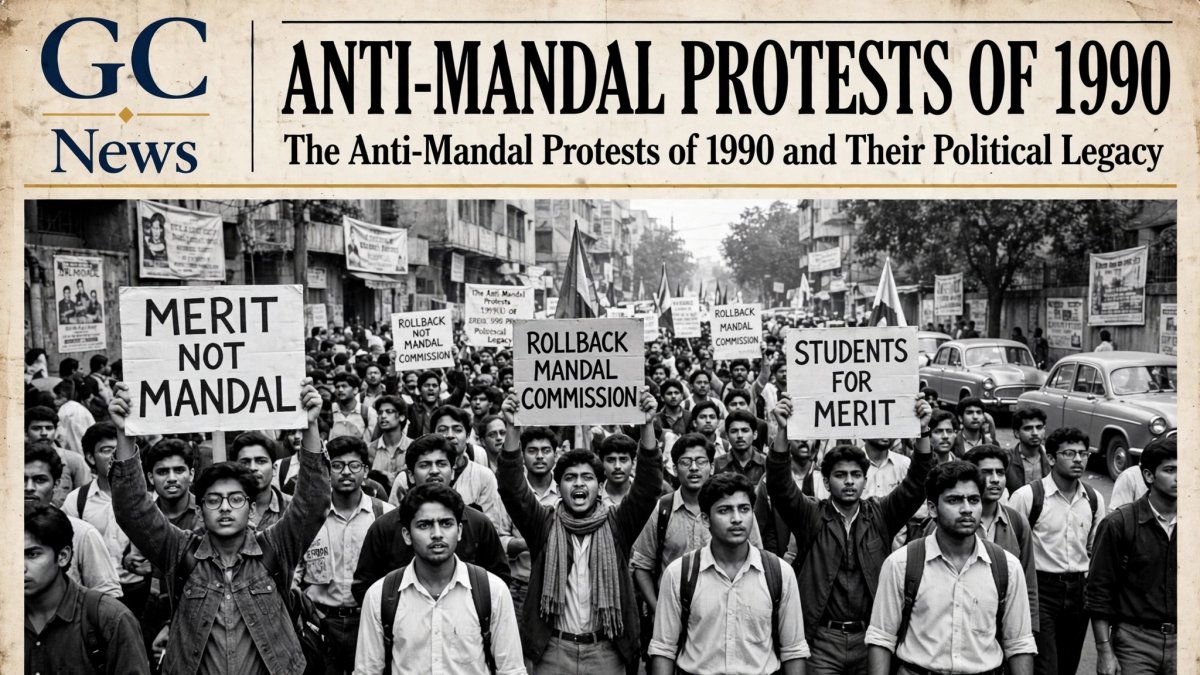
The Anti-Mandal Protests of 1990 and Their Legacy
The Anti-Mandal protests of 1990 were among the most significant student-led political agitations in modern Indian history. Triggered by the Union Government’s decision to implement the Mandal Commission’s recommendation of 27 per cent reservation for Other Backward Classes (OBCs) in central government employment, the movement brought questions of caste, merit, equality and representation into the centre of national debate.
The protests exposed deep disagreements over the role of reservation in a competitive society. While opponents questioned the consequences of expanding caste-based quotas, supporters argued that historical discrimination and unequal access to education and employment required meaningful corrective measures. More than three decades later, the events of 1990 continue to influence discussions about social justice and public-sector opportunities in India.
1. Background to the Mandal Commission
The origins of the Anti-Mandal movement can be traced to the establishment of the Second Backward Classes Commission in January 1979 by the Morarji Desai government. Chaired by B. P. Mandal, the commission was tasked with identifying socially and educationally backward communities and recommending measures to improve their representation.
The 1980 Report
The Mandal Commission submitted its report on 31 December 1980. It estimated that Other Backward Classes constituted approximately 52 per cent of India's population and recommended 27 per cent reservation for OBCs in central government services. The commission's recommendations became the foundation of the subsequent political controversy. The "National Commission for Backward Classes" https://ncbc.nic.in/User_Panel/UserView.aspx?TypeID=1161 provides further information about the Mandal Commission.
The Decision of 1990
On 7 August 1990, Prime Minister V. P. Singh announced his government's decision to implement the recommendation. On 13 August, the Department of Personnel and Training issued an Office Memorandum providing for 27 per cent reservation for socially and educationally backward classes in civil posts and services under the Union Government.
The announcement transformed a long-standing policy debate into a nationwide political controversy.
2. Emergence of the Anti-Mandal Protests
Following the government's announcement, demonstrations began in Delhi and spread to several other parts of northern India. Students from colleges and universities organised rallies, strikes and public demonstrations demanding reconsideration or withdrawal of the proposed reservation policy.
Concerns Raised by Protesters
Opponents of the Mandal recommendations raised several arguments. Many believed that expanding caste-based reservation would reduce the proportion of government employment opportunities available through open competition.
Other protesters questioned whether caste should be the principal basis for identifying disadvantage. They argued that economic circumstances and individual educational opportunities should also receive greater consideration.
For many students, the issue was closely connected to uncertainty about future employment. Government jobs were highly sought after, and the proposed policy generated concerns about competition and access to limited vacancies.
These arguments became central to the anti-reservation movement. However, protesters did not necessarily share one uniform position, and their motivations varied across regions and social backgrounds.
Expansion Across Northern India
The agitation spread through several cities, disrupting educational institutions, transport and normal public activity. Demonstrations also led to confrontations between protesters and law-enforcement authorities.
On 19 September 1990, Delhi University student Rajiv Goswami became a prominent figure in the movement after attempting self-immolation during a protest. Contemporary reporting documented the incident and the wider demonstrations. The "UPI Archives" https://www.upi.com/Archives/1990/09/19/Students-set-themselves-ablaze-in-job-reservation-protest/6879653716800/ provide a contemporary account of the protests.
The intensity of the agitation placed the central government under considerable political pressure and made reservation a major national issue.
3. Political and Social Impact
The Anti-Mandal agitation was not simply a student movement against a government decision. It exposed competing understandings of equality and representation in Indian society.
The Debate Over Merit and Social Justice
One of the central arguments raised by opponents concerned merit-based selection. They maintained that government recruitment should prioritise academic performance and competitive examinations rather than relying extensively on caste-based categories.
Supporters of the Mandal recommendations presented a different perspective. They argued that formal equality in examinations could not independently address generations of social exclusion, unequal educational access and limited representation in public institutions.
This disagreement highlighted a fundamental policy question: whether equal opportunity requires identical selection conditions or additional measures to address structural disadvantages.
The debate also demonstrated that economic hardship and caste-based disadvantage are related but distinct issues. People from different communities can experience financial insecurity, while social discrimination may continue even when economic circumstances improve.
The Fall of the V. P. Singh Government
The Mandal decision contributed to an already unstable political environment. Prime Minister V. P. Singh faced opposition from different political groups, including divisions within the broader coalition supporting his government.
In November 1990, the Bharatiya Janata Party withdrew its support amid disagreements surrounding the Ram Janmabhoomi movement and the arrest of L. K. Advani during his Rath Yatra. V. P. Singh subsequently lost the confidence of the Lok Sabha on 7 November 1990.
Although the Mandal controversy was an important factor in the political atmosphere of the period, the government's fall cannot be attributed to the anti-Mandal protests alone.
4. The Supreme Court and the Legal Outcome
The controversy over the Mandal recommendations eventually reached the Supreme Court of India. The resulting judgment became an important milestone in the constitutional development of reservation policy.
The Indra Sawhney Judgment of 1992
On 16 November 1992, a nine-judge bench delivered its judgment in Indra Sawhney v. Union of India. The Court upheld the 27 per cent reservation for OBCs in central government employment, subject to important conditions.
The judgment also established the exclusion of socially advanced sections, commonly known as the creamy layer, from OBC reservation benefits. It generally reaffirmed a 50 per cent ceiling on reservations, while recognising that exceptional circumstances could require separate consideration.
The "Supreme Court judgment in Indra Sawhney v. Union of India" https://indiankanoon.org/doc/1363234/ provides the legal basis for understanding the ruling and its implications.
5. The Continuing Legacy of the Anti-Mandal Movement
The events of 1990 significantly influenced Indian politics, public administration and student activism. The Mandal debate strengthened the political visibility of OBC communities and contributed to the emergence of political movements centred on social representation.
At the same time, the anti-Mandal protests ensured that concerns about competitive examinations, government employment and the criteria for reservation remained part of national political discussion.
A Debate That Continues
The introduction of the 103rd Constitutional Amendment in 2019, which enabled reservation for Economically Weaker Sections (EWS), added another dimension to the debate by introducing a separate economic criterion for eligible applicants outside the existing reserved categories.
Today, discussions about reservation involve several questions, including representation, educational inequality, economic disadvantage, the creamy layer and the distribution of limited public-sector opportunities.
The Anti-Mandal protests remain an important historical episode because they revealed the complexity of balancing competing demands within a constitutional democracy. Understanding the movement requires examining both the concerns expressed by its opponents and the historical disadvantages that reservation policies were designed to address.
Conclusion
The Anti-Mandal protests of 1990 marked a turning point in India's debate over reservation and public employment. They brought student opposition, questions of merit and concerns about social representation into national politics.
The Supreme Court's 1992 judgment established an important legal framework for OBC reservation, while the political consequences of the Mandal controversy continued to influence Indian elections and public policy.
The legacy of the movement is therefore not limited to opposition against one government decision. It reflects an enduring national debate about how India should balance equality, representation, economic disadvantage and fair access to opportunities.
Sources and Further Reading
1. "National Commission for Backward Classes – Mandal Commission Report" https://ncbc.nic.in/User_Panel/UserView.aspx?TypeID=1161
2. "Supreme Court Judgment – Indra Sawhney v. Union of India (1992)" https://indiankanoon.org/doc/1363234/
3. "The Indian Express – Mandal Commission Report, 25 Years Later" https://indianexpress.com/article/india/india-others/sunday-story-mandal-commission-report-25-years-later/
4. "The Indian Express – Student Movements and Anti-Mandal Agitation" https://indianexpress.com/article/research/from-nav-nirman-andolan-to-anti-caa-protests-how-student-movements-have-shaped-indian-politics-9095079/
5. "UPI Archives – Anti-Mandal Protests, September 1990" https://www.upi.com/Archives/1990/09/19/Students-set-themselves-ablaze-in-job-reservation-protest/6879653716800/
Join the Conversation